A week before today, Muslims around the world will gather with their families to take part in the first sahuror pre-dawn meal, of the holy month of Ramadan. After that for 30 days, in Bangalore like everywhere else, they will flock to the mosque, praising and thanking Allah.
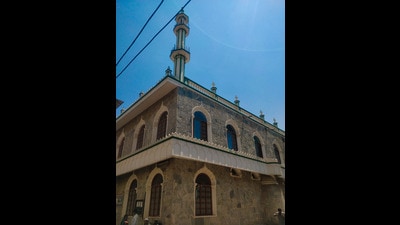
A minaret of the Sangin Jama Masjid in Bangalore (JustDial)The first mosque in India – the Cheraman Juma Mosque in Kodungallur, Kerala – is believed to have been built in 629 AD during the Prophet’s lifetime. The first mosque in Karnataka – Masjid Jinath Bux, also known as Belye Palli (Palli in Tamil and Malayalam languages) – arose around 644 AD in the Bandar area of Mangalore.
Given the ancient, strong trade links between Arabia and the southern Indian peninsula, it is no surprise that these early mosques were established in coastal cities.
Despite Mangaluru being only 350 km away from us, Bangalore did not get its first mosque until 1000 years after Beliye Palli. How it came to be is a long and winding story.
The first independent Muslim state in the Deccan, the Bahmani Kingdom, was founded in 1347 AD by Allah-ud-din Bahman Shah, an Afghan-born general under Sultan Muhammad bin Tughlaq of Delhi after a successful rebellion against his master. Ruling first from Gulbarga (1347–1425) and then from Bidar (1425–1527), the Bahmanis, who were not only great builders of forts, madrasas, tombs and mosques, but also, arguably, the first empire to invent and use gunpowder cannons and firearms transformed the military subcontinental landscape today. Kalyan-Karnataka. Their constant wars against the Vijayanagara empire emboldened the Bahmanis; Finally, they were defeated by Krishnadeva Raya in 1527. In the political vacuum the Bahmanis gave rise to five Deccan sultanates – Bijapur, Golconda, Bidar, Berar and Ahmednagar; In 1565, they united to destroy Vijayanagara in the Battle of Talikota.
More Read
In 1526, a year before the fall of the Bahmanids, Timur’s descendant Babur established the Mughal Empire in Delhi. In 1537, between the arrival of the Mughals and the fall of Vijayanagara, Kempegowda, a vassal of Vijayanagara, first founded Bangalore. A century later, in 1638, his descendant Kempegowda III lost Bangalore to the Sultan of Bijapur. The Sultan gifted the city to the Maratha military adventurer Shahaji Bhosle, who played an important role in the conquest. After Shahji, Bangalore passed to his son Venkoji, who ruled from Thanjavur.
In the following decades, Shahji’s other son, Shivaji, built a powerful Maratha Sangha, often shifting his alliance between Bijapur and the Mughals—first under Shahjahan and then under Aurangzeb of Alamgir—to his advantage. In 1674, Shivaji, who had vast wealth and territory but no official title, was finally crowned King of the Maratha Empire – Chhatrapati. In 1677, he invaded the kingdom of Mysore and sacked Srirangapatna, only to be defeated by Chikkadevaraja Wadiyar.
After Shivaji’s death in 1680, his son Sambhaji came to the throne. In 1682, Alamgir, fed up with constant run-ins with the Marathas and the Deccan Sultanates, proceeded with his ultimately pyrrhic southern campaign. In 1687, Qasim Khan, Aurangzeb’s governor of Sira (near Tumkur) briefly captured Bangalore from Venkoji, before selling the city to Chikkedevaraja Wadiyar for three lakh gold pagodas.
More Read

Bangalore got its first mosque during or after Qasim Khan’s short reign – the Sangin (stone-built) Jama Masjid or Taramandal Masjid. Located deep within the original fort city that Kempegowda built on Siddana Lane and enriched over the centuries by patrons like Tipu Sultan, who built his spectacular rocket next to the mosque, at Taramandalpet, the historic mosque continues to serve the faithful today.
(Rupa Pai is a writer who maintains a long-standing love affair with her hometown of Bangalore.)