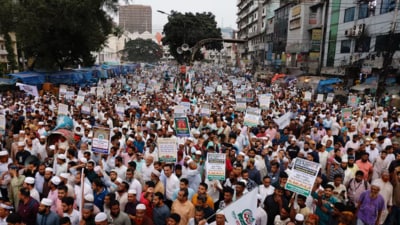
Bangladesh is set to hold national elections tomorrow (February 12), and the most notable trend is the rise of the Bangladesh Jamaat-e-Islami, which is gaining strength and momentum as the election approaches. The party has been openly flaunting its radical Islamist views, particularly on women and governance, which threatens the country’s secular foundations. He made no attempt to hide his hatred for India. Once known for its vibrant secularism and fast-growing economy, Bangladesh is now experiencing a strong Islamist resurgence. Jamaat-e-Islami is regaining influence lost under Sheikh Hasina, and the years in political exile from 2013 to last year appear to have strengthened its fundamentalist position. The Bangladesh Nationalist Party (BNP) will win the election, but it is a powerful Jamaat and does not deny the danger posed by the mainstreaming of its ideology in Bangladesh.
Jamaat-e-Islami is regaining the influence it lost during Sheikh Hasina’s tenure. (Reuters)In early February 2026, “Winter is Coming” banners began appearing in the country, with Aamir Shafiqur Rahman styled like Jon Snow from Game of Thrones. Instead of a sword, the image uses a balance scale, the election symbol of the Jamaat, along with the famous Stark motto – “Winter is coming”. For Jamaat supporters, the slogan is a call for vigilance, an expectation of justice and a sign of big changes ahead. For others, especially minorities, it seems like a warning that an ideological “cold” could disrupt the country’s secular and social progress. These banners obviously mean more than just pop-culture references.
If you think the meaning of these banners is up for interpretation, Rahman’s recent statements make his views on social progress abundantly clear. In a recent interview with Al Jazeera, she said that women will not be allowed in leadership roles. Later, a post from his X account, which he later claimed was hacked, compared the employment of women to — hold your breath — “prostitution.” It is more than just social or religious conservatism; This is a direct attack on the rights of Bangladeshi women, similar to the Taliban’s attempt to remove women from public life. By not nominating a woman in the February election, the Jamaat showed that Bangladeshi women – despite the country having two powerful female prime ministers – have no voice in the country’s politics. It is ironic that a group, which once opposed the independence of Bangladesh, is now claiming to protect their moral future.
This hardening of norms is all the more worrying given the widespread concern about election rigging. The interim government led by Muhammad Yunus was intended to restore order, but many now worry that Jamaat supporters have quietly taken over the administration. Reports of “booth management” and intimidation of secular and minority voters in rural areas suggest that the party is not just contesting elections, but trying to win by any means necessary. Many fear that if the Jamaat gains power, the country could become a “state within a state”, where extremist ideas will replace the country’s secular laws.
Although there is little evidence to show that the US had any role in the 2024 uprising that ousted Sheikh Hasina, its policy towards the Jamaat is somewhat curious.
More Read

In the name of stability and balancing regional power, Washington has shown a certain willingness to work with the Jamaat, seeing them as a kind of moderate partner in a new democratic system and a potential antidote to China. I understand the reasoning behind the American desire to include all parties in Bangladesh with international legitimacy by publicly including the Jamaat, the United States may be encouraging the spread of extremist ideas in the region and India’s neighbours. Moreover, supporting a group with a history of war crimes and extremist links is a risky move that could have serious consequences, something American policy has done in the region in the past.
There are also clear signs of resistance. During my recent visit to Dhaka, I saw that the “Gen Z” force that helped overthrow the last government does not support the rise of Jamaat-e-Islami, especially among women leaders. The recent alliance between the youth-led National Citizen Party (NCP) and the Jamaat has sparked an internal revolt, with more than 30 senior NCP leaders resigning in protest. Secular activists, women’s rights groups and students from major institutions like Dhaka University are lagging behind. They are skeptical of the “moral police” message and question why the freedoms they fought for in 2024 are being replaced by fascist ideals. Many students who A who led the coup for a new Bangladesh is now worried that if the rise of the Jamaat continues, they may turn into an Islamist Bangladesh. Not only did they not get what they wanted, but they got something worse.
For India, the presence of a Jamaat-led government or even a strong opposition party in Dhaka is a major concern, even if a post-Jamaat government is unlikely to form in Bangladesh. With the 4,000km border at stake and Jamaat leaders publicly threatening to “red card” what they call a “hegemonic force”, New Delhi will be watching the elections closely. While India has to engage whoever is in power in Dhaka, be it the Jamaat, it is important not to lose sight of the regressive ideology that the party represents. The Jamaat will likely use anti-India propaganda to garner support at home and justify their regressive changes, while also being positive about Bangladesh’s relationship with China. Post-election, New Delhi’s challenge will be to carefully manage the relationship so that it does not spiral into a cycle of animosity and hostility.
More Read

Happymon Jacob is a Distinguished Visiting Professor, School of Humanities and Social Sciences, Shiv Nadar University, and Editor of India’s World. Opinions expressed are personal