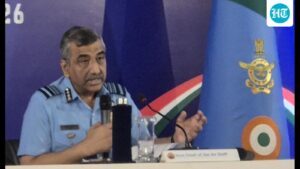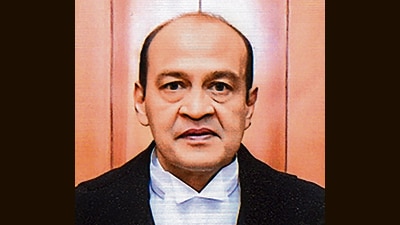
The three-member inquiry committee set up by the Speaker of the Lok Sabha to look into allegations against Allahabad High Court Justice Yashwant Verma has fast-tracked its proceedings over the discovery of unaccounted cash at his official residence in Delhi last year, apparently in view of the impending retirement of one of its members, Madras High Court Chief Justice MM Divastar.
Justice Verma first appeared before the committee constituted under the Judges (Inquiry) Act, 1968 on January 24. (PTI)Justice Verma first appeared before the Committee constituted under the Judges (Inquiry) Act, 1968, on January 24, soon after. Supreme Court Challenged to initiate impeachment proceedings against him, rejected his plea. Since then, at least two more hearings have been held in the past week, with the committee indicating its priority to conduct proceedings on a day-to-day basis. Two more hearing dates have been set this week.
Also Read | No evidence of cash was found in the house, Justice Verma told the Lok Sabha committee
The investigation proceedings are being captured on camera in line with the statutory framework governing removal proceedings against judges. Lawyers and law officers are also strictly prohibited from speaking or discussing with journalists outside the committee.
Apart from Justice Srivastava, the inquiry committee includes Supreme Court Justice Arvind Kumar and senior advocate BV Acharya. It was formed in March 2025 by Lok Sabha Speaker Om Birla after Lok Sabha Speaker Om Birla accepted a motion to remove Justice Verma for allegedly finding unaccounted cash following a fire at his official residence in Delhi when he was serving as a judge of the Delhi High Court.
More Read
In a detailed judgment delivered on January 16, the Supreme Court cleared the way forward for the committee, saying that “the removal of constitutional protections for judges cannot come at the cost of paralyzing the process”. The apex court rejected Justice Verma’s challenge to the Speaker’s decision to constitute the panel, ruling that he had failed to establish a present or imminent violation of his fundamental rights.
Also Read | The Rajya Sabha did not accept the motion to remove Justice Verma, the Lok Sabha Speaker’s office told the SC
Importantly, the court stressed that the Judges (Investigation) Act itself provides “extensive protection” to judges facing removal proceedings. These include the formulation of specific charges, full opportunity for defence, the right to cross-examine and cross-examine witnesses and the trial of senior constitutional officers. The bench said the statutory scheme adequately safeguards judicial independence and ensures that allegations of misconduct are effectively checked.
More Read
The apex court also rejected Justice Verma’s argument that the impeachment proceedings cannot proceed after the Rajya Sabha refused to entertain the parallel impeachment motion, saying that the Lok Sabha’s decision to set up an inquiry committee was valid and autonomous.
The impending retirement of Justice Srivastava has also been seen in recent Supreme Court proceedings. On 4 February, Chief Justice of India Surya Kant pointedly noted that the office of Chief Justice of the Madras High Court has “only one month” left when the state government replaces the Governor in appointing the Vice-Chancellor while dealing with cases on the Tamil Nadu Act. The CJI gave the option to Chief Justice Srivastava to constitute an appropriate bench to decide the matter expeditiously, recognizing the practical constraints posed by the impending retirement of the Chief Justice.
Also Read | Multiple flaws in opposition motion to remove Justice Yashwant Verma: Rajya Sabha official
In this context, the hearing before the Lok Sabha’s inquiry committee is seen to be speeding up with a view to concluding the inquiry before Justice Srivastava’s retirement on March 5. If proceedings remain incomplete after that date, the committee must be reconstituted with new members, which will require an action to reconstitute. (Investigative) Act – Potential impeachment proceedings significantly delayed.
Justice Verma attacked the impeachment proceedings initiated against him in March 2025 following the discovery of cash following a fire at his official residence in Delhi. A Supreme Court in-house inquiry panel subsequently found his explanation unsatisfactory, prompting the then CJI Sanjeev Khanna to recommend action to the Prime Minister and President.
Subsequently, notices for his removal were sent to both the Lok Sabha and the Rajya Sabha on 21 July 2025. When the Speaker of the Lok Sabha accepted the proposal on 12 August and constituted a three-member inquiry committee, the Deputy Chairman of the Rajya Sabha announced his resignation, soon after the then Chairman and Vice President Jagdeep Dhankar announced his resignation. faulty