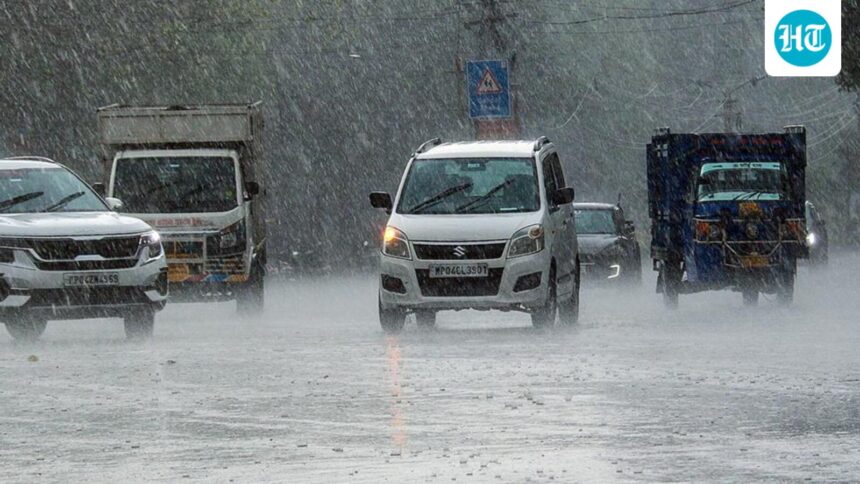
The thunderstorms and hailstorms that hit northwest India last week — unseasonal even by pre-summer standards — are the result of an intermittent polar jet stream and a shifting polar vortex that have led to an unusual increase in western disturbances, forecasters said.

March recorded eight western disturbances versus a normal rate of five to six, and at least three more are expected until mid-April. The rise is made all the more surprising by what preceded it: January and February saw far fewer snowfalls than usual, resulting in lower snowfall across the Himalayas. Regulations have intensified sharply since mid-March.
Western disturbances are moisture-laden cyclonic systems that originate over the Mediterranean Sea and move eastward along the jet stream — the narrow, elevated band of fast-moving winds that surrounds the globe at an altitude of about 30,000 feet. Imagine the WD—usually moving slightly lower in the atmosphere—riding the tail of the jet stream. When the jet stream oscillates, rather than flowing in a relatively straight path, it directs more of these systems into lower latitudes, including northwest India.
“When the westerly jet stream is particularly wavy, we sometimes see an increase in the influence of low-latitude westerlies,” said Mahesh Palawat, Vice President of Climate and Meteorology at Skymet Weather. “The wavy jet stream is associated with rapid warming in the Arctic.” A similar disturbance in the polar jet stream has brought snowstorms and extreme cold across parts of the United States this winter.
Scientists say the broader pattern reflects a structural shift in the time of arrival of WDs — not just their number. “WD activity usually peaks in winter and declines sharply by spring. However, recent studies show that WD activity shifts to the spring season, and WD often occurs in April, May and June. This may be due to the melting of Arctic sea ice in recent years,” said Climatologist and former Secretary of the Ministry of Earth Sciences Rajeevan.
This transformation is driven by a series of interconnected atmospheric systems. The polar vortex – a mass of cold air orbiting the North Pole – affects the jet stream, which in turn affects the North Atlantic Oscillation, a pattern of pressure differences over the Atlantic Ocean that determines how many WDs reach India and how far south they travel. “When the NAO is in the negative phase, we don’t see a large number of WDs, but now its phase is zero. As it moves to the positive phase, we see more WDs in southern latitudes,” said OP Sreejith, head of the Climate Monitoring and Forecasting Group at IMD.
The immediate impact is expected to intensify. The IMD has warned of light to moderate rain over northwest India from April 2 to 5, with peak activity and hailstorms expected on April 3 and 4. Scattered heavy rains are likely in Kashmir Valley on April 3. Thunderstorms and lightning are likely to occur in central India until April 6. Diurnal temperatures across northwest India are expected to remain near normal to below normal during the period.
On Tuesday, snowstorms hit Himachal Pradesh, Punjab, Haryana, Uttar Pradesh, eastern Rajasthan and western Madhya Pradesh. Thunderstorms with wind speed of 50-80 kmph were reported across Northeast, Uttarakhand, Gangetic, West Bengal, Jharkhand and Delhi. “We can expect severe thunderstorms, lightning and hail in April. People should be careful,” said M Mohapatra, Director General of IMD.
While the immediate effect was relief from early heat, the unusual WD pattern poses risks to perennial crops – and mirrors the conditions that produced the deadly storms last May. At least 59 people died in two states in a thunderstorm on May 23, driven by a similar convergence of western disturbances, cyclonic circulation and moisture from both seas.