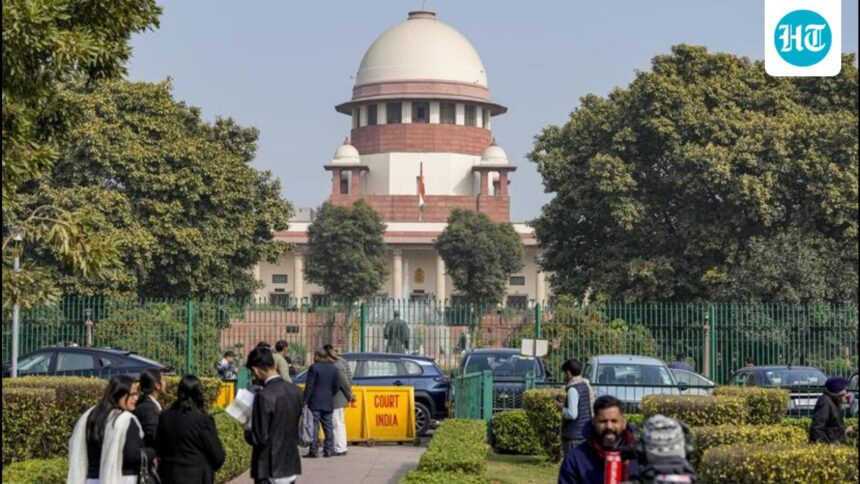
Deploring the “total failure of civil administration and police administration” in West Bengal, the Supreme Court on Thursday took suo motu cognizance of the hostage-taking of seven judicial officers in Malda district and termed it an “unfortunate” and “well-calculated and planned” attempt to intimidate the judiciary and challenge the authority of the Supreme Court.

A bench comprising Chief Justice of India Surya Kant and Justices Joymalia Bagchi and Vipul M Pancholi moved quickly to secure the ongoing Special Intensive Review (SIR) of electoral rolls, directing the Election Commission of India (ECI) to order and immediately deploy central forces at all places where judicial officials are adjudicating voter objections. The court also asked the Election Commission of India to hand over the investigation into the April 1 incident to the CBI or the NIA, while issuing notices to the chief secretary, director general of police, home secretary and district officials of West Bengal explaining why contempt action should not be taken against them.
After publishing the order on April 6, the bench ordered the officials to remain present online, adding that it would closely monitor compliance with its directions and investigate the incident.
The court order was based on a detailed report received from the Chief Justice of the Calcutta High Court, which painted a disturbing picture of administrative paralysis. Seven judicial officers, including three women, were detained for about 10 hours inside the BDO office in Kaliachak, Malda, after they were besieged by protesters since around 2.30pm on Wednesday.
Despite urgent communications from the Supreme Court Registry to the state administration, no effective action was taken until late night. The officers were deprived of even basic necessities like food and water, and senior officials, including the district magistrate and superintendent of police, did not reach the scene.
The situation escalated to the point where the Chief Justice himself had to intervene, with the Director-General of Police and the Interior Minister eventually arriving at his residence around 11pm. The officers were not released until around midnight, and even then, the court recorded, they were stoned and assaulted with bamboo sticks while leaving the building.
The Supreme Court described the incident as “shocking” and said: “This is not a routine incident… It appears, at first glance, to be a calculated and deliberate move to demoralize judicial officials and obstruct them from performing their duties.” The panel added that such behavior “amounts to a challenge to the authority of this court,” because the officers served as its “extended hands” in supervising the SIR process.
During the hearing, the bench expressed clear dissatisfaction with the attempts to shift responsibility between the state administration and the Independent Electoral Commission.
First, the CJI asked: “Did you all see what happened yesterday?” As senior advocate Kapil Sibal, representing West Bengal Chief Minister Mamata Banerjee, admitted the incident, the bench questioned the failure of the authorities to maintain law and order.
When the state’s senior counsel, including state Attorney General Kishore Datta and senior advocate Menaka Guruswamy and Gopal Sankaranarayanan, argued that the administration was effectively under the control of the Election Commission of India due to the ongoing electoral process, the court strongly rejected the claim. “It is of no use to say that we were not responsible,” the bench responded, stressing that the primary responsibility for maintaining law and order lies with the state.
The court also took note of the presence of political actors at the protest site. “If it was apolitical, what were the political leaders doing in it? What was their duty? Why was law and order put in their hands?” The bench asked pointedly.
On a significant note, the bench said it had “never witnessed such politicization in any country”, warning that even judicial officers had been targeted in the charged atmosphere surrounding the SIR exercise.
The court affirmed that the judicial officers charged with adjudicating voter objections work under its authority, and that any attempt to intimidate or obstruct them will have dire consequences. “Our earlier orders speak volumes… Judicial officers are our extended hands,” the bench observed, adding that any breach of their work would be construed as contempt of court.
She further warned that she would not allow “anyone to take the law into their own hands to create psychological fear in the minds of judicial officers.” The bench noted with concern that the incident was likely to have a “chilling effect” on officers who had been working tirelessly, including on weekends, to complete the massive operation involving the objections of millions of voters.
In an attempt to restore confidence and ensure the continuity of SIR practice, the Court issued a comprehensive set of directives, placing responsibility on both the ECI and state agencies.
The IEC has been directed to request adequate central forces and deploy them at all places where cases are adjudicated, while ensuring security at the places where judicial officers reside, as well as for their family members. The state government, working under the ECCI directives, has been asked to take all necessary remedial measures to ensure that officers are able to work without fear or hindrance.
The court also ordered that strict control be maintained over access to separation centres, with no more than three people allowed at any time, to prevent overcrowding or intimidation.
It is worth noting that the court directed that the investigation into the geraoing case be entrusted to either the Central Bank of Iraq or the National Intelligence Agency, with a compliance report to be submitted before the court. The investigating agency will submit its findings directly to the Supreme Court.
In its order, the court strongly criticized the conduct of senior officials of the state, pointing out that even the Chief Secretary could not be contacted at a critical juncture and he did not share accessible contact details.
The court described the administration’s response as “deeply regrettable” and said officials must explain why effective measures were not taken for the safe evacuation of judicial staff, despite clear warnings and escalating risks.
“This undoubtedly amounts to criminal contempt,” the court noted, linking the administrative error directly to the breakdown of constitutional responsibility.
The incident occurred against the backdrop of widespread protests in Malda district, where protesters alleged widespread deletion of names from electoral rolls as part of Operation SIR. In several areas, roads and highways were closed, and tensions rose throughout the day.
On Wednesday, the Supreme Court already confirmed that the right to vote is a “precious” constitutional right and cannot be “washed out” in an “oppressive” way, while allowing the courts to consider new documents submitted by affected voters. The court also warned against any attempt to pressure judicial employees, and made it clear that they must be allowed to work independently.