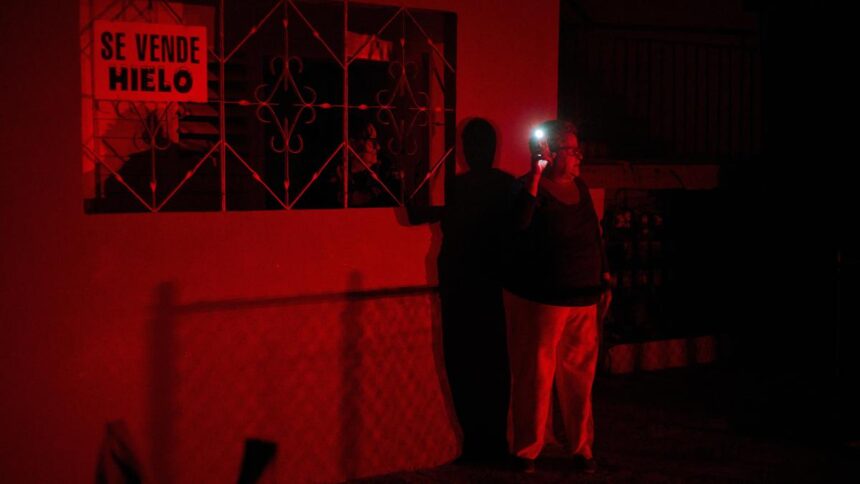
The smell of sulfur is strong in this coastal town, which produces petroleum and houses one of Cuba’s largest thermoelectric plants. Yet, even when the plant returns to life, the inhabitants remain in the dark, surrounded by untapped energy sources.
Tensions are rising between Cuba and the After the US attacked Venezuela And oil shipments were disrupted, hence the woes of Santa Cruz del Norte.
People in this town east of Havana are plunged into darkness every day and are forced to cook with coal and firewood, but not everyone can afford this new reality.
Kenya Montoya recently tore out the wooden door from her bathroom in her cinderblock home because she needed firewood and shared it with her children to eat.
“Things are getting worse for us now,” he said. “They don’t supply us with petroleum. They don’t supply us with food. Where does that leave us?”
A faded purple sheet now hangs over their bathroom. Nearby, only coal remains in a small bag.
A 50-year-old mother doesn’t know how to cook after running out of coal because supplies in the area are running low.
It’s one of many uncertainties gripping towns like this one across Cuba after US President Donald Trump threatened to impose tariffs on any country that sells or supplies oil to Cuba.
“Well, it’s a failed nation now,” Mr. Trump said this week. “And they’re not getting any money from Venezuela, and they’re not getting any money from anywhere.”
Near the main entrance to Santa Cruz del Norte, an elaborate mural is emblazoned with the following message in all caps: “No one gives up here. Long live free Cuba.”
But people wonder how long they can hold out.
The island’s crisis is deepening: severe blackouts, soaring prices and shortages of basic goods.
Meanwhile, the Cuban government remains tight-lipped about its oil reserves, giving no word on whether Russia or anyone else will increase their shipments when oil supplies from Venezuela are disrupted. In early January the US attacked and arrested its president.
Cuban officials recently hailed a phone call with Russian Foreign Minister Sergey Lavrov, though they did not share details. Meanwhile, Mexico has pledged to send humanitarian aid, including food, after Trump asked it to freeze oil shipments to the island.
Many in Santa Cruz del Norte feel the worst is yet to come.
“With all the tariffs they’re going to put on countries, no oil will come in and how will we survive?” Gladys Delgado said.
The 67-year-old recently opened her front door to get some fresh air while sewing small, colorful rugs made from scraps of fabric to earn extra money since her pension is just $6 a month.
A couple of houses down, Minarkis Hoyos dropped a handful of cassava sticks into an old pot filled with water from a barrel and placed it on a small, makeshift grill inside his house.
“You live with what you have,” she said, as she had no other food available at that moment.
Some of the rechargeables used to light her small, dingy house broke, and she began scavenging until a neighbor gifted her with an improvised lantern made from fuel and a recycled baby food jar.
“I can’t see when it’s dark,” said the 53-year-old diabetic. It was noon when she was cooking, but her house was already dark.
Outside, two children sat on the dusty sidewalk. They stacked dominoes on top of each other to see how high they could go before the whole thing fell down.
For the past three months, Santa Cruz del Norte has had electricity, but much of Cuba has been subject to continuous outages caused by aging infrastructure at power plants and fuel shortages.
People like Ivan Amores were wary of rejoicing, fearing that they would plunge back into darkness like last year. His fears came to fruition when it stalled again a week ago.
“It was amazing,” he recalled of his town when it had electricity. “Now, this is really torture.”
He uses a small, makeshift barbecue pit to cook for himself, his daughter and young granddaughter, buying expensive coal for $3 a bag because it produces less smoke inside their tidy home.
Amores invested in a single tube light that a Cuban man built and sold in another town; It can be charged and with a USB port Also comes.
But even such amazing inventions as Cubans know are out of reach for people like 67-year-old Mariela Viel; She and her husband still can’t afford to add a bathroom with a dirt floor to their cinderblock house.
Growing up, Viel said he didn’t know what a blackout was: “We lived well. We had food, money.” He worked in the cafeteria of an electric company in Cuba for more than 40 years and now receives a pension of $8 a month.
“What can I give? Nothing. Not even a package of chicken,” she said. When there’s energy, she cooks rice and beans and listens to her favorite music: Cuban big bands.
Viel sat outside one recent afternoon, watching as a couple of neighbors briskly walked with buckets of warm water so their families could shower during a cold snap that began in late January, when the southeastern town of Santa Cruz del Norte recorded a record 32 degrees (0 degrees).
Celebrations start early now, as a family hosts a boy’s 15th birthday — a milestone across Latin America — and by mid-afternoon he and his friends decide to finish partying outdoors under a big yellow moon.
It beamed down on a nearby crowd of people who danced and sang along to scooter blasting music from its speakers to celebrate the birthday of Olga Lilia Laurenti, now 61.
“I’m telling you, whatever’s going to happen, let it be, because we can’t stop it,” she said as she paused to dance.
“You’re not going to waste part of your life on something that’s beyond your control. If we can do something, but what are we going to do? We can’t feel, you need laughter, you need happiness.”