New Delhi
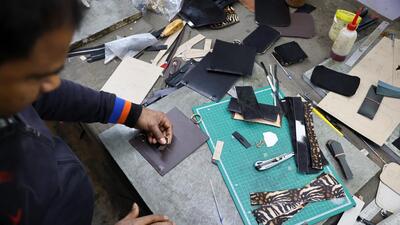
A worker works on leather cloth at a leather goods manufacturing unit in New Delhi, India on January 27, 2026. (REUTERS)India’s labor-intensive industries such as textiles, seafood, footwear and leather goods have received a boost from budget proposals that cut tariffs on many inputs, a move aimed at boosting their competitiveness in international markets, particularly in the US, where the Trump administration’s 50% tariff poses a high hurdle.
Union Finance Minister Nirmala Sitharaman in her budget speech on Sunday announced several measures to boost exports of seafood, leather and textile products.
“I propose to increase the duty-free import limit of certain inputs used for processing marine products for export from the current 1% to 3% of the FOB value of the previous year’s export turnover,” said the minister.
Indian fish and other aquatic invertebrates exports fell 9.2% year-on-year to $1.25 billion in April-November 2025, after the Trump administration’s tariffs took effect in August.
More Read

Similarly, Indian knitwear exports fell by 3.88% to $1.70 billion during the period, other readymade garments by 6.47% to $1.82 billion and leather items by 2.24% to $525 million.
To address this, Sitharaman said: “I propose to increase the duty-free import limit of certain inputs used for processing marine products for export from the current 1% to 3% of the FOB value of the previous year’s export turnover”.
He also proposed to allow duty-free import of certain inputs, currently available for leather or synthetic footwear, for the export of shoe uppers. Apart from this, the deadline for export of final products of these sectors has been increased from six months to one year.
More Read

Union Commerce and Industry Minister Piyush Goyal called it a budget for “future-ready India” that will boost exports and domestic manufacturing.
“With a dedicated focus on accelerating manufacturing growth, increasing exports and positioning India as an attractive investment destination, the Budget reinforces the country’s role as a trusted global economic partner,” he said in a post on X.
Commerce Secretary Rajesh Agrawal noted that the budget provides much-needed procedural support.
“The Budget is very positive for trade as it provides much-needed systemic and structural support for long-term sustainable growth of exports. It will make Indian manufacturing competitive which will lead to sustained growth in exports. Trade facilitation measures under the Budget will improve export competitiveness by reducing costs,” Agarwal said.
The proposals will strengthen the services sector and give a sectoral boost to semiconductor, marine, textiles, leather and other labour-intensive sectors, he added.
Strategic production boost
More Read

Sitharaman announced tariff concessions to help India develop global manufacturing capabilities by establishing economical and reliable supply chains.
He proposed extending the basic duty (BCD) exemption used for battery energy storage systems to capital goods used to manufacture lithium-ion cells for batteries. He also exempted BCD of sodium antimonate used in making solar glass.
In line with opening up private investment in the sector, the finance minister has extended duty exemption on goods required for nuclear power projects till 2035 and extended it to all nuclear plants irrespective of capacity. He also proposed concessions on capital goods for processing essential minerals for sectors such as automobiles and solar energy.
Assocham President Nirmal K Minda said the budget takes a calibrated approach to enhance India’s competitiveness in both manufacturing and services so that it can fully utilize existing and potential Free Trade Agreements (FTAs).
“Equally important is the opportunity arising from India’s recent FTAs, which position exporters to tap diverse markets, integrate into global value chains. With targeted support for quality, compliance and market access, Indian exporters can transform global barriers into a sustainable competitive advantage,” Minda said.
The Modi government has concluded eight FTAs involving 37 countries, mostly with developed countries including the United Arab Emirates (UAE), Australia, the four-nation European Free Trade Association (EFTA) bloc, the United Kingdom (UK), Oman, New Zealand and the European Union.
It concluded negotiations for the “Mother of All FTAs” with the EU on Jan. 27, integrating two markets with a combined GDP of about $25 trillion and a population of 1.9 billion. The most recent agreement is the India-U.K Close on the heels of the FTA and the four-country EFTA bloc – combined totaling more than $30 trillion.
FIEO President SC Ralhan said the government’s focus on strengthening domestic manufacturing in high-value and strategic sectors such as electronics, semiconductors, biopharma, textiles, chemicals, aircraft components, construction equipment and rare earth magnets will boost the economy.
Trade facilitation measures such as duty concessions on key inputs, extension of export deadlines, recognition of trusted exporters and export cargo clearance from factory premises will significantly reduce transaction costs, improve ease of doing business and enhance supply-chain efficiency, he said.
“These reforms will directly strengthen exporters’ confidence and competitiveness,” added Ralhan.