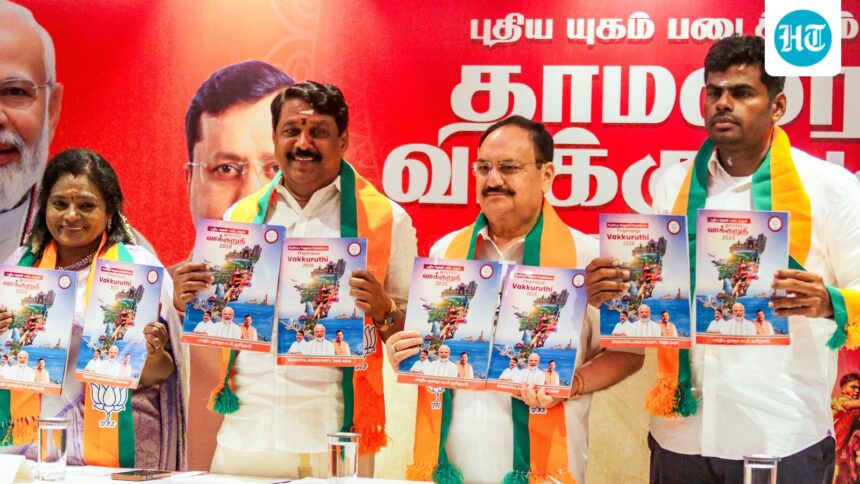
The BJP, which won an impressive victory in West Bengal, retained power in Assam and is part of the ruling coalition in Puducherry, and is now in power, either alone or with its allies, in 22 of the 31 states and union territories. The number of BJP legislators across the country has also doubled since 2013, from 773 to 1,798. But as its presence increases across the country, there remains a frontier the party aspires to penetrate — the South.

With the exception of Karnataka, where the party was previously in power (it first formed government in 2008) and Andhra Pradesh, where its ally the Telugu Desam Party is in power, electoral success has eluded the party in Tamil Nadu, Telangana and Kerala. The party’s attempts to gain a foothold in these states did not yield any results on Monday, and it was forced to make do with three seats in Kerala and one seat in Tamil Nadu.
The BJP has worked hard to expand its presence south of the Vindhyas. In 2016, the party developed a plan to overcome the obstacles it faced in the southern and eastern states that make up the Coromandel Belt, and achieved some success in implementing it. It already controls power in Odisha and now West Bengal, and hopes to regain Karnataka in 2028.
Party leaders, who spoke on condition of anonymity, admitted that the leadership and cadres on the ground are still a work in progress. There is also the issue of communication.
“There is a gap between the BJP and voters, though there has been a tangible shift in perception. The BJP has not been able to understand the language and sentiments of the region,” a senior party official said.
This is most evident in Tamil Nadu, where the BJP’s attempts to cling to the AIADMK have yielded no results. The party was able to win only one seat, with 2.97% of the votes.
“There was huge anti-incumbency against the ruling DMK, but people chose to vote for the new outfit (TVK) instead of the AIADMK, which is an ally of the BJP… They preferred to stay with a party committed to social justice and identity-based politics of the state,” the above-mentioned functionary said. The BJP tried to paint the DMK as an anti-Hindu party for not allowing Karthigai Deepam rituals at the Subramanya Swamy temple in Thiruparankundram, but the issue did not find resonance across the larger Hindu constituency.
In Kerala, the BJP’s attempts to attract Christians did not yield the desired results, although the party won three seats, an all-time high, and ended up with a respectable independent vote share of 11.43% (the slightly larger NDA alliance received just over 14% of the vote).
“In Kerala too, the Congress was the favourite; this shows that the BJP’s message of inclusivity has not registered with Christians, who constitute the third largest group in the state,” the official said.
According to the 2011 census, Christians account for about 18.38% of the state’s population, and the BJP has been courting them, engaging with various sects and sects within the community.
A second leader in the state, who requested anonymity, said: “There was an experiment conducted by the BJP in Kerala, so we reached out to non-Catholics… and to Hindus with the message that the demographics of the state have changed, and what are the risks that both communities will face. The results were not what we expected, but there is gradual growth, which will change for the better.”
The leader said both Prime Minister Narendra Modi and Home Minister Amit Shah have repeatedly emphasized that for the BJP to grow as a pan-India entity, it will have to dispel the impression that it is a North Indian party and speaks in Hindi. It has already done so in the West, East, and even the Northeast. Only the south remained.