The 2026 House of Representatives elections have produced decisive rulings. But beneath the clarity of these findings lies a deeper flaw: India’s regional party system faces the limits of dynastic politics in a changing social and regulatory landscape.

For decades, regional parties have derived their strength from charismatic founders, ideological platforms, and enduring social alliances. Over time, many of them turned into family-run businesses. The political family at the center of these parties provided continuity and cohesion. In the past ten years, many of these groups have experienced leadership shifts, closing lines of command, impeding organizational mobility, and preventing renewal of social alliances.
Read also: Key takeaways from the election results
The problem is not that the parties have ruling dynasties. The problem is that family succession collides with generational shifting among voters and party workers alike. This clash has begun to reshape the electoral results. The results in Assam, West Bengal, Tamil Nadu and Kerala suggest that voters do not necessarily reject these family-led parties, but they are opposed to the way these parties are run.
Start with Essam. The BJP’s third successive victory marks the consolidation of the party’s dominant system. Equally telling is the Congress Party’s continued inability to mount a credible challenge despite the lead of Gaurav Gogoi, the three-time prime minister’s son. This is not just a story of the BJP’s organizational strength. It also concerns the limits of dynastic succession as an alternative to political renewal. Leadership inheritance without organizational reinvention has proven insufficient.
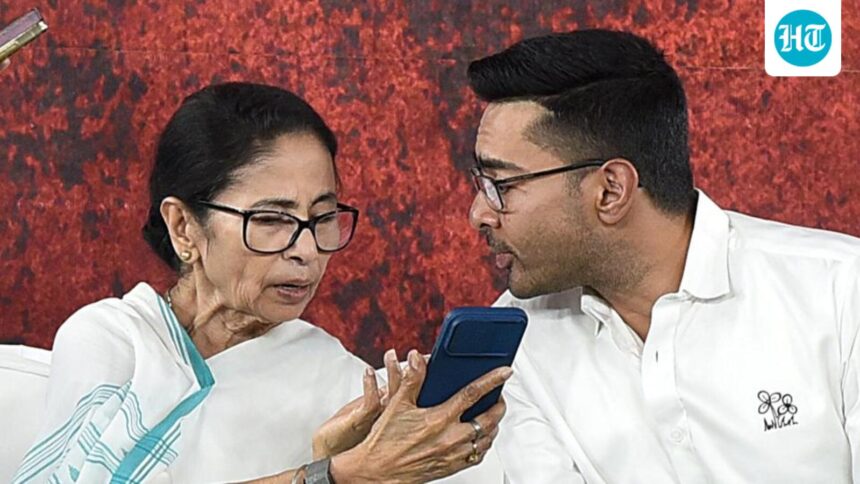
In West Bengal, the BJP’s progress has a similar implication. It seems that voters have distinguished between the leader and the regime that runs under her. Almost all reporters on the ground pointed out that while Mamata Banerjee retains her personal appeal, the rise of her nephew Abhishek Banerjee as an organizational linchpin has generated controversies. Over time, the organization of the TMC became linked to local control, patronage networks, and exclusionary gatekeeping.
Also Read: Deciphering the vote swing in Bengal, Tamil Nadu, Kerala and Assam
Tamil Nadu provides the most dramatic illustration. The rise of Tamilaga Vetri Kazhagam under Vijay was a systemic rupture. By pushing the Dravida Munnetra Kazhagam side to second place, TVK has disrupted what had long been seen as an established duopoly. The KDP’s ideological legacy remains intact, but internal consolidation around Udhayanidhi Stalin – son of Prime Minister M K Stalin and grandson of M Karunanidhi – has generated unease within and outside the party.
Ideological parties rely on cadre motivation, internal discussion, and a sense of collective ownership. In contrast, dynastic consolidation often replaces these chains with chains of patronage and networks of personal loyalty. The ruling reflects not only anti-incumbency but also the fatigue of concentrated family succession.
Some might argue that Kerala presents a contradiction to this hypothesis. But here too, the basic story is about organizational vitality. The Congress Party, despite its limitations, has seen a renewal of its leadership over time – from AK Antony and Oommen Chandy to Ramesh Chennithala and V D Sathisan, among others. In contrast, the left struggled to modernize its leadership. The absence of generational transformation has gradually eroded their ability to adapt.
Taken together, the 2026 results reinforce a trend that has been evident for some time.
The BJP has successfully challenged the ruling dynasties – the Hoodas and Chautala in Haryana, the Thackeray and Pawars in Maharashtra, Naveen Patnaik in Odisha, and the Lalu Prasad family in Bihar. However, exceptions like the comeback of Hemant Soren in Jharkhand or the retreat by the Samajwadi Party in 2024 in Uttar Pradesh, remind us that dynastic parties too can pose challenges to the BJP juggernaut. Three lessons follow.
First, the transition of leadership must be negotiated, not inherited. Voters are more willing to accept new leaders when they emerge from within the party ecosystem, rather than when they are promoted simply by lineage. Parties that concentrate power within a narrow circle risk hollowing out their own structures. In a competitive system, political parties have to quickly adapt and respond to changing electoral environments.
Second, social welfare in the absence of political inclusion has diminishing returns. Material benefits can only guarantee support to an extent. Younger voters are much more ambitious. In both West Bengal and Tamil Nadu, incumbents hoped to return to power simply by the welfare generosity. Perhaps they have not learned the right lessons from the recent defeats of the YSRCP in Andhra Pradesh, the BRS in Telangana and the BJD in Odisha.
Third, anti-incumbency might change its target. It is no longer directed only at governments or policies, but also at the party’s organization and leadership style. The shift from mass politics to targeted politics, evolving with the social media landscape and the emergence of political consultants, has created new points of friction.
The broader meaning is unambiguous. For the BJP, these elections validate a model that combines ideological messaging, welfare delivery, and organizational depth.
But this advantage is conditional on its ability to avoid the same pitfalls it has exploited elsewhere. As for regional parties, most of which are also family-run companies, the message is clearer. It is a warning of how not to run their parties.
Rahul Verma is a fellow at the Center for Policy Research in New Delhi. The opinions expressed are personal.