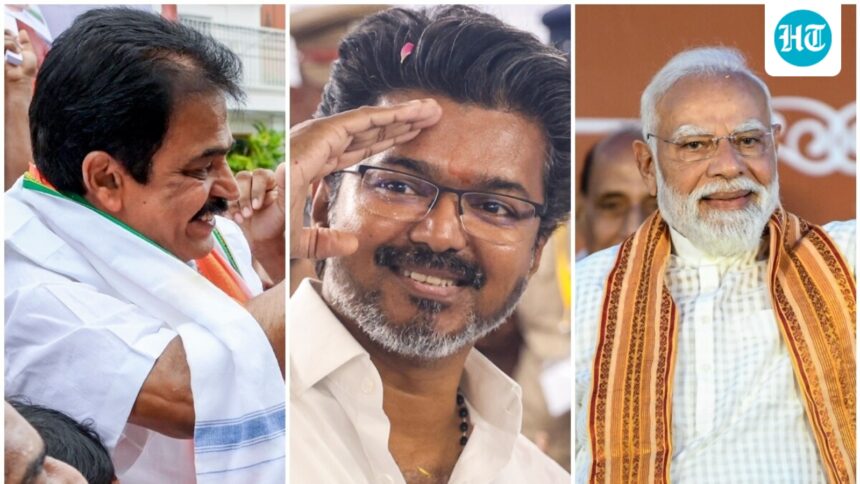
A decisive victory for Vijay’s TVK in Tamil Nadu, the return of the Congress-led United Democratic Front in Kerala, a massive mandate for the BJP in West Bengal – May 4 was a day filled with many historic firsts as some political parties made huge strides, while others witnessed one of their biggest setbacks ever.

Although the actor-politician’s party failed to achieve an absolute majority in its first election, the ruling in Tamil Nadu was enough to leave a significant impact on the power dynamics in the state.
As for Assam and Puducherry, the incumbent NDA governments have resurfaced with a major victory. Deciphering what sent votes swinging all over the place:
Tamil Nadu
The last time a cinematic mascot stirred up an election storm in Tamil Nadu, one in two people in India lived below the poverty line, cable television and cell phones were still two decades away, and a white ambassador ruled the roads. Life veered between careful distribution of oil and rice, carrying a ration card like a prayer, and negotiating with a kerosene lamp when the electricity went out every evening like clockwork. Indira Gandhi has just been voted out by an overwhelming majority.
That year, in 1977, Maruthur Gopalan Ramachandran came to power in his first electoral appearance, riding to power through an unusual coalition of women, young people and the poor. He will never lose another election in his life.
Read also: Vijay will be Tamil Nadu’s next chief minister, says DMK worker as Thalapathy’s TVK makes stunning debut
Since that fateful election, no debut in the southern state has been as momentous as that of Joseph Vijay Chandrasekhar, whose rising team Tamilaga Vetri Kazhagam emerged as a dark horse in Monday’s Tamil Nadu Assembly elections within striking distance of power. The 51-year-old actor has done what Captain Vijayakanth could not do, what screen legend Rajinikanth hoped to do but never tried, and what Kamal Haasan failed to do. Using his larger-than-life image, his popular network of film clubs, and his cult status among the youth, Vijay successfully broke the Dravidian duopoly that had persisted for half a century. He could become the first non-Dravida Munnetra Kazhagam or all-India Anna Dravida Munnetra Kazhagam chief minister since the formation of Tamil Nadu in 1967.
How did he manage the impossible – especially for a group launched in February 2024, which was overwhelmed by the tragic death of 41 people at a rally just months before the election?
Firstly, he moved away from Dravidian disciplines but not from Dravidian ideology. He respected Periyar, CN Annadurai and Ramachandran, did not speak ill of M Karunanidhi or G Jayalalithaa, and said he was committed to social justice and upliftment of the poor irrespective of community affiliation. He said he would work to restore the glory of the Tamil language and secure Tamil Nadu against cultural aggression. In a country where sectarian polarization has not historically worked as a mobilization tactic, he strove to court all religions, visited shrines of every sect, and emphasized his identity as a Tamil at the expense of any specific religion. See His Statement Promises – a monthly newsletter from $2500 per woman in Tamil Nadu, $10,000 to unemployed graduates, waived off cooperative crop loans, six free gas cylinders, a gold coin and a silk sari for every bride – reminiscent of Jayalalithaa’s alms and his speech – saying that his vision was based on essential Thirukwal qualities like aram (virtue), porul (wealth) and inbam (joy) – which go back to Thirukwal’s poetry. Karunanidhi, and Vijay clearly did not abandon the time-tested Dravidian model that has worked in both disciplines over the last 50 years, but simply rebooted it.
Secondly, this reboot relied on his image as an arrogant, honest person trying to change something about a corrupt system stacked against the weaker – as he did in countless hit films like Thuppakki, Mersal or Pokkiri.
In an environment where there was no prominent Dravidian leader in the fray – Jayalalithaa died in 2016 and Karunanidhi two years later – and voters were tired of lofty rhetoric but populist politics as usual, Vijay seemed like someone who did not fit the mold of a politician. Autorickshaw drivers in Chennai and laborers in Madurai marveled at his lavish lodgings, exorbitant acting fees and collection of luxury cars, but not with resentment. They marveled that a man who had everything could delve into the dirty world of politics, and they thought that a man who already had everything would not need trivial bribes.
Third, Vijay leveraged his network of film clubs not only to mobilize supporters, but also to select loyalists as candidates – people who may not have been particularly distinguished in their daily lives, but who were untainted by corruption charges and were the face of the proverbial big man. Many of them were electoral rookies but that only added to Vijay’s freshness and appeal. It didn’t hurt that the clubs had millions of members.
Ultimately, if everything seems to have gone well for Vijay, it is also an indictment of the rot of Dravidian politics that has favored rhetoric over rights and promoted dynasty over mobility. If the DMK cannot curb corruption at the lower level, act against its own local followers, work to fulfill aspirations by covering them with subsidies, and chooses to promote the son of the incumbent Prime Minister only for the sake of his predecessors, how true is it in achieving the goal of rational ideology?
Read also: The Dravidian mutation in Tamil Nadu is called TVK
Likewise, if the AIADMK has teamed up with the BJP in its quest for power, has little ideological glue holding its campaign together, and has failed to build a real state-level coalition, why should voters entrust it with control of the state? Vijay asked these questions over and over again. On Monday, the people of Tamil Nadu responded with such resounding force that its repercussions will extend far beyond Chennai.
Assam
Few major Indian states have been shaped in the image of the Prime Minister like Assam. Himanta Biswa Sarma tries on many hats – a brilliant strategist, protector of the indigenous Assamese people, able administrator and controversial leader. More than anyone else, the Assembly elections were a referendum on five-year rule for the man who handed over the northeast to the BJP, but also alienated much of his state with his controversial comments about illegal immigrants.
The stakes were high for Sarma, who faced his first election as prime minister and focused on infrastructure promises, a blueprint Orunodoy delivers. $1,250 for women, a controversial eviction campaign that forced thousands of people to live in makeshift camps, and determined the tribal status of six communities.
Opposing him was Gaurav Gogoi, whose father Tarun Gogoi – Sarma’s former mentor – was the last person to win three consecutive elections in Assam. Gaurav Gogoi was optimistic that there were signs of anti-incumbency. He won the Jorhat Lok Sabha constituency in 2024 despite Sarma personally campaigning against him. The Congress party was hoping for a big win in upper Assam on the back of its alliance with Raijor Dal and Assam Jatiya Parishad, among others.
Read also: The decision to contest the Assam elections was to fight for the rights and dignity of the tribals: the Surin
This hope would be a lie. In a border state with a turbulent history of infiltration and violent unrest that led to massacres, Sarma achieved victory and pushed the National Democratic Alliance past the 100-seat barrier for the first time in history.
The Congress party can blame polarization and inflammatory seating Controversy for 2023, but failed to put forward a credible alternative to the BJP, allowed Sarma’s personality to dominate the campaign, and collapsed across the state, except in pockets of lower Assam. Uniting Muslims failed to strengthen the opposition even as the smart alliance strategy helped the NDA, which was already in a dominant position in the north-eastern state.
The victory added further weight to Sarma’s rapidly growing national image. The BJP has now achieved a simple majority on its own in Assam for the first time. On the other hand, Gaurav Gogoi lost his Jorhat Lok Sabha seat by a margin of 23,000 votes.
Kerala
It is not unusual for an incumbent and a challenger in a major Indian state to fight for survival. However, this was exactly the scenario in Kerala, the only Left-dominated state. Reshaped in the image of Chief Minister Pinarayi Vijayan, the cadre-based party was hoping for a repeat of the turmoil of 2021, when it flipped the script in a state where power alternated between the Left Democratic Front and the Congress-led United Democratic Front.
What happened? Amid allegations of corruption – particularly the scandal over the alleged theft of temple gold at Sabarimala and the Karuvannur Cooperative Services Bank corruption case – and turmoil over ideological issues such as the entry of women into the Sabarimala shrine, and anti-incumbency in general, the LDF slumped to its worst performance ever, with the loss of 13 ministers.
The United Democratic Front achieved an easy victory and the Congress recorded its best results in the state in a generation. The BJP, building on its Lok Sabha victory in Thrissur and its win in the Thiruvananthapuram Municipal Corporation, bagged three seats – its best performance in a state where it has traditionally struggled to find a foothold.
How did that happen? The United Democratic Front appears to have largely held on to the gains it made in the 2025 local body polls. It has erased the gains made by the Left among Muslim sections and in north Kerala. Muslims appear to have united behind the UDF’s constituent Indian Union Muslim League. Another ally, the Kerala Congress led by PJ Joseph, helped win back parts of the Christian vote from the LDF. Smart selection of candidates helped win a portion of Ezhava votes. Congress tried to clamp down on the factions, support every candidate, and push workers to take to the streets in numbers that surprised some allies. At rally after rally, V D Sathisan and Ramesh Chennithala spoke of Indira’s five-point guarantee, which includes free bus travel for women, $1,000 per month for female university students, $3000 pension, $25 thousand health insurance and interest-free loans. As a result, the United Democratic Front improved in terms of its 2025 local body vote share in each district.
In contrast, the LDF’s campaign was burdened by anti-incumbency and dissatisfaction with Prime Minister Pinarayi Vijayan, whose personality greatly overshadowed the campaign. The Left tried to argue that the development of infrastructure and welfare schemes over the past decade was due to Vijayan’s personal investment. Cut-outs and billboards bearing his face spread across the state, but they were not enough to reverse the LDF’s fortunes. Instead, a group of rebels and independents prevailed – in Payyannur won by Kunhikrishnan, who had been expelled by the Communist Party of India (Marxist) and fought as an independent backed by the United Democratic Front; Former minister G Sudhakaran, who ended a six-decade association with the CPI(M) to fight as an independent, contested from Ambalapuzha as an independent and won.
The BJP will be happy with its achievement – the highest percentage of votes and seats it got in the Kerala Assembly elections – especially in the southern part of the state, although it will be a little disappointed after its loss in Palakkad. With the Left now out of power in every Indian state for the first time in nearly sixty years, the BJP will believe it can carve out a more permanent space for itself in “God’s own country.”
West Bengal
On the eastern edge of Nadia district lies the town of Tehata, which lies on land where West Bengal and Bangladesh overlap, and the flooding of the Jalangi River is a regular harbinger of grief. Partition sent a tidal wave of refugees into this region, rewriting its demographics and social fabric. Hindus constitute two-thirds of the population, and Muslims make up the other third. Almost everyone is either an agricultural worker or a distressed migrant.
Jadavpur is the opposite. Located in the heart of South Kolkata, this constituency has long sat on a throne of political prestige. Home to the university that bears its name, the area is home to an educated Bengali middle class, interspersed with queues of urban poor clustered along the railway lines – many of whom came to India as refugees. In 1984, the Jadavpur Lok Sabha seat witnessed the rise of a young woman named Mamata Banerjee. For about 25 years, it was the residence of Buddhadeb Bhattacharjee, the chief minister and then chief minister of West Bengal, before the TMC came to power.
Gosaba is different from either. A small group of islands at the mouth of the Bay of Bengal, the area where Bengal melts into the Sundarbans, a vast maze of mangroves and tides that is no stranger to storms, dangerous waves crashing into embankments and brick walls, and the poor often take rickety boats to school. Most people – dominated by Dalits and Muslims – live either by subsistence farming, fishing or manual labour. Every decade, a cyclone drives salt water deep into the soil and drives young people to Surat, Hyderabad and Gurugram. It is the citadel of the Left first and then the Transitional Military Council.
Taken together, however, the story of these three constituencies encapsulates the saffron storm that rocked West Bengal on Monday, ousting Mamata Banerjee and completing, arguably, the BJP’s most significant victory in a legislative election since Uttar Pradesh in 2017. They underscore the three key factors that buoyed the BJP to its first victory in the eastern state.
The first is to unite Hindu voters and fragment Muslim voters. Using a combination of sectarianism, anti-Bangladesh rhetoric, genuine concerns about jobs and popular corruption, and the lure of better job opportunities, the BJP was able to win over nearly two-thirds of the state’s Hindu population. In Tehata, for example, Union Home Minister Amit Shah held a rally to remind voters of the dangers of uncontrolled migration, saying the BJP would stop cow smuggling and end the TMC’s “money-down” culture. As a result, in a Hindu-majority seat where the TMC would get nearly half the Hindu votes along with the Muslim votes in the bloc, the BJP moved forward on the back of uniting Hindus, especially among the Matua community which largely comprises Dalit refugees from across the border. The BJP’s Subrata Kabiraj won by 28,000 votes – nearly three times the TMC’s 2021 margin.
Second, dissatisfaction with the authoritarianism of the TMC strongmen who fended off anti-Bengali accusations led to the BJP. In Jadavpur, for example, an unknown BJP candidate, Sarpori Mukherjee, may have surprised herself by winning the seat at the heart of Bengali politics by 27,000 votes. It was a stunning coup for the TMC which won the seat in 2021 with 45% of the vote. “If adding a floor to a house, or opening a new store, is always fraught with local dadas demanding a commission, how long can this be tolerated?” asked Peddabrata Ghosh, a local resident. In a seat dominated by Bengalis, Among the salaried people, the BJP has found a vital issue that goes beyond demographics or regional exceptionalism – in the TMC’s citadel in Kolkata.
Third, there has been a crack in women’s votes due to the social welfare campaign reaching its ceiling. In Gosaba, Malati Das wondered if she could live for the rest of her life $1,500 if her children never get a job. Heavy rains had washed away the house next to hers, and she feared it would be her next residence. “But I don’t just want to survive,” she said. “I want to live well.” In 2021, Banerjee managed to fend off the BJP’s attack by assembling a coalition of women beneficiaries of her flagship schemes — among them Lakshmir Bhandar and Kanyashree Prakalpa — that was largely caste, region and caste agnostic. In 2026, this alliance was divided because urban women’s choices largely mirrored their male counterparts, rural women’s ambitions meant that handouts were expected (after all, the BJP had promised to double Lakshmi R Bhandar’s sum) and welfare was the floor, not the ceiling.
Of course, the foundation of this amazing victory was based on two basic pillars. The first was the Special Intensive Review (SIR) which resulted in nine million names being deleted, of whom 2.71 million were found to have been deprived of their rights. The practice created an atmosphere in which communal resentment among Hindus – evident not just at the Ram Navami rallies in Purulia but in the chic living rooms of south Kolkata – was complemented by rhetoric against illegal immigrants. The BJP’s greatest weakness – the absence of a popular network in the TMC’s stronghold of south Bengal – was overcome by the deployment of 2,500 companies of paramilitary forces, which effectively neutralized the TMC’s ground advantage. After all, Das was clear that no one in her village would have ever thought of the BJP if they had not seen their option as viable on the ground — especially in the TMC citadel of south Bengal. As a result, for the first time since 1967 – when the Jana Sangh won the seat – the BJP’s Bhikarna Naskar won 16,000 seats.
In 2021, Banerjee managed to cover up her colleagues’ mistakes by saying she was the candidate in every seat and begged people not to punish their mistakes. Five years later, this scenario ended.