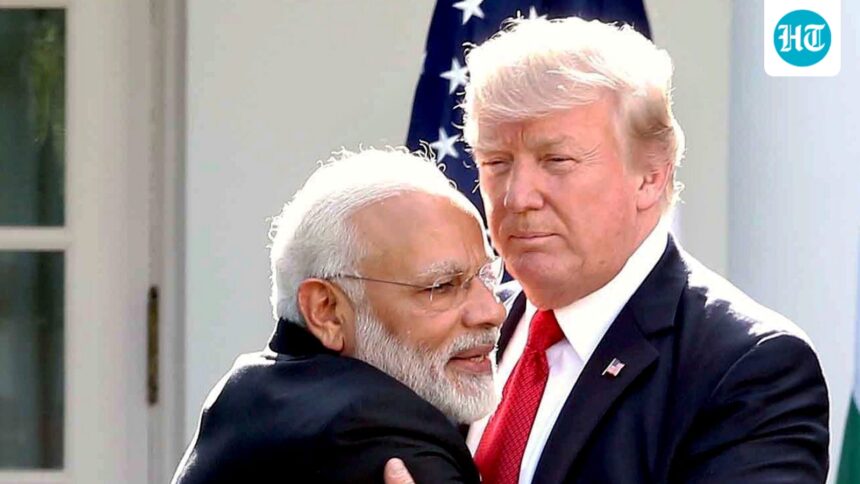
A 12-member Indian delegation led by chief negotiator Darpan Jain will work with their American counterparts as the two countries look to finalize the trade deal.

India and the United States are set to begin a new round of high stakes Trade negotiations in Washington on Monday, April 20. The three-day talks, from April 20 to 22, aim to finalize the first phase of the proposed bilateral trade agreement (BTA).

A 12-member Indian delegation led by chief negotiator Darpan Jain is scheduled to participate with their American counterparts in the first in-person talks since October 2025.
10 points in the trade agreement between India and the United States
- The talks will be held from April 20 to 22 in Washington, led by India Chief negotiator Darpan Jain. and officials from the Ministries of Trade, Customs and Foreign Affairs.
- The discussions come after a major reset of the US tariff system following a US Supreme Court ruling that struck down comprehensive reciprocal tariffs imposed under the US-China Free Trade Agreement. International Emergency Economic Powers Act (IEEPA).
- In their place, Washington set up a temporary apartment 10% tariff on all countries for 150 days starting February 24 (ending July 23).
- The biggest driver for the renegotiation was the unified US tariff of 10% on all trading partners. Earlier, India got a preferential structure with US tariffs on Indian goods reduced from a high level 50% to 18%. This included removing a 25% penalty linked to India’s purchase of Russian oil. This comparative advantage has now been eroded.
- Since the agreement has not yet been signed, India has the flexibility to reconsider its commitments. Officials told PTI that the agreement will be “recalibrated and reworked” to ensure India is not disadvantaged under the new global tariff framework.
- One of New Delhi’s goals is to regain the cost advantage it previously enjoyed in the US market. Under the previous conditions The reduction in tariffs gave Indian exporters an advantage over competitors.
- Under the February framework, India made many concessions to the United States. These were – eliminating or reducing tariffs on US industrial goods, reducing tariffs on a wide range of agricultural products (nuts, fruits, soybean oil, DDGs, wines and spirits) and removing many non-tariff barriers. It is now possible to reformulate many of these commitments.
- India had previously indicated plans to do so Buying up to $500 billion in US goods over five years. This included energy, aircraft, semiconductor inputs, precious metals and coke. This will also likely be re-evaluated as the deal is reworked.
- Two investigations are ongoing by The US Trade Representative’s Section 301 (targeting alleged “excessive” manufacturing capacity in countries including India) is expected to be a key point. India has strongly objected to these investigations and is pressing for their withdrawal. New Delhi said it was unjustified.
- February meeting between senior negotiators It was postponed due to tariff disruption. The current Washington round is essentially a reset. It also takes place in a completely changed global business environment.
Trade dynamics
The negotiations come at a time…
- China has overtaken the US as India’s largest trading partner in 2025-26.
- India’s exports to the United States rose marginally by 0.92% to reach $87.3 billion.
- Imports from the United States jumped by 15.95% to $52.9 billion.
- The trade surplus shrank to $34.4 billion from $40.89 billion.
(with PTI inputs)

Anita Goswami is a Senior Content Producer at Hindustan Times, where she primarily covers Indian and international news. With four years of experience in the field, she has led coverage of Indian general elections, Assembly elections, and national polls in the US, Canada, Bangladesh and Nepal. Its reports cover world wars and major events, including Operation Sindoor, the overthrow of Sheikh Hasina, and the Mahakumbh Mela. It verifies the facts and uses clear sources to ensure the accuracy of the reports. As a former Editor-in-Chief at Storytailors, she has managed teams to produce high-quality content for networks such as NDTV, Profit, CNBC-TV18, Upstox and News18. Her work has appeared on NDTV, Meaww and Global Pulse. Throughout her tenure, Anita has collaborated with and received mentoring from leading industry experts. When she’s not reading, Anita can be found outside or at a bakery. Areas of interest: Indian political history, international elections, historical policy analysis, global conflicts, cultural events, Formula 1, art, media ethics, reporting on social and political change over time.Read more