

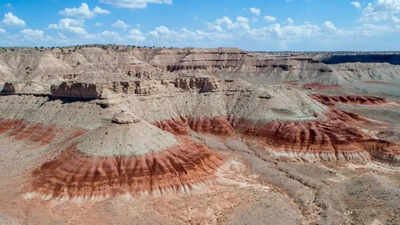
The Grand Canyon has long been regarded as one of the most astonishing landscapes on Earth, yet its origins remain surprisingly unstable. Scientists widely agree that the Colorado River played a central role in carving the canyon millions of years ago, as reported by the US Geological Survey.
However, the exact sequence of events has not been fully determined. A new study now revisits an old idea, suggesting that the flood of an ancient lake may have led the river to course through the region. This argument relies on microscopic geological evidence, offering a new angle to a debate that has spanned decades. It doesn’t settle everything, but it adds weight to a theory that had previously been largely set aside.
Grand Canyon formation theory Connected to an extension of the ancient lake
According to the study published in the journal Science, titled “Late Miocene Colorado River Reach into the Bidahoochee Basin Supports an Indirect Origin of the Grand Canyon,” it focuses on the prehistoric lake that occupied the Bidahoochee Basin in northern Arizona. The researchers suggest that this basin gradually filled with water over time, perhaps being fed by early flows associated with the Colorado River system. At some point, the lake seems to have reached a tipping point.The water likely seeped across its natural boundaries, crossing high terrain such as the Kaibab Arch.
This flood may have forced the water to cut a new path through the landscape, laying the foundation for what later became the Grand Canyon. This process may not have been entirely sudden, although it may have involved periods of rapid erosion. This kind of fallout is one plausible way for a large river system to create a new path, experts say.
New clues reinforce Grand Canyon formation theory
The most convincing evidence comes from zircon crystals found in sandstone samples.
These crystals form in volcanic environments and can maintain their chemical composition over long periods of time. The researchers analyzed zircons from both the Grand Canyon and the Bidahoche Basin. The chemical signatures matched those associated with sediments carried by the Colorado River. This indicates that material transported by the river reached the basin, indicating that there was contact between the two areas long before the valley was fully formed.Scientists used laser-based techniques to examine the internal structure of the crystals. This allowed them to trace the origin of the sediments with great precision. The results seem to support the idea that the river was flowing in the basin before continuing on its course.
The rock formations indicate the Grand Canyon formation process
Apart from the microscopic analysis, there are the physical properties of the rocks that are considered in the study. In particular, some rock layers have ripple marks.
It consists of the flow of water in the presence of a fixed body, such as a lake. The presence of ripple marks indicates that flowing water once joined the lake.
Controversy continues over the Grand Canyon formation theory
However, there are some geologists who do not fully accept the spillway theory due to many uncertainties. The first uncertainty concerns when and at what magnitude the hypothesized extension occurred. Additionally, there were concerns about the possibility of a natural water course in that area. If any previous valleys or runs exist, the behavior of the lake and river may be very different from those reported in the results.
Another concern is what level the lake must reach for spillover to occur.