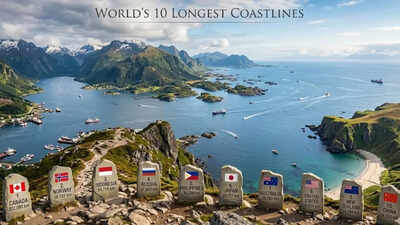
Coastlines are usually thought of as beaches and seas, but the length of their coastline can vary greatly based on geographic conditions. According to the World Atlas, certain geographic elements such as the shape of the coastline and the configuration of islands and straits help determine the length of a country’s coastline, making it appear larger at its borders.Countries with unusually long coastlines are due to the country’s fragmentation into multiple parts and influential geographical elements. The coastline helps the country thrive economically, biologically and climatically.
Countries with the longest coastlines and what makes them unique
The coasts of these countries are characterized by geographical factors such as bays, peninsulas and islands. Long coastlines serve as the basis for marine life, fishing, and international shipping lanes.
Often, coastlines may be jagged, complicating measurements. Below is a list of the top 10 countries with the longest coastlines in the world.
Canada (202,080 km)
Canada’s coastline extends for 202,080 kilometres, making it the longest in the world. It touches the waters of the three oceans, the Atlantic, the Pacific, and the Arctic Ocean, and is somewhat convoluted due to the presence of many islands, bays, and straits.
Norway (58,133 km)
The total length of the Norwegian coastline is 58,133 km due to the presence of deep fjords formed due to glacial movement. The fjords narrow to extend inland, increasing the length of the coastline. The coastline makes an important contribution to Norway’s fishing industry.
Indonesia (54,716 km)
The Indonesian coast is one of the longest due to the large number of islands, numbering more than 17,000. These coasts contain many types of life and consist of coral reefs and mangrove forests.
Russia (37,653 km)
The Russian coast extends for a distance of 37,653 km, and covers several oceans, such as the Arctic Ocean and the Pacific Ocean. The Russian coast experiences cold environments, with much of the coast freezing over in winter.
Philippines (36,289 km)
The Philippine archipelago consists of many islands and therefore has a very extensive and complex coastline of 36,289 km. The coasts are famous for their beautiful coral reefs, diverse marine life and abundant fishing villages.
Japan (29,751 km)
Japan’s coastline is 29,751 kilometers long due to it being an archipelagic country. Its coastline consists of several bays, peninsulas and rugged beaches.
Australia (25,760 km)
Australia’s 25,760 km coastline consists of diverse landforms such as beaches, cliffs and reefs, including the Great Barrier Reef. This enables tourism, marine life and coastal ecosystems.
Despite its large area, it does not have a winding coastline compared to others.
United States (19,924 km)
The United States has a long coastline of 19,924 kilometers on the Atlantic Ocean, Pacific Ocean, and Gulf of Mexico. The country also has a long Alaskan coastline, making the coastline longer than usual.
New Zealand (15,134 km)
New Zealand’s coast extends 15,134 km long, and its formation is due to the presence of volcanoes and tectonic activities. Its notable geographical features include bays, bays and rugged cliffs.
China (14,500 km)
China’s coastline is about 14,500 kilometers long and extends around the Pacific Ocean. The coastline is not very far, but it is economically important. The coastal areas have a large population, and they have great economic importance.