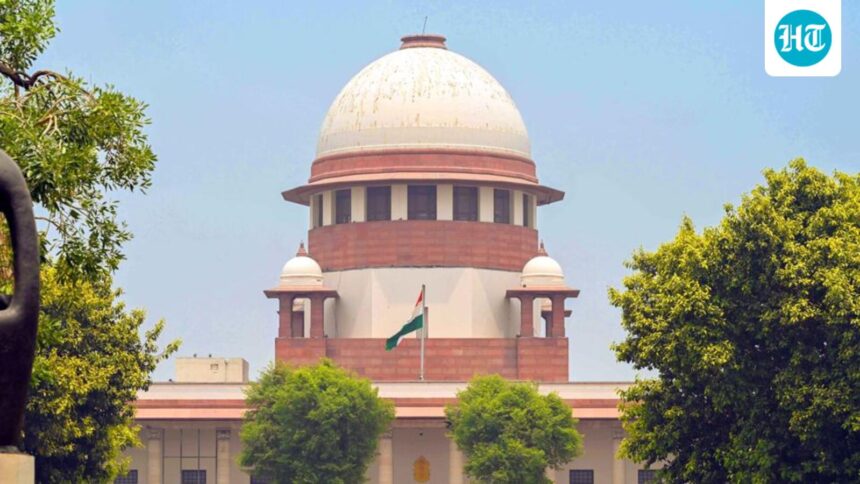
The Supreme Court on Tuesday announced a nationwide initiative to speed up the resolution of consensual disputes, unveiling the “Supreme Court Procedure for Dispute Adjudication and Harmonization of Disputes Across the Nation” – Samdan Samaroh 2026, which will culminate in a special Lok Adalat from August 21-23.

The initiative, which was issued as a public notice, aims to promote what the court described as a vision of “participatory justice” and “doorstep justice,” inviting litigants, lawyers and stakeholders to opt for amicable settlement of cases pending before the Supreme Court through consent-based mechanisms.
The programme, which officially began on April 21, will run over four months, during which parties can register and attempt resolution through both physical and virtual modes before the special Lok Adalat sessions in August. The court also established a dedicated “war room” and electronic portal to simplify engagement and coordination. As of April 2026, the total number of cases pending in the Supreme Court exceeds more than 94,000.
This initiative is being implemented under the leadership of Chief Justice of India Surya Kant, who in recent months has consistently emphasized the need to mainstream alternative dispute resolution, especially mediation, as a fundamental pillar of judicial reform.
The focus on mediation featured prominently in the ICJ’s public engagements at the Hindustan Times Leadership Summit in December 2025, where it described mediation as one of the “game changers” for the future of India’s judiciary, citing its ongoing “Mediation for the Nation” mission as a key reform effort.
“Mediation creates a win-win situation for both sides,” he said, stressing that, unlike adversarial lawsuits, it allows both parties to leave “with smiling faces,” which maintains relations and strengthens the social fabric. He added that it is worth noting that mediation must be accessible and connected, with processes conducted in a language and environment that resonates with the “consumer of justice” rather than intimidating them.
Likewise, at a seminar organized by the Orissa High Court Bar Association in December 2025, the CJI identified alternative dispute resolution methods, especially mediation, as a strategy with “tremendous immediate potential” to address the growing delays in the justice system. At the same time, he warned that structural reform alone would not be sufficient without a deeper cultural transformation.
He had said that litigants should get rid of the perception that settlement amounts to surrender. “Settlement is not a capitulation, but a strategy,” he noted, while also urging government departments to move away from their ingrained tendency to challenge every contrary order, a practice that burdens the courts significantly.
Earlier this month, speaking at the International Conference of the Indian Council of Arbitration in Delhi, Kant reiterated that India’s ambition to become a preferred hub for resolving complex cross-border disputes will depend on building an integrated dispute resolution ecosystem. He stressed that mediation and arbitration should act as complementary mechanisms and not as competing alternatives.
The Supreme Court’s latest initiative seeks to translate these ideas into systematic and widespread practice at the Supreme Court level, a relatively uncommon move given that Lok Adalats are often associated with district courts. The program also signals an institutional push to include consensual dispute resolution even at the highest levels of the judicial hierarchy.