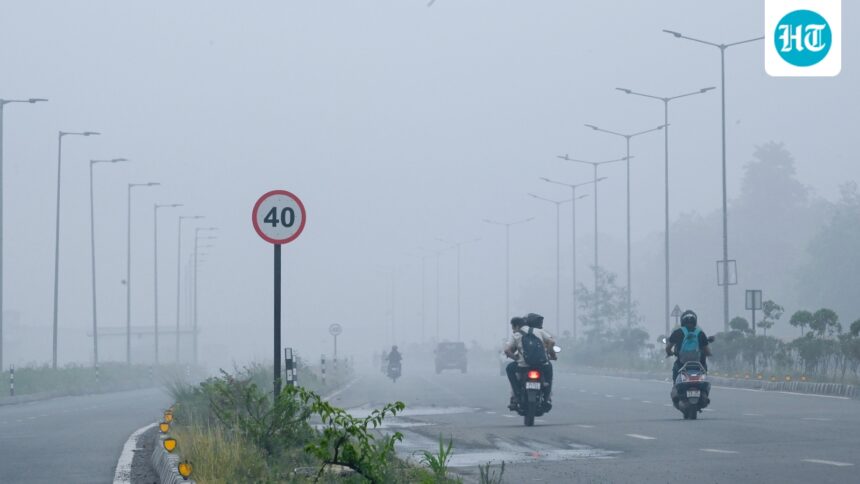
New Delhi: In a rare occurrence in April, parts of the Delhi-NCR region were shrouded in fog on Saturday morning, and experts attributed the unusual phenomenon to a combination of recent rainfall spells, low night temperatures and high humidity that created condensation near the surface in the early hours of the morning.

Experts said that the foggy start to the day was the result of the interaction of multiple factors over the past 48 hours.
Read also | Successive western disturbances lead to rain in the northwest. Delhi on cloudy and sunny days
Light rain on Friday led to increased humidity levels, while a slight drop in temperatures and relatively clear skies overnight were conducive to condensation and shallow fog, said Mahesh Palawat, head of Skymet Weather. “Misty conditions were seen in parts of Delhi NCR with falling temperature and rainfall over the last two days. Therefore, there was extreme humidity in the air coupled with clear skies resulting in mornings like this which may happen sometimes during the months of March and April.”
Delhi recorded a minimum temperature of 20.7 degrees Celsius on Saturday, which is 1.9 degrees above normal, but still low enough in humid conditions to help with fog formation. The India Meteorological Department (IMD) also noted that the recent western disturbance and associated cloudiness played a role in modifying temperatures and affecting humidity levels.
Despite the foggy start, the day progressed into a relatively mild and pleasant afternoon, with temperatures remaining below typical early April levels. The maximum temperature reached 32 degrees Celsius, about two degrees below normal, continuing the trend of low daytime temperatures in the capital.
However, rain activity remained limited throughout the day. Safdarjung, which serves as the city’s primary meteorological station, recorded just 0.5 mm of rain in the 24 hours ending Saturday morning. Local variations were observed, with Ayanagar having an average rainfall of 5.8 mm during the same period. Delhi recorded light to very light rainfall at most places in the last 24 hours, accompanied by gusty winds and overcast skies, the IMD said.
“Delhi is likely to continue to face relatively mild conditions over the next few days, with patchy cloud cover and the possibility of light rain or thundershowers on Sunday evening,” the IMD also said in its latest forecast.
However, Palawat said daytime temperatures are likely to rise on Sunday and Monday, with the next rain likely only on Monday night, due to a new western disturbance that will impact cyclonic circulation in the region.
“An active Western Disturbance is expected to impact northwest India around April 7-8, which may bring fresh rains on Monday night onwards, with thunderstorms and gusty winds across the Delhi NCR,” Palawat said.
The IMD also noted that temperatures are likely to remain near normal to below normal through most of next week, delaying the onset of typical early summer heat.
Meanwhile, the air quality in Delhi recorded a sharp improvement on Saturday, coinciding with the change in weather conditions. The air quality index dropped from 266 (poor) on Friday to 137 (moderate), according to the daily bulletin of the Central Pollution Control Board. Experts attributed the improvement of Al-Qaeda in Iraq to a group of different meteorological factors.