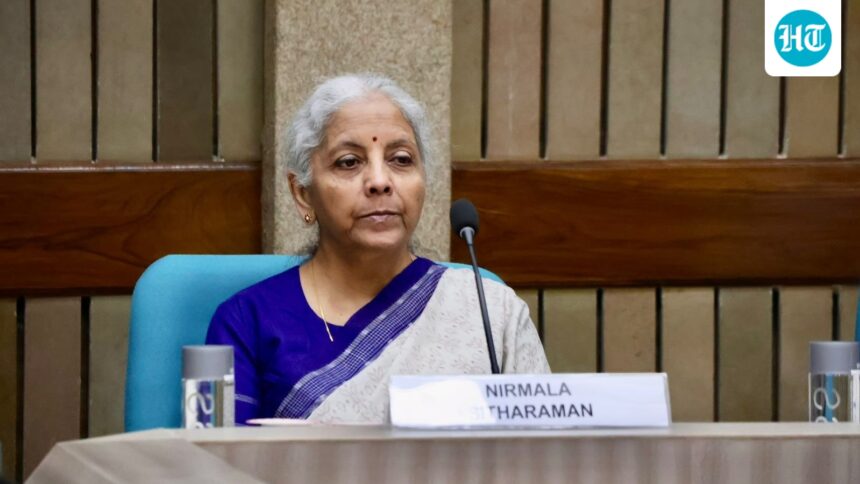
Finance Minister Nirmala Sitharaman on Monday warned that the ongoing war between the US and Iran has gone far beyond regional security concerns and now poses risks to the global economic system, describing it as a “systemic earthquake”.

Addressing the golden jubilee event of the National Institute of Public Finance and Policy in Delhi, Sitharaman said the emerging crisis threatens vital global energy supply routes and reshapes geopolitical alliances.
She said: “The escalation of the conflict in the Middle East has evolved from a regional security concern into a systemic tremor that threatens the vital arteries of global energy and hardens the lines of a new multipolar world order.”
She stressed that the global economy has entered a phase of “permanent fluctuations,” moving away from a period characterized by isolated shocks. “This year is more challenging as we move from a landscape of ‘shocks’ to a landscape of ‘permanent fluctuations,’” Sitharaman noted.
path Live updates about the US-Iran war here
Describing the broader global situation, she said the current reality could best be depicted through a world defined simultaneously by “volatility, uncertainty, complexity and ambiguity.”
The turmoil that struck the global economy
The Finance Minister pointed to a series of disruptions that have reshaped the global economy in recent years – from the Covid-19 pandemic to the Russia-Ukraine war, rising tensions in the Middle East, and trade uncertainties linked to the policies of former US President Donald Trump.
Commenting on the past year, Sitharaman said 2025 was more critical than expected, as trade fragmentation disrupted supply chains and forced downward revisions in global growth forecasts, though the year ended on a relatively upbeat note for India.
She also cited rising global debt as a major concern. Citing data from the International Monetary Fund, Sitharaman said that public debt has risen to about $106 trillion, which exceeds 95% of global gross domestic product. The debt-to-GDP ratio in the United States is expected to reach 125% in 2025, while the ratio in Japan is 235%.
According to her, many advanced economies now face limited fiscal space after years of expansionary policies, which limits their ability to respond to new economic challenges.
In contrast, Sitharaman highlighted India’s relatively strong macroeconomic fundamentals. The ratio of general government debt to GDP in India is about 81%, which is among the lowest rates in major economies after Germany, and is expected to decline further to 75.8% by 2030.
India’s external debt-to-GDP ratio remains low at 19.1% as of September 2025, while foreign exchange reserves have crossed $688 billion as of March 31, 2026, enough to cover about 11 months of imports, it added.
The US-Iranian war continues
The conflict continues to escalate with no immediate signs of de-escalation. US President Donald Trump has issued a deadline for Iran to reopen the Strait of Hormuz, warning of potential strikes on key infrastructure such as bridges and power plants if Tehran does not comply. The deadline ends on Tuesday
Iran rejected the 45-day ceasefire proposal, insisting instead on a permanent end to the war with guarantees against future attacks.
The United States and Israel carried out new strikes on Iran on Monday, reportedly killing more than 25 people, while Iran responded with missile attacks targeting Israel and Gulf states.
The US military has struck more than 13,000 targets so far, according to Central Command, underscoring the scale of the ongoing conflict.
Meanwhile, tensions have spread across the region, with missile warnings regularly sounded in Bahrain and the United Arab Emirates amid a new Iranian barrage.
Global fears of escalation
The war also raised international concern. The UN Security Council is set to vote on a revised resolution aimed at reopening the Strait of Hormuz, a vital route through which nearly a fifth of the world’s oil supplies pass.
World leaders have urged restraint, with countries such as New Zealand warning that threats targeting civilian infrastructure could worsen the crisis and calling for an urgent de-escalation.