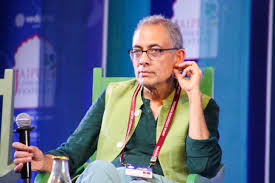
KOLKATA: Despite the country’s robust growth figures, Nobel-winning economist Abhijit Banerjee cautioned that political polarization in India is undermining transparency and turning the nation into a “mystery” for foreign investors.
Transparency is being undermined by political polarization; India is a “mystery” for international investors: Abhijit Banerjee In an interview with PTI, Banerjee stated that, from an economic standpoint, media freedom and transparency are the most significant issues facing the nation today, contending that investors are more concerned with data credibility than political rhetoric.
“I believe that India is going through a period of political polarization because there are many long-standing conflicts and we need to decide as a country how transparent and trustworthy we want to be perceived. I think the real issues are related to media freedom,” he said.
“Transparency and media freedom are the most crucial issues. Are the numbers truly known to us? Investors are concerned about that,” Banerjee stated.
He described India as unstable and extremely sensitive to uncertainty, despite the country’s continued appeal to foreign investment.
More Read

“In terms of foreign investment, we have performed fairly well, but it is erratic. The rupee is depreciating because money is not coming in fast enough,” he said, attributing the currency’s weakness to the absence of sustained capital flows.
Banerjee cautioned that the nation’s reputation as a long-term investment destination was being damaged by both domestic polarization and policy unpredictability.
“People must understand the guidelines of the policy. Will perceptions of particular businesses shift? He stated
More Read

“Unless we have a very predictable and transparent policy system and a transparent media, India will remain a mystery to the world,” he continued.
According to him, institutionalizing transparency is not necessary for India to expand its capital markets and eventually draw in foreign investment.
The 64-year-old economist stated, “We need transparency at all levels if we want to be a place where people always want to invest.”
Banerjee acknowledged that identity politics existed everywhere, including in the US, but he questioned whether the nation’s leadership had considered a practical development plan.
He stated, “The government is serious about development, but it hasn’t thought enough about what it will actually take.”
“What’s the roadmap, how do we get out of this trap of very few good jobs, how do we get everyone really high-quality education, and what if AI takes away more of these jobs?” He stated
More Read

He cautioned that significant social problems cannot be permanently concealed by headline GDP growth.
“GDP may rise, but poverty will rise and growth will slow if the majority of people lack a good education. Distributional issues still require attention.
Beyond markets, Banerjee highlighted long-term threats to political stability, contending that a lack of trust in institutions makes economic reform all but impossible.
He added that erosion of trust makes consensus-driven reforms very challenging. “If people feel left out of the voting process, that creates other problems,” he said.
Banerjee cited electricity subsidies to farmers as an example of how such reforms were politically unfeasible due to a lack of trust, even though direct compensation would be economically superior and environmentally necessary, particularly as groundwater tables collapse.
Banerjee disregarded the phrase “dole politics” when referring to welfare, claiming that large-scale transfers to the middle and upper classes were seldom recognized.
He declared, “I really detest the term ‘dole politics,’ and I detest it because I think we don’t recognize the amount of public investment that goes to the rich and middle class.”
He claimed that the cash transfer was a sensible reaction to an economy that, despite expansion, had not produced enough jobs.
“We haven’t been able to establish a thriving Chinese-style labor market where people can find employment and profit from expansion. It makes sense to me that migration is the only way to include people in the process of national growth if there is unemployment growth.
Banerjee addressed worries that welfare programs might lead to dependency by stating that technological advancements, particularly artificial intelligence, are quickly changing discussions about the nature of work in the future.
“Bhav, we have no idea what the real world will be like. According to Elon Musk, “we’re headed toward a world where no one has a job and the state has to pay something or people starve,” he stated.
Pointing to early signs of disruption, Banerjee noted that Indian IT firms have already scaled back hiring.
IT companies are already ceasing to hire mid-level skilled workers. What are these individuals going to do? He inquired. “We have to decide whether people will just starve if AI replaces a large part of the work,” he stated.
Regarding long-term priorities, Banerjee warned that the system is structurally biased against the poor and stated that India’s most significant shortcomings are found in the country’s extremely unequal access to healthcare and education.
He remarked, “It’s astounding how unequal access to health care and education is.” “The system is biased against the poor, and the best schools are private.”
“If we want to pool our talent, we need real equality of opportunity,” he continued, emphasizing that India’s demographic advantage will be diminished in the absence of genuine access to high-quality education.
Banerjee visited Kolkata to speak at the Exide Kolkata Sahitya Sama about the faltering economy.
Without any text editing, this article was produced from an automated news agency feed.
Get the latest updates India News on Global India Broadcast News your trusted digital destination for breaking headlines, entertainment buzz, lifestyle trends, health and fitness tips, technology insights, business developments, political updates, world news, and exclusive interviews from India and around the globe