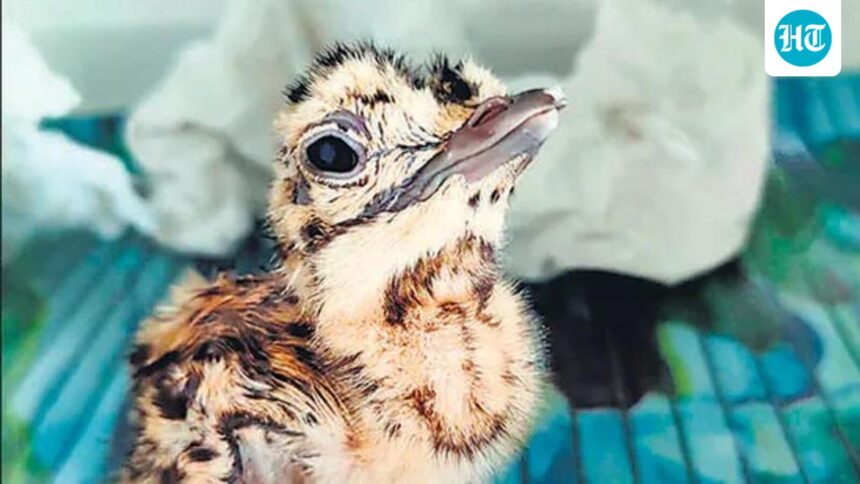
A month-old Great Indian Bustard chick, which hatched in the wild in Gujarat’s Kutch state in a first-ever inter-state egg transfer, has been missing since April 18, with forest officials not ruling out predation and experts questioning whether adequate habitats are being ensured for its survival.

The great Indian bustard, the state bird of Rajasthan, is one of the heaviest flying birds in the Indian grasslands, measuring about one meter in length. Once distributed among 11 states, the national bird population has declined from an estimated 1,260 birds in 1969 to perhaps fewer than 150 birds today, with more than 90% of the remaining birds concentrated in Rajasthan.
Read also | Rajasthan: 3 Great Indian Bustards bred naturally; Experts point to decreased stress
What is the great Indian bustard?
Classified as critically endangered by the International Union for Conservation of Nature since 2011, this bird lays a single egg on open ground, reproduces slowly, and has very poor forward vision, making it particularly vulnerable to power line collisions and terrestrial predators.
In Gujarat, there are only two or three wild females left, with no males in the state’s wild animals.
“The jumping technique has already been successfully implemented in Rajasthan for the great Indian bustard,” said YV Jhala, former dean of the Wildlife College. “Gujarat was healthy, and Kutch was its last stronghold. Earlier, hunting led to a decline, but now power lines associated with wind and solar projects have become a major threat. There were about 40 birds at Naliya in 2009-10. With only three females today, the The jump-start method addresses the immediate gap in reproduction.” Institute of India, which has been involved in national level research and policy inputs related to Houbara conservation.
Read also | Gujarat: Great Indian bustard chick seen in the wild for the first time in a decade
A chick is missing after its first wild hatching
The missing chick was born on March 26 in the Naliya pastures after a fertilized (captive-bred) egg was transported over 770 km from Rajasthan in a 19-hour road trip using a portable incubator. The egg was laid in the nest of a wild female that had laid a sterile egg. This was the first wild hatching in Gujarat in a decade and the first such inter-state hatching in the country.
This intervention follows the framework laid down by the Supreme Court of India, which ruled that the species is “critically endangered” and requires active recovery, while also directing that conservation measures be implemented alongside the expansion of renewable energy through expert-led site-specific recommendations.
A field team of around 40-50 personnel, including experts and forest staff, was monitoring the site with the GPS-tagged mother watching.
A senior Gujarat forest department official said the bird was last seen attempting a short flight about 10 days before it disappeared.
Forest conservator Dheeraj Mittal said: “We are not ruling out the possibility of predation on the chick. There is a high possibility of it but my team is conducting a survey and is still optimistic. This terrain is difficult. I have not yet announced that the bird is missing.”
“Work on the fence is ongoing, but we could not wait. The fertilized egg was placed in Rajasthan and had to be transported and placed inside a fixed window. These opportunities come in real time, so the process and the habitat work had to run together. There are some changes in the design of the fence that will be implemented,” he said.
He added that the result should not be viewed in terms of lapses alone. “We learn in the wilderness,” he said.
Concerns about habitat readiness
But wildlife experts said many preconditions were absent on the ground when the operation was conducted. A wildlife expert who requested anonymity said the grass had not yet been managed and the vegetation was not tall enough to hide the chick from predators.
“The habitat restoration work required under the Supreme Court’s framework has not been completed. Anti-predator fencing has not been installed. The problem of loose dogs at the site, which was specifically identified in the expert committee’s report submitted to the Supreme Court, has not been addressed,” the expert added.
The Supreme Court, in its judgment dated 19 December 2025, accepted the recommendations of the expert committee it had constituted in March 2024. The committee’s report listed predator management – particularly targeting free-ranging dogs – as one of the specific in situ conservation measures required in the revised priority area in Gujarat. It also recommended restoring grasslands, removing invasive species, designating key areas including Naalia grasslands as protected reserves, and building protective fences. The court ordered these measures to be implemented immediately.
The Kutch Bustard Reserve, with an area of about 2 square kilometres, is one of the two notified protected areas for this species in Gujarat, while the actual habitat extends across a larger grassy area outside formal protection. The court ruling fixed the revised priority area for Gujarat at 740 sq km, up from 500 sq km earlier. Many of the directives issued by the court and recommended by the expert committee have either not been implemented or no significant progress has been made in this context four months after the ruling.
“Risks from predators must be addressed but power lines must be mitigated, and a contiguous area of 200-400 square kilometers must be secured without power lines or with them adequately mitigated so that residents can survive,” said former dean of WII Jhala.
Kutch CF Mittal said, “Efforts to restore GIB populations in Kutch will continue through the Jumpstart method. Two GIBs have been tagged for nest tracking, and their future eggs will be used in similar interventions. At the same time, habitat improvement measures such as Prosopis removal, fencing reinforcement, predator relocation, and water management are being taken to improve their chances of survival in future attempts.”