

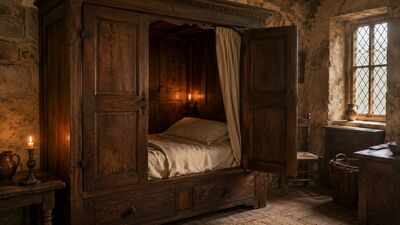
At first glance, it looks like an ordinary wardrobe. It has solid wooden doors and a sturdy frame and hardly suggests anything unusual. Open it up, however, and instead of shelves or rails, there’s a bed tucked inside.
For hundreds of years, these enclosed sleeping quarters were part of daily life across Europe, serving people from agricultural families to wealthy families. They are not built as wonders or luxury furniture. They answered the practical problems that shaped domestic life in the Middle Ages and later, from harsh winters to crowded homes. These closet-like beds remained in use from the Middle Ages until the first decades of the 20th century before quietly disappearing from most homes.
How box beds turned wooden closets into hidden sleeping spaces
Known as box beds, enclosed beds, or cabinet beds, these wooden frames feature mattresses within a cabinet-like frame. Some were little more than ordinary wooden boxes, while others were carefully carved, painted, or fitted with storage drawers and benches underneath. Many included doors that could be closed completely, leaving the sleeper inside an enclosed space, while others relied on curtains or small openings instead.
According to the BBC, they are designed as functional pieces of home furniture rather than separate bedrooms, often combining several purposes into one compact structure.Their role extended beyond providing a place to sleep. In homes where space is limited, a box bed effectively creates another sleeping area without the need for an additional room. The BBC describes examples from Scotland where families living in one-room country houses relied on these beds to accommodate everyone.
At the same time, seasonal workers also used them when temporary accommodation became overcrowded.
During the busy hunting seasons around Wick, several migrant workers would sometimes share a single bed because there was not enough space elsewhere.
Why did box beds keep families warm during Europe’s Little Ice Age?
Modern bedrooms benefit from central heating, insulation and double glazing, but medieval and early modern homes offered little protection from harsh winters.
Closing the box bed doors helped trap body heat within the enclosed space, making nights more manageable when indoor temperatures dropped significantly.According to the BBC, most of Europe experienced the Little Ice Age between the 14th and 19th centuries. During that period, winters were much colder than the winters we experience today. Historian Roger Eckersh points out that rivers such as the Thames frequently froze over, while everyday objects inside homes, including inkwells, could freeze overnight.
Under these conditions, sleeping inside a wooden enclosure was less about privacy and more about keeping warm.
Sharing space with other people also became practical because the additional body heat made the cramped interior warmer.This warmth came with limitations. Families and workers often share the same closed bed, sometimes with two or three people together. The BBC also points to historical accounts suggesting that overcrowding inside poorly ventilated box beds may have created safety risks, with a medieval story describing hidden occupants who were said to have suffocated after remaining inside the enclosed space.As housing conditions changed, the practical advantages of box beds became less important. Larger houses, separate bedrooms, and improved heating reduced the need for enclosed sleeping quarters. Over time, these wooden beds became increasingly associated with rural life and poverty rather than modern life.According to the BBC, by the mid-20th century, box beds had become uncommon throughout Europe. Its decline reflects changing expectations about home comfort as much as improvements in construction and household design.
Sleeping behind closed wooden doors no longer lends itself to ideas of spacious and airy bedrooms, even if the arrangement used to be quite logical.
How modern bed tents and sleeping nooks are reviving the idea of box beds
Although traditional box beds have largely disappeared, the idea behind them has not completely disappeared. Reportedly, products such as bed tents and compact wooden sleeping nooks now provide enclosed spaces that resemble their historical predecessors, even if they are marketed for different reasons.The purpose has changed. Medieval families relied on enclosed beds because they helped people deal with freezing temperatures and crowded homes. Modern versions tend to focus on privacy, comfort, or interior design instead. The appearance may reflect a long-standing tradition, but the conditions that once made wooden chest beds a practical necessity no longer exist in most homes.