

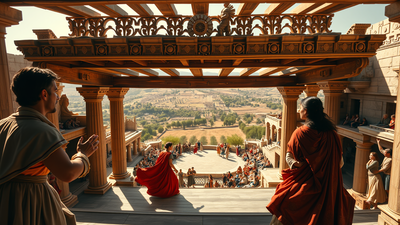
Long before modern theaters began using motorized stages and moving sets, ancient Greek theater builders seem to have solved the same problem by using wood, stone tracks, and simple wheels.
New research by a team from Kumamoto University in Japan has strengthened the argument that theaters from the Hellenistic period used large, movable wooden stage structures that could be rolled into place and then pulled away when the scene changed. These findings come from a detailed study of the ancient theater at Messene in Greece, where the stone grooves and storeroom beside the stage point strongly towards a theater system built for stepped structures rather than fixed, permanent scenes.
What researchers found in Messini Theater
The discovery began years ago during excavations at the ancient theater of Messene, where a research group from the Laboratory of the History of Western Architecture at Kumamoto University found a large storage room and three parallel rows of stones running alongside the theater. Similar stone rows have also been documented in ancient theaters in Sparta and Megalopolis, which has led some researchers to suspect the presence of wheeled theater elements at these sites.
According to the Kumamoto University research announcement, these newly documented stone rows and storage space at Messene are important physical evidence supporting the idea of the use of portable wooden stages in Hellenistic period theaters.
how Prosquinion and knife Maybe you moved separately
Two main structures make up the ancient theater setting, the Proscenion, a raised platform used as a backdrop where actors could also perform from its upper balconies, and the Skene, a taller building used as a dressing area and as an additional scenic backdrop.
Associate Professor Ryuichi Yoshitake, who led the research project, suggested that these two heavy structures did not share a single set of wheels as previous theories suggested.
Instead, based on the exact positions of the three stone rows discovered at the site, he said the Proscenion and the Skene most likely moved independently, each resting on its own pair of tracks, since moving both massive structures together along one common axis would have been extremely difficult in practice.
Why does transporting such heavy sets require real engineering
Moving these wooden stage buildings required great physical strength, and details of the stone grooves provide clues as to how ancient builders solved this challenge. Yoshitake explained that a great deal of force would have been needed to move heavy structures such as the proscenion and the knife, which helps explain why the tracks were built with such precision and consistency in width and depth.
Ancient literary sources also refer to revolving stage devices used in both Greek and Roman theatres, suggesting that this type of mechanical theatrical production was not an isolated invention but part of a broader tradition of solving practical display problems using wheels, tracks, and coordinated human effort.
A theater with over six centuries of use
The Messini Theater was not a secondary venue. For over six hundred years, it served as a center for both dramatic performances and major political gatherings, hosting notable figures from the ancient world including Philip V of Macedon and General Philopomenes of Megalopolis of the Achaean League.
Its role extended beyond entertainment, as it sometimes served as a public gathering space where major political events took place in front of large crowds.
This long and multi-layered history makes the material evidence discovered at the site particularly valuable, as the theater’s successive rebuilding phases required an efficient and reliable theater system capable of supporting centuries of continuous public use.
What happened to the theater after it stopped being used?
Like many ancient buildings, the Theater of Messene eventually fell into disuse and was left neglected for centuries. During the Byzantine era, many of its stone benches were removed and reused as building materials for local homes and religious structures, a common fate of abandoned ancient ruins throughout the region. It was only after nearly 1,700 years of neglect that the site was properly reopened to the public in the summer of 2013, allowing modern visitors and researchers alike to study its remains firsthand and revisit ancient theories about how its theater once functioned.
Why this research is important for understanding ancient theater
The Messini results provide a rare opportunity to test previous assumptions using precise physical measurements rather than guesswork. By comparing the size, spacing and depth of stone tracks found at Messene with similar features at Sparta and Megalopolis, researchers are building a clearer picture of how widespread this type of mobile grading technology was throughout the Hellenistic Greek world. Yoshitake and his team point out that more research is planned to better reconstruct the full appearance of these wooden wheeled stages and understand how this early projection technology influenced later developments in Roman theater architecture and later architecture, adding another layer of technical sophistication to how ancient audiences experienced live performance.