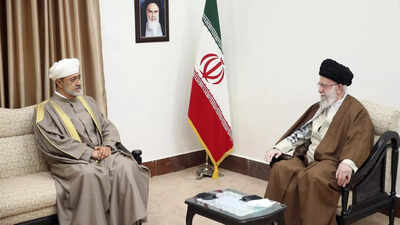
Archive photo: Iran’s Supreme Leader, Supreme Leader Ayatollah Ali Khamenei, right, with Sultan of Oman Haitham bin Tariq Al Said, in Tehran (Image source: PTI)
As the confrontation between Iran, Israel and the United States intensified, missiles lit up the Gulf sky. However, one country stood out as a non-target: Oman.Following coordinated US-Israeli strikes on Iran, explosions were reported in Tehran. US President Donald Trump said that the campaign aims to eliminate “imminent threats from the Iranian regime” and dismantle its nuclear program. Israeli Prime Minister Benjamin Netanyahu described the attack as removing an “existential threat.”
Assassination attempt on Khamenei: Bombs explode near the office of the Iranian Supreme Leader in Tehran | He watches
In response, Iran’s Islamic Revolutionary Guard Corps launched missiles at targets linked to the United States across the Gulf. As a result, Bahrain, Kuwait, Qatar and the United Arab Emirates were bombed, and explosions were heard in Riyadh.
Gulf bases under fire
Bahrain confirmed that the headquarters of the US Navy’s Fifth Fleet was targeted. Kuwait said that the Ali Al-Salem Air Base was attacked by ballistic missiles, although they were all intercepted. The Qatari Ministry of Defense said it “thwarted” several attacks, adding that the missiles were intercepted before they reached Qatari territory, Al Jazeera reported.In the United Arab Emirates, including near Abu Dhabi, one person was killed by shrapnel from an intercepted missile, according to official media reported by Al Jazeera.
Saudi Arabia said the attacks on Riyadh and the Eastern Province had been repelled, describing them as a “flagrant violation” of its sovereignty.All four countries temporarily closed their airspace.
Why was Oman not targeted?
Unlike Bahrain, Qatar, or the United Arab Emirates, Oman does not host a large permanent US combat base directly involved in offensive operations against Iran. While Washington has access to facilities like RAFO Masirah under defense agreements, they are largely considered rotational and logistics centers rather than offensive centers.Most importantly, Oman has long served as a diplomatic bridge between Tehran and Washington. Omani Foreign Minister Badr bin Hamad Al Busaidi recently met with US Vice President J.D. Vance before the escalation. It was central to the indirect talks between the United States and Iran held in Amman and Geneva.According to the Oman News Agency, Al Busaidi said that the nuclear discussions had achieved “major, important and unprecedented progress.” He had expressed optimism that peace was “within reach” and described Iran’s agreement not to store enriched uranium as a breakthrough. Hours later, US-Israeli strikes occurred, effectively collapsing the talks.
Military objectives versus mediation role
The Gulf Cooperation Council includes Bahrain, Kuwait, Oman, Qatar, Saudi Arabia, and the United Arab Emirates. Among them, Bahrain, Qatar, and the United Arab Emirates host major US military infrastructure. Iranian strikes appear to have focused on countries seen as directly facilitating US operations.Tehran’s calculations, as reflected in the pattern of attacks, targeted countries with a clear American combat presence. Oman’s neutral stance and continued mediation role are likely to protect it from retaliation.While Gulf capitals remain on high alert and missile exchanges continue, Oman stands as the only GCC country not hit by this round of escalation, currently maintaining a fragile diplomatic channel in an increasingly militarized region.