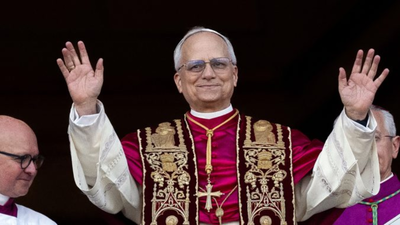
Pope Leo
“The document, which was presented at the Vatican alongside Christopher Olah, founder of Anthropology, highlights how the Catholic Church continues to use one of the oldest forms of communication to address modern social and moral challenges.An encyclical is a formal letter written by a pope, usually addressed to bishops around the world. These documents are used to provide authoritative teachings on important moral, social, or political issues.
Although it does not have the canonical status of a papal bull, Catholics are encouraged to use it as a guide in their daily lives.Although popes have written letters to the faithful since the early days of the church, Pope Benedict XIV, who led the church from 1740 to 1758, is credited with drafting the encyclical in the form it is recognized today.“According to the etymology, an encyclical (from the Greek egkyklios, kyklos meaning circle) is nothing more than a circular epistle.
In modern times the use has been confined almost exclusively to certain papal documents which differ in their artistic form from the ordinary style of bulls or summaries, and which in their writing are expressly addressed to the patriarchs, hierarchs, archbishops and bishops of the universal Church in communion with the Holy See.
As an exception, publications are sometimes addressed to archbishops and bishops in a particular country, according to the Catholic Encyclopedia.Leo XIV’s The Greatness of Humanity now joins a long line of influential encyclicals that have shaped debate within and outside the Catholic Church.
Five important publications
1. “Rerum Novarum” (1891) – about workers’ rightsRerum Novarum, which means “New Things,” issued by Pope LeoThe document defended workers’ rights, including the right to form unions and earn a living wage, while rejecting socialism and laissez-faire capitalism.
It also inspired the broader social justice movement within the church, according to the New York Times.It is also the encyclical that inspired the current Pope’s choice of name Leo XIV. The Pope officially signed the Magnifica Humanitas document on May 15, 2026, on the anniversary of the Rerum Novarum, although it was presented publicly 10 days later.2. “Peace in Earth” (1963) – about world peaceDuring the Cold War, Pope John XXIII wrote Pacem in Terris, which was addressed not only to Catholics but to all of humanity.The encyclical called for a ban on nuclear weapons and proposed the idea of creating a global public authority working for the “global common good”, with the United Nations as a first step.He also urged people to participate in public life “and work together for the benefit of the entire human race.”When it came out, The New York Times published the entire text.3. “Human Autobiography” (1968) – about birth controlPope Paul VI’s autobiography Human Life reaffirmed the Catholic Church’s opposition to artificial birth control.The document’s central teaching stated that every sexual act should remain free from intentional attempts to prevent pregnancy.The encyclical immediately sparked controversy among Catholics, a debate that continued for decades. According to a 2024 Pew Research Center poll, most Catholics in the United States and Latin America believe the church should allow artificial birth control.To help stop the spread of AIDS, many bishops later provided qualified support for teaching about condoms.4. “Love in Truth” (2009) – in economicsIn his book Caritas in Veritate or Charity in Truth, Pope Benedict XVI called for a fundamental rethinking of the global economy in the wake of widening economic inequality.The publication criticized the widening gap between the rich and the poor, urged ethical behavior in finance, and called on companies to assume greater social responsibility.As with Peace in Terris, it also called for the creation of a global political authority to help regulate the economy, according to the New York Times.Many scholars have praised the document for its reflections on love, truth, and justice, although critics have described it as difficult to read due to its dense language and broad themes.5. “Laudato Si’” (2015) – about the environmentPope Francis’ Laudato Si, which means “Praise be to You,” was the first papal encyclical to focus entirely on the environment.The document positioned caring for the planet as a moral and spiritual duty, not just a political, scientific or economic issue.
Francis also highlighted the links between climate change, poverty and social instability.The encyclical became influential in the global environmental movement, although Francis later lamented in the 2023 document that little progress had been made on environmental issues.In his Magnifica Humanitas, Leo
Do you think that artificial intelligence poses a threat to human dignity?