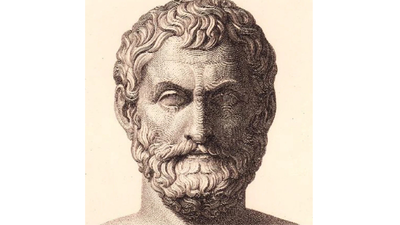
Hope has inspired humanity through wars, disasters, personal struggles, and moments of uncertainty for thousands of years. Long before modern psychology discovered the power of optimism, the ancient Greek philosopher Thales of Miletus was thinking of hope as one of life’s greatest strengths.
His famous words, “Hope is the one good common to all human beings; and those who have nothing else still have hope,” still resonate because they embody a universal truth. While wealth, power, and success are distributed unequally, hope remains within everyone’s reach, regardless of age, background, or circumstance. It is this enduring quality that has allowed the quote to survive for over two thousand years.Thales is remembered as one of the first thinkers to explain the natural world through observation and reason rather than mythology.
Although he is best known for his contributions to philosophy, mathematics, and astronomy, his reflections on human nature remain relevant to this day. His words remind us that even when people lose material possessions or face enormous challenges, hope can remain intact, encouraging resilience and faith that tomorrow can be better than today.
Quote of the day What Thales of Miletus meant when he said, “Hope is the only good common to all men…”
The quote expresses a simple but profound idea: Hope belongs to everyone.
Unlike money, influence, or opportunity, hope can only be possessed by a select few. It is an inner force that exists regardless of a person’s social status or circumstances.Thales suggests that even someone who has lost everything still has hope. It is often the last source of comfort during difficult times and the strength that motivates people to keep trying despite repeated setbacks. Rather than being wishful hope, hope represents confidence in the possibility of change.
It encourages perseverance, resilience, and the courage to keep moving forward when the future seems uncertain.
Who was Thales of Miletus?
Thales of Miletus lived between approximately 624 BC and 546 BC in the ancient Greek city of Miletus, located in present-day western Türkiye. He is widely regarded as the foremost philosopher in the Western tradition and the founder of the Milesian school of philosophy.Unlike early thinkers who explained natural events through myths and divine intervention, Thales sought logical explanations based on observation and reason.
His approach marked a turning point in intellectual history and laid the foundations of philosophy and scientific research in the Western world.
Why is Thales considered one of the greatest thinkers in history?
Thales is known not only for his philosophical ideas but also for his contributions to mathematics and astronomy. Ancient historians credit him with predicting the famous solar eclipse in 585 BC, one of the oldest recorded scientific predictions in history, although historians still debate how accurate this prediction was.He also suggested that water was the basic substance from which everything in nature originated. While modern science has moved beyond this theory, it represented one of the first attempts to explain the universe using rational thought rather than mythology. His desire to question accepted beliefs inspired generations of philosophers, including Socrates, Plato, and Aristotle.
Why does the quote remain relevant today?
The modern world presents its own challenges, from financial uncertainty and professional stress to personal losses and global crises.
In such situations, hope often becomes the emotional force that helps people cope and recover.Modern psychological research has consistently shown that optimistic individuals are more likely to remain motivated, solve problems effectively, and cope with adversity. Although Thales lived more than 2,500 years ago, his observations reflect what researchers are still finding today: that hope is closely linked to resilience and emotional well-being.
His words remind us that optimism is not just an emotion, but rather a mindset that helps people endure hardships.
Lessons we can learn from Thales’ quote
The quote offers many timeless lessons that apply just as much today as they did in ancient Greece.
- Hope belongs to everyone, regardless of wealth or status.
- Difficult circumstances do not determine a person’s future.
- Optimism encourages action rather than surrender.
- Inner strength can be more valuable than material success.
- Believing that tomorrow can get better helps people overcome today’s challenges.
These principles explain why Thales’ words continue to inspire readers across cultures and generations.
Thales’ enduring legacy
Although none of Thales’ original writings have survived, later philosophers such as Aristotle have preserved many of his ideas and attributed several sayings to him.
His influence extends beyond philosophy to mathematics, astronomy, and scientific thinking.Today, Thales is remembered as one of the pioneers who transformed human thinking by encouraging people to question, observe, and search for evidence rather than accepting myths without examination. His legacy continues to shape education, science, and philosophy around the world.More than 2,500 years after it was first attributed to Thales of Miletus, the saying “Hope is the one good common to all men; those who have nothing else still have hope” remains deeply relevant. It reminds us that although circumstances may change and fortunes may rise or fall, hope is something that cannot be taken away easily. Whether we are facing personal hardship or broader uncertainty, this timeless vision encourages us to believe in the possibility of a better future and to find strength in one of humanity’s most enduring qualities.