

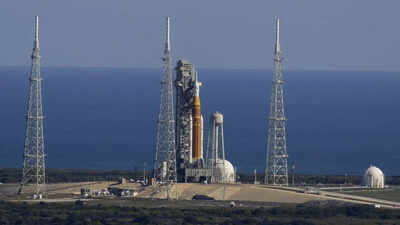
NASA’s Artemis 2 mission is the first to return humans to the region around the Moon in more than 50 years, and it took place on April 1, 2026. A Space Launch System (SLS) rocket launched the mission into orbit, but it was a small white stuffed animal designed by an 8-year-old that caught attention and became the “silent hero” of the mission.
The mascot, now floating aboard the Orion spacecraft, is an official zero-gravity indicator to let both the crew and Houston mission control know that the astronauts have reached zero gravity by visually identifying the system used in the weightless environment.NASA uses toys like this as visual cues to show the crew and controllers that there’s a lack of gravity (or they’re floating!) right away! Through this unique design, NASA hopes to connect young people around the world to the Artemis program and encourage a new generation (Generation Artemis) to succeed in their journey to the Moon and Mars by providing them with their own “silent hero” on the journey!
NASA’s Artemis II Moon Mission: The surprising story of a plush toy that stole the show
The selection of a white plush toy for Artemis II builds on a long-standing tradition in aviation, where small plush objects signify the transition into microgravity.
According to NASA, once the Orion spacecraft reaches the initial orbital insertion and translunar injection (TLI) phase, the toy will float, giving the crew (which consists of four people) a visual telemetry signal that they have passed through the strongest gravitational field on Earth.
The toy was selected through the “Moon Mascot” design challenge and will be an icon for the next generation of explorers. NASA’s STEM Engagement Office has found through research that involving children in designing mission hardware creates a lasting interest in developing future careers in space science and engineering.
Why does NASA trust plush toys instead of high-tech sensors?
Zero gravity indicators are oddly shaped functional optical measuring instruments that have been recorded in flight data by agencies such as NASA and the Canadian Space Agency (CSA). The crew will experience enormous gravitational forces during the eight minutes of intense liftoff of the Space Launch System (SLS) rocket that will strap the crew into their seats. The moment the plush toy drifts off the rope confirms the transition into a microgravity environment.Technical documentation from the International Space Station (ISS) National Laboratory states that the use of plush items is optimal because they will not conduct electricity, are extremely lightweight and therefore will not damage sensitive glass equipment or cockpit instruments inside the Orion capsule.
How the Amulet of Artemis II protects and inspires the crew
The moon mascot went through a lot of testing to ensure quality before being launched as an astronaut into space, and was conceptualized through the Global Youth Design Challenge.
NASA states that anything entering the Orion spacecraft must be made of specially designed materials that are rated for space applications and must meet specific requirements for flammability and outgassing within a closed, pressurized atmospheric environment.
This is done to ensure that it is safe for the astronauts to breathe while on board the Orion spacecraft and will not negatively impact the gaseous environment inside Orion during the entire flight of astronauts Reed Wiseman, Victor Glover, Christina Koch and Jeremy Hansen. The Smithsonian National Air and Space Museum states that these artifacts help create a historical record of space exploration, providing us with a connection to the technology/machinery that makes humanity’s extraterrestrial mission possible, as well as a tangible connection to the human experience on our home planet.