India on Saturday told Arab League member states that “zero-tolerance” for terrorism must be an “uncompromising universal ideal” as the two sides discussed priorities for the Gaza peace plan and ways to navigate the current geopolitical environment.
The dialogue focused on advancing the Gaza peace plan and strengthening cooperation among Arab countries. (PTI)These issues were identified at the second Indo-Arab foreign ministers’ meeting in New Delhi attended by the 19 member states of the Arab League, considered an influential group.
Before the start of the meeting, the participants, including several foreign ministers, met Prime Minister Narendra Modi.
Also Read | Jaishankar Gaza, Maritime Security Flag at Indo-Arab Summit; Warns against terrorism
“The Arab world is a part of India’s extended neighbourhood, connected by deep civilizational bonds, vibrant people-to-people connections and bonds of enduring brotherhood, as well as a shared commitment to peace, progress and stability,” Modi said.
More Read

“Increased cooperation in technology, energy, trade and innovation will unlock new opportunities and take the partnership to new heights,” he said on social media.
Also Read | Goldie Brar’s parents arrested in 2024 extortion case sent to 3-day remand
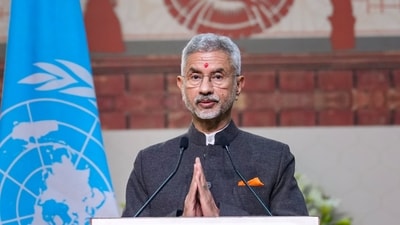
In his opening address at the Foreign Ministerial meeting, Jaishankar said that advancing a comprehensive peace plan to end the Gaza conflict, based on UN Security Council Resolution 2803, is a widely shared priority.
More Read

“Different countries have made policy declarations on peace planning, individually or collectively. This is the larger context in which we discuss the challenges and prospects of the region,” he said.
The foreign minister said there have been several developments in the Middle East over the past few years, each with significant results, and many of which have reflected well beyond the region.
Considering these multifaceted challenges, our common interests strengthen the forces of stability, peace and prosperity, he said.
In his remarks, Jaishankar expressed serious concern over the challenges posed by terrorism and called for concerted global efforts to combat it.
“A common threat in both our regions to these objectives is terrorism in all its forms and manifestations,” he said.
“International terrorism is particularly unacceptable because it violates the basic principles of international relations and diplomacy,” he said in comments seen as an apparent reference to Pakistan.
More Read
“Societies targeted by terrorism have a right to defend themselves and will understandably exercise it,” he said.
Jaishankar said it is a “global disease” that we must strengthen international cooperation to tackle.
“Zero-tolerance for terrorism must be an uncompromising universal ideal,” he said.
Jaishankar said India has strong partnerships with all Arab League members and the region has some of India’s largest diaspora communities, key energy sources, major trade ties and emerging technology and connectivity initiatives.
“We are very important to each other in terms of food security and health security. Today’s talks, though of a joint nature, will complement many bilateral relations,” he said.
Jaishankar said that India has developed many more capabilities and powers with time.
Also Read | Punjab train track blast, Khalistani link under lens after viral letter says ‘it was just a trailer’
“Many of these are technology-related and their application is people-centric. We believe it will be to our mutual benefit to share experiences and best practices in this regard,” he said.
In his speech, Jaishankar also referred to the current geopolitical environment and nowhere is this more evident than in the Middle East.
“We meet at a critical juncture when the global order is undergoing change for a number of reasons. Politics, economics, technology and demographics are all fully in play,” he said.
“Nowhere is this more evident than in West Asia or the Middle East, where the landscape itself has undergone dramatic changes in the past year.”
“This obviously affects all of us and India as a contiguous region. To a large extent, its implications are also relevant for India’s relations with Arab countries,” he said.
This story appeared from a wire agency feed without text changes.