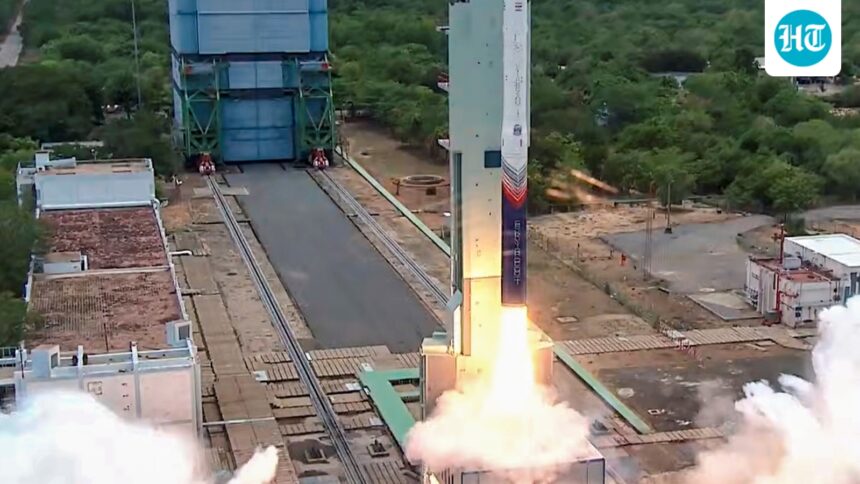
India became the third country, after the US and China, to have a private orbital launch capability on Saturday, as Skyroot Aerospace’s Vikram-1 rocket completed its maiden flight from the Satish Dhawan Space Center in Sriharikota, opening the door to commercial spaceflights from Indian soil.
The rocket, developed by a 400-strong team as part of the Agaman mission, lifted off at 12.05pm and injected four test payloads of the technology into a 450-kilometre-long, 60-degree orbit within 20 minutes. Designed to carry satellites weighing up to 350 kilograms into low Earth orbit, the seven-storey, multi-stage vehicle is built with an all-carbon composite hull and an internal propulsion system – including 3D-printed engines and solid-propellant high-thrust boosters.
Read also: India’s first private orbital launch succeeds as Vikram-1 launches into space | video
“We have achieved a global breakthrough from India,” said Pawan Kumar Chandana, CEO and co-founder, who founded the Hyderabad company with Naga Bharath Daka in 2018. The company’s value is estimated at more than 1.1 billion US dollars. “I thought it wouldn’t be possible,” he added. “A big shout out to the exceptional team whose average age is 28 years.”
Co-founder and Chief Operating Officer Dhaka said Vikram-1 achieved all mission milestones, verified propulsion, avionics, guidance and control systems under real operating conditions, and produced data that will benefit future missions.
Also Read: Who is Pawan Kumar Chandana, CEO of Skyroot, who is behind the historic Vikram-1 launch in India?
The first flight meets all mission objectives
Minutes before the scheduled 11:30 a.m. take-off, the countdown was suspended and rescheduled for 12:05 p.m. “There was a glitch at the beginning of the automatic launch sequence,” said Pawan Goenka, head of IN-SPACe, the government agency set up to empower private space companies. “It was minor and quickly rectified, then it restarted, and we had absolutely smooth sailing.”
He added that the mission exceeded its goal: “The goal was to launch and clear the tower, which is only about 100 meters high. But it traveled a distance of 450 kilometers, launched all the satellites, and all the goals were achieved.”
Also Read: Vikram-1: All about India’s first specially developed orbital rocket saying ‘hello’ to space
From startup to unicorn in space technology
The Vikram-1 mission was Skyroot’s second mission, after the Vikram-S suborbital flight on November 18, 2022, and is the first private rocket to reach space from Indian soil.
Chandana and Dhaka, Indian Institute of Technology graduates and former ISRO scientists, said the company started “when there was no policy, no funding and no talent in the private sector,” crediting government support and seeing the launch as proof that “India has the talent, technology and industrial strength to build launch vehicles that meet global standards.”
PM Modi hails achievement of private space
Prime Minister Narendra Modi, who sent a handwritten postcard with the name ‘Vande Mataram’ on board the rocket, later contacted the Skyroot team.
Referring to the doubts raised when his government opened up the space sector to the private sector, he said: “Many said this couldn’t happen…but I went ahead, and now thanks to you my decision has been proven right. Now my team will accept that we must trust the country’s youth to do this work – and you have done it.” He later posted on X that the launch was a “defining moment in India’s space journey” that would “encourage countless young people to dream bigger”.
Also read: Vikram-1 launch: PM Modi hails success of India’s first private rocket
India’s growing commercial space ambitions
The mission is important for the $600 billion global space industry, in which India’s $8 billion share is set to grow to $44 billion by 2032. India is home to more than 400 space startups since sector reforms in 2020; Skyroot became the country’s first space technology unicorn in May, after raising $60 million at a valuation of $1.1 billion.
Union Science and Technology Minister Jitendra Singh, who attended the launch, described the launch as a “solid vindication” of the decision to open up the space sector to private sector participation, adding that Vikram-1 carried live experimental payloads instead of the dummy blocks that many countries fly at the first launch, which is a sign of growing global confidence in India’s commercial launch capabilities.
Chandana told HT earlier this month that Vikram-1 was “100% designed in India, 100% manufactured in India”, and was built from scratch using hundreds of systems developed and tested to work together. “Building a rocket is the hardest work in engineering…that’s why it’s called rocket science.”
The four payloads were Solaras S3, from Bengaluru-based startup Grahaa Space; Embrace, a robotic arm to remove debris from Cosmoserve Space in Hyderabad; Domain, created by Skyroot; And a demo from German hardware manufacturer DCUBED.
Also on board the rocket were miniature golden sculptures of scientists CV Raman, Vikram Sarabhai and APJ Abdul Kalam, and artwork by Cosmos Diamonds.