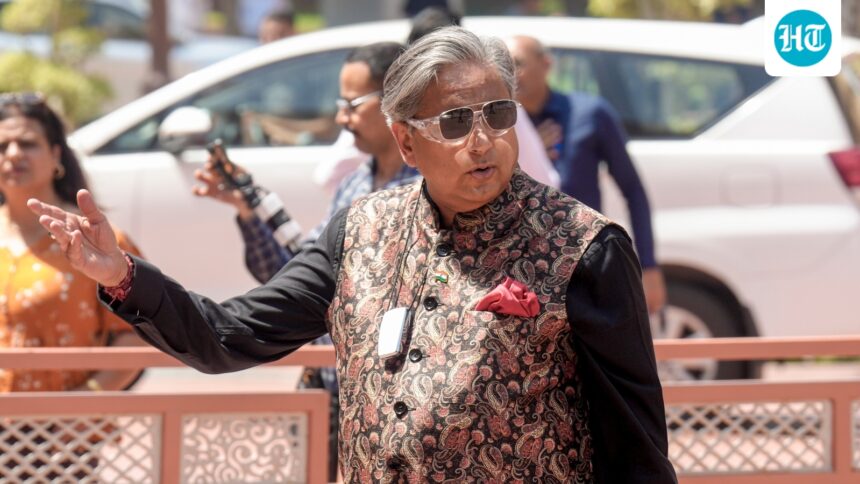
congress representative Shashi Tharoor compared the Special Intensive Review (SIR) process in Kerala and West Bengal, claiming that it was one of the reasons for the Bharatiya Janata Party’s (BJP) victory in the recent assembly elections in the eastern state.

While Tharoor admitted that The Congress may have made use of SIR for voters’ lists in Kerala, and the Thiruvananthapuram MP pointed out the large number of appeals in the West Bengal Assembly compared to “a few hundred” in the southern state. He also pointed out that only a small number of such cases were decided in West Bengal before the polls, leaving a vast majority unresolved at the time of voting.
“With regard to the SIR, what you said is a legitimate question to answer. Look at the Bengal case. 91,000 names were struck from the rolls. Of these, 34,000 living human beings appealed, saying that they existed and that they were legally entitled to vote. The rules required adjudication of each case individually, so only a few hundred were decided before voting. To this day, about 31,000 and 32,000 people have Bharat” during the Stanford India Conference: “It turns out that they were legitimate voters in the remaining years while the adjudication continues, but they missed their opportunity to vote.”
Draw attention to the size of the numbers, and note that The BJP’s margin of victory, of about 30,000 votes, closely matches the number of pending voter appeals, raising questions about whether eligible voters were actually unable to cast ballots.
“And the BJP won Bengal by a margin of 30,000 votes. Now tell me, is this completely fair and democratic? That’s the question I’m asking. Frankly, I have no problem deleting fake, deleted, absentee and migrant voters,” Tharoor said.
Moreover, Tharoor suspects that the removal of duplicate or multiple voter registrations in Kerala, where he claimed there have been instances of double, triple and even quadruple registrations in the past, may have worked to the Congress party’s advantage by cleaning up bloated voter rolls historically associated with rival political practices.
“Especially in Kerala, I think the Congress benefited from the deletions because the CPM had long been a master of dual registration, triple registration, quadruple registration – the same people in four different booths and so on. This was happening. And so they were excluded by the SIR, and as I said, in Kerala and Tamil Nadu, there were very few appeals. But in Bengal, there is no doubt that there were 34 lakh appeals. And that’s 34 lakh forms that were done,” he said. It was filled out by 34,000 people, and only a few hundred were heard.”
Assembly election results in Bengal and Kerala
The BJP and Congress achieved contrasting results in Bengal and Kerala. The saffron party registered a historic win in the 2026 West Bengal Assembly elections, winning 207 seats and ending the Trinamool Congress’ 15-year rule in the state. The Transitional Military Council won 80 seats in the elections.
It is possible that Congress will win only two seats in the 294-member House of Representatives. After the ruling, the BJP formed its government in West Bengal for the first time Suvendu Adhikari is leading the charge as Chief Minister.
In Kerala, the Congress-led United Democratic Front ended the Left’s decade-long rule, winning 102 of the 140 seats in the state assembly. The Left Democratic Front won 35 seats while the BJP managed to increase its seats to 3 while its vote share remained largely constant.