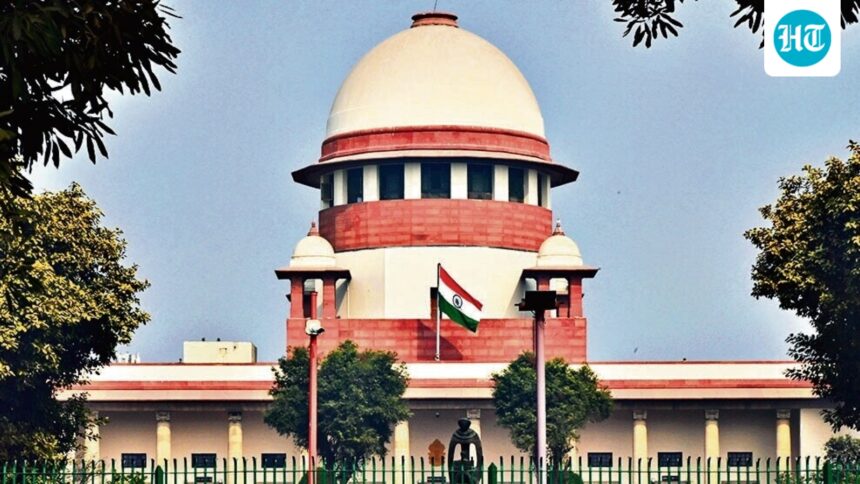
The Supreme Court on Tuesday observed that the Special Intensive Review (SIR) of electoral rolls went smoothly in all states except West Bengal, despite similar or more complex issues elsewhere.

Hearing a batch of petitions challenging the SIR in the state, Chief Justice of India Surya Kant and Justice Joymalia Bagchi said: “Except for the BI, it happened smoothly in every state. There were more complex, if not equally complex, cases, but there were almost no cases before the court. These were states like Gujarat where voter deletion was much higher.”
In Gujarat, 6.8 million voters were removed after the SIR, reducing the number of voters from over 50 million to 44 million.
Kalyan Banerjee, a senior advocate for West Bengal, said the Election Commission of India (ECI) has uniquely introduced the ‘logical inconsistency’ category in the state, putting around 13.6 million voters in the suspect list. He added that no other country had witnessed such measures, including the transfer of the First Secretary.
Given the volume of claims, the court adopted a “new approach”, asking the Chief Justice of the Calcutta High Court to assign the task of adjudication to judicial officials, including employees from neighboring states.
Ahead of the elections scheduled for April 23-29, the Mamata Banerjee government has urged the court to freeze the electoral rolls and allow candidates categorized under the “logical inconsistency” tag to contest.
Senior advocate Shyam Divan, representing the Prime Minister, said urgency was crucial as 14 candidates could not file nominations due to pending claims. He also stressed the need to finalize the lists at least a week before the polling date.
The authority said it would talk to the Chief Justice of the Calcutta High Court to determine the voting priorities of the constituencies in the first phase. She said: “If it is possible to divide the electoral districts and conduct the preliminary separation of the electoral districts that go to the polls in the first stage,” the matter will be postponed to April 1.
Dhamma Sisadari Naidu, representing the Election Commission of India, pointed to the “practical difficulties and shortcomings” in submitting the sealed envelope.
The court recognized the “burden” placed on judicial officials. “The bottom line of our initiative is that the fundamental right to participate in elections is protected. We have conveyed this burden to the Chief Justice of the Supreme Court.”
When Banerjee sought reasons for rejecting 2.7 million claims that have already been decided, the bench said: “You do not understand the kind of pressure these judicial officers are under. They have not taken even a single leave. It is not a question of apportioning blame, but after all this, do you think, they should also give reasons.”
Last month, the apex court had asked the Calcutta High Court to summon judicial officials from West Bengal, Jharkhand and Odisha, along with 250 serving and retired district judges, to adjudicate nearly 5 million claims and objections relating to voters who had been flagged for “logical inconsistency”.
These include cases of voters assigned to more than six offspring; Age gaps of less than 15 years with parents; Individuals over 45 were missing from the 2002 lists; Mismatch in fathers’ names between 2002 and 2005 lists; Age gaps of less than 40 years with grandparents; Age gaps of more than 50 years with parents; The gender does not match the 2002 records.
The court said the ruling will be based on 11 documents listed by the Election Commission of India, its September 8, 2025 order allowing Aadhaar as proof of identity, and its January 19 order allowing Madhyamik (Class 10) certificates and admit cards.