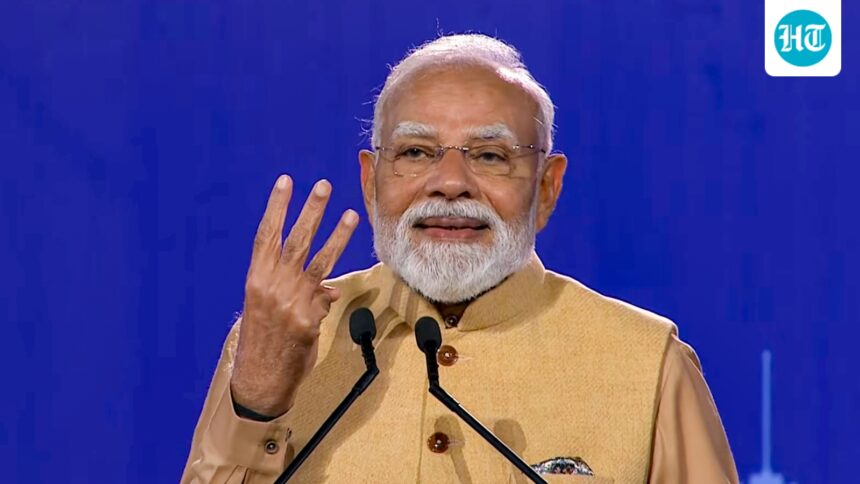
Prime Minister Narendra Modi on Thursday raised Operation Sindoor at a community event in Australia, saying a “demonstration” of India’s defense capabilities had been seen.

Speaking at a diaspora event with his Australian counterpart Anthony Albanese, Prime Minister Modi said the world is now witnessing the credibility of Indian defense platforms.
“The world is witnessing the capability and credibility of Indian defense platforms. You must have seen a demonstration of this during ‘Operation Sindoor’. The explosions were occurring in terrorist hideouts, but their echoes were heard across the world,” he said at the event held in Melbourne.
“Did this massive strike on terrorist hideouts fill you with pride or not?” asked Prime Minister Modi.
Prime Minister Modi said that over the course of his 12-year tenure so far, the ‘Make in India’ initiative has evolved into a ‘global brand’.
“Over the past 12 years, ‘Make in India’ has evolved into a global brand. Our mobile phones and electronics have reached markets across the world. Our cars and pharmaceutical products have expanded their global footprint,” he said.
Sindor process
Operation Sindoor was a rapid-fire, multi-domain military and diplomatic campaign carried out by India between 6 and 10 May 2025. It was launched in response to the terrorist attack in Pahalgam in Jammu and Kashmir about two weeks ago, in which a group of terrorists killed 26 innocent people, including 25 Indian nationals.
The initial strikes on May 7 strictly targeted terrorist training camps of groups such as Lashkar-e-Taiba and JeM in Pakistan, with the Indian Army saying it killed more than 100 terrorists in the strikes.
Following India’s targeted action, Pakistan responded from May 7 to 10 with coordinated drone, missile, and artillery strikes targeting more than a dozen Indian military installations and civilian areas. India deployed its integrated drone network and advanced ground-based air defenses (GBADs) – including the indigenous Akashteer system – to successfully intercept and neutralize hundreds of Pakistani drones and missiles.
In a calculated counter-reaction, the Indian Air Force carried out precise local strikes to dismantle identified Pakistani air defense systems and military airfields that had enabled the aggression.
India targeted 11 Pakistani air bases, including intense strategic strikes on the Noor Khan and Rahimir Khan air bases. The Israeli Air Force bypassed and jammed the Pakistani air defenses provided by China, and completed its operations in only 23 minutes using Rafale aircraft.
Pakistan agreed to cease hostilities on 10 May 2025 after severe damage to its air infrastructure. A ceasefire understanding was announced that evening.