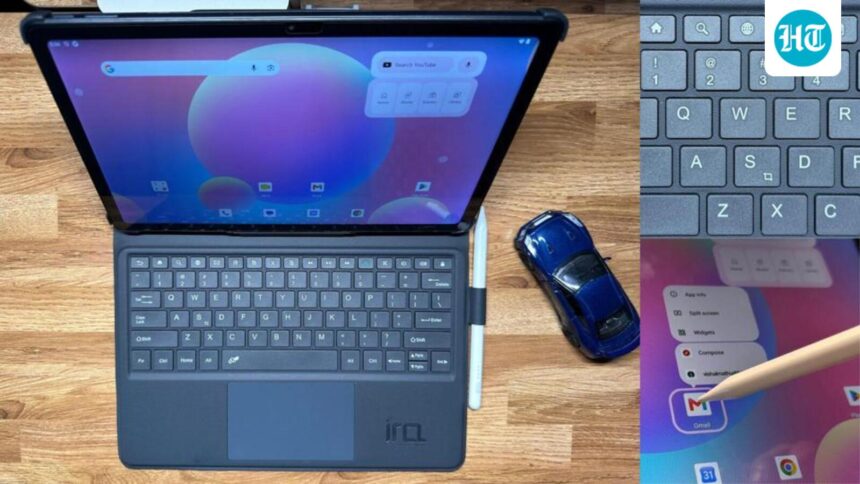
Not exactly a name that would be on your shortlist for a planned splurge on Android convertibles, but there’s more appeal to Indian tech company Wishtel than many realize. It has been around since 2012, has bagged contract manufacturing for the government’s ambitious Aakash project for affordable tablets, launched its own low-cost IRA tablets which have been around for over a decade, has developed educational solutions like Vidya AI, has solutions for the financial as well as healthcare sectors, and has a wide range of affordable convertible computing devices that run Microsoft’s Windows operating system as well as Google’s Android as well. They have been pushing for Digital India, ever since it became policy.

The reason for this jog in Wishtel’s historical timeline is that the company has expanded its already fairly extensive tablet portfolio, with something that might once again be relevant to that crossover between educational use, a group computing device at home, and a modest secondary computing device on the go for a younger audience. The price of Wishtel IRA Duo Pro 5G is $31,096 with pen and keyboard set at an additional price $6,999.
Of course, the OnePlus Pad 2 (this $36,999; and Wi-Fi only with mobile data (requiring a phone) will appear in the same conversation — although both will require purchasing a keyboard or stylus as separate accessories. OnePlus will charge you an additional fee $8499 for that. It’s rare to find good Samsung tablets with an official keyboard accessory at these price points. There is also the Xiaomi Redmi Pad 2 Pro 5G $28,999 with keyboard accessory included $3,499. The themes are that you’ll get more performance than some competitors, but particularly for the education and enterprise verticals that Wishtel wants to attract, the alternatives may not work due to a variety of factors – custom software, pre-loaded apps, repairability, and security concerns that IT teams often have.
That’s great value, too, because you’d hardly believe everything that’s casually bundled with the tablet — a keyboard case (with a fairly wide touchpad), an 18W charger, a power cable, a stylus pen, and an OTG cable for connecting peripherals like a printer or external storage. Speaking of which, there’s a memory card slot on the tablet, which I’ll get to in a moment. This is a rare tablet with two USB-C ports, one of which is capable of outputting to an external display. 5G connectivity is a real value addition, and Wishtel has kept it simple with a physical SIM slot. There is no eSIM option here.
Speaking of which, the 12-inch display has a resolution of 2000 x 1200 pixels and a refresh rate of up to 90Hz. This is a regular LCD screen at a time when most tablets adapt different types of LED display technology – the reason for this is that Wishtel uses the so-called in-cell display. Unlike traditional displays that need 3 or 4 distinct layers of touch sensors and display pixels that can make these panels thicker, the in-cell methodology integrates more than one function into a layer. There are only two layers, which means there is a relative advantage of not only freeing up space inside, but the visuals you see are much sharper.
These displays are designed using LCD backlighting, which means there is a trade-off in terms of deep blacks and overall contrast. I’m sure the demographic considering the IRA Duo Pro 5G won’t point to that as a major drawback, because this is a very bright and responsive screen (actually more so than tablets made by some brands with better recall value). This may not be the best for watching movies, but it’s more usable outdoors in bright sunlight as well as indoors with the typically harsh office floor lighting.
Wishtel has unlocked split-screen multitasking on its 12-inch display, in a clean, mostly untouched Android operating system. This is the strongest point of the IRA Duo Pro 5G. It simply works for the masses, who don’t always have a checklist of needing the latest hardware or higher specs.
Although this tablet will only do a certain amount of heavy lifting in terms of multitasking, and 8GB of memory is mostly sufficient, Wishtel is clearly trying to balance the books with a Unisoc T760 chip that doesn’t really keep up with Qualcomm and MediaTek silicon if you want to push the performance envelope. There’s a reason Wishtel is using a slightly more powerful chip here. For perspective, the OnePlus Pad 2 is based on Qualcomm’s 8 Gen 3 platform, while Xiaomi built the Redmi Pad 2 Pro 5G around the Snapdragon 7s Gen 4 chipset.
Using a Wishtel with a 10,000mAh battery capacity is great news, as it shows very strong endurance, and you’re looking at days of use before this needs to be plugged in for a charge.
There might be some concern about the 128GB of internal storage, which will start to fill up after a while no matter how diligent you are with your spring cleaning. There is SD card support to expand this up to 1TB, which is no inconvenience although it is an extra step to go through in the end.
There’s a distinct lack of this improvement in places when compared to everything Samsung, Xiaomi, or OnePlus has to offer in the tablet space. Out of the box, audio levels are quite loud (and trust Android to send the inevitable notification when you least expect it). This is still running Android 14 and despite giving it days to find its groove, no update has arrived to Android 15 – Google Play’s June 2026 system update. Although Wishtel says the IRA Duo Pro 5G will also get Android 16 and Android 17 updates.
Can I also point out the somewhat unique placement of the USB-C ports, which if you hold the IRA Duo Pro 5G in portrait orientation, will be at the top. The one that will charge the tablet is clearly marked as such, while the other will be useful for connecting peripherals or an external monitor. When docked to the keyboard case and in landscape orientation, both ports are located on the left side of the spine. Most tablets have this on the right side. Nice change.
A big positive for long-term ownership and repairability (and this is often overlooked by individuals) is that Wishtel has been incorporated into the government’s Right to Repair initiative, which mandates that manufacturers share product manuals, schematics, and replacement parts with consumers and third-party repairers. The idea is to not only provide protection to consumers in terms of repair as an option, but also reduce e-waste and create opportunities for repair shops to be able to offer what a service center may be able to offer exclusively.
Wishtel has undoubtedly delivered on the aspects that matter most, the ones that users interact with most often. For example, the keyboard case, despite the long mechanism to support it at the back, has an excellent touchpad. Plus perfect spacing between each key and precise typing response, which is great for long documents or if you’re patiently navigating between spreadsheet cells. Strong battery life, a very usable screen, and the simplicity of the overall package make this a rather interesting option.
It may not be the slickest tablet one can buy, but I have a feeling that educational institutions and companies that need tablets for their field workforce will appreciate what Wishtel has provided with the IRA Duo Pro 5G. A focused approach, focusing on the list of materials, simply works.
(Vishal Mathur is technology editor at Hindustan Times. When he’s not understanding technology, he’s often searching for an elusive analog space in a digital world.)