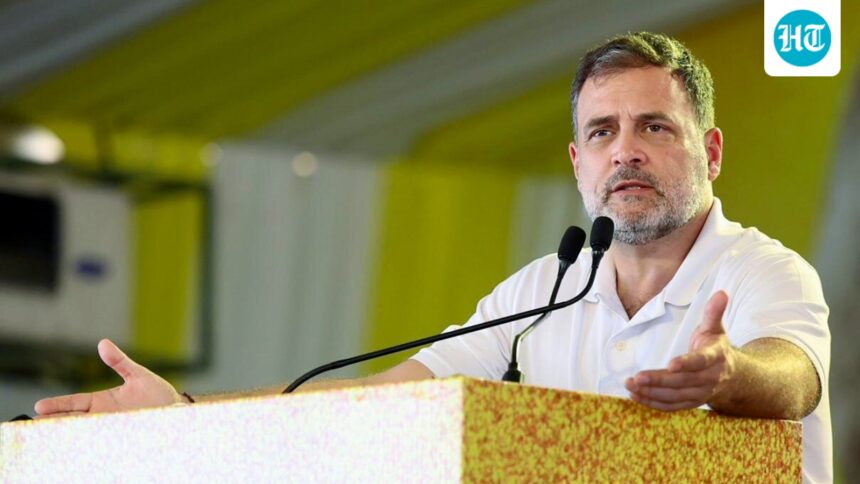
Rahul Gandhi said that as the conflict in the Middle East continues, oil prices are expected to rise, which will lead to inflation and a slowdown in the growth rate.

Congress leader Rahul Gandhi on Friday said that although the conflict in the Middle East appears to be between the US, Israel and Iran, the real players are the US, China and Russia, even as he tried to draw an analogy of a “great power struggle” in a multipolar world.

Speaking at an event in Idukki, Kerala, the opposition leader raised concerns about India’s energy security due to tensions in the Middle East, which have already disrupted energy supplies from the region after a week of fighting.
Follow the latest updates on the Iranian-American conflict
Gandhi told the audience, “On the surface, it looks like a war between America, Israel and Iran. It is actually a conflict between America, China and Russia. The conflict is taking place in Iran, Ukraine and other places. But the big conflict is that we have a superpower called the United States and we have a competitor called China.”
Rahul Gandhi’s statements come despite the ongoing war between Iran and the US-Israeli alliance since February 28. While more than 1,000 people have been killed in Iran, missile and drone strikes from Tehran have targeted US bases and energy infrastructure in Middle Eastern countries, including the United Arab Emirates, Saudi Arabia, Qatar, Bahrain and Oman.
The Strait of Hormuz, a major sea route connecting Middle Eastern oil and gas suppliers to the world, remains close as Iran threatens to attack ships crossing the narrow channel.
Rahul Gandhi said, “The Middle East is the center of energy production in the world. A large portion of energy comes from the Middle East… The case of Hormuz is closed. The Americans are attacking Iran. The Iranians are attacking American assets.”
Read also: “Abdication of responsibilities”: Congress criticizes the government for “silence” about the sinking of the Iranian ship IRIS Dena in Sri Lankan waters
The war between Iran and the United States has great risks for India
Speaking about the clash between the superpowers, of which the Middle East or Ukraine remains their home, Rahul Gandhi said that the ongoing conflicts have a direct impact on India.
He believed that oil prices are expected to rise with a decrease in supply from the Middle East, which in turn will lead to inflation and a slowdown in the growth rate.
He said: “Our energy dependence is on the Middle East. A large part of the oil comes from the Middle East. Prices in India will rise. Fuel in India will become more expensive. Economic growth in India will slow down. So we have to be very careful about what we do.”
He also warned that India needs to be “very clear” about its policy positions.
He added, “We have to be very clear about our political positions… because if we don’t do that and we fall into fighting, we will face a serious problem. China is on our borders and America is our ally. They are preparing to fight. So we have to be very careful where we stand.”

Majid Alam is a senior content producer at the New Delhi-based Hindustan Times. He currently heads the online office shifts and manages the home page apart from writing, editing and organizing articles. Majed has more than six years of experience in the field of journalism, and has navigated national, political and international news. His work focuses primarily on Indian heartland politics, government policy, and South Asia. He also writes about US and European policies towards India. Before joining Hindustan Times, Majid worked at ABP LIVE as Chief Copy Editor and at News18, where he ran the World and Explainers divisions. His articles have appeared in Dialogue Earth, The Quint, BMJ, The Diplomat and Outlook India. Majid has a keen interest in using data to tell stories. Majid holds a master’s degree in convergent journalism from Jamia Millia Islamia. He was awarded an Erasmus+ scholarship to study International Affairs at Sciences Po in Paris in 2020. He is also part of OCEANS, the Erasmus+ researcher exchange alumni network. He currently holds the position of National Representative (India) in OCEANS Network. Aside from journalism, Majed has a talent for academic writing and loves teaching. He has published a chapter from the book: “Bombay Cinema and Postmodernism” in the book: “A Handbook of Research on Social and Cultural Dynamics in Indian Cinema”. He was also part of the OCEANS network delegation to Hanoi National University of Education, Vietnam in 2025. He also gave a guest lecture on digital journalism at AJK MCRC, Jamia Millia Islamia.Read more