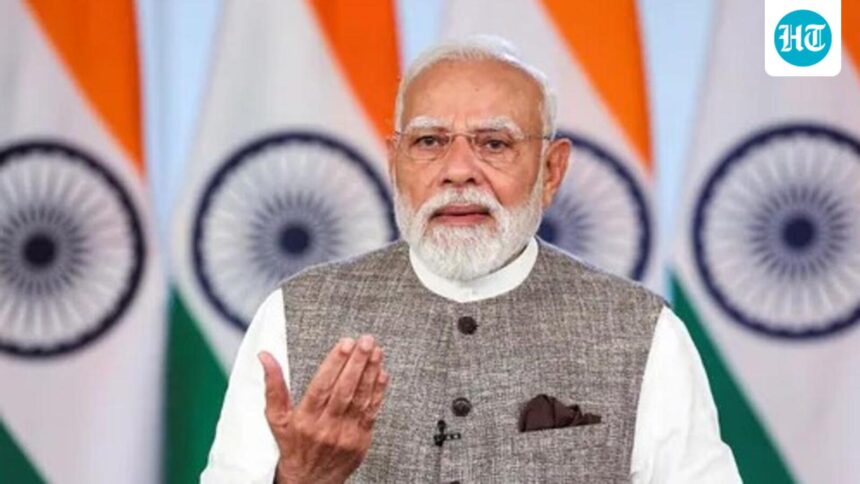
Prime Minister Narendra Modi, in his 133rd Mann Ki Baat address on Sunday, highlighted ongoing conservation efforts to protect the endangered Great Indian Bustard (GIB), saying ongoing scientific interventions and ground-based actions have helped conserve the species.

Describing the bird as a “distinctive feature” of the desert, Prime Minister Modi said: “At some point, it was… [Great Indian Bustards] The numbers have dwindled considerably. The situation was such that this bird was on the verge of extinction.
However, with the help of scientific methods, including artificial insemination technology and setting up dedicated breeding centers at Ramdevra and Sudashree in Rajasthan’s Jaisalmer district, he said the species is now recovering.
“When we understand nature, respect it and live in harmony with it, positive changes are bound to happen,” he said.
GIB, one of the heaviest flying birds, is the state bird of Rajasthan. It is also one of the rarest species in the world and is still threatened with extinction.
Once widely distributed throughout the Indian subcontinent, its population has now declined to less than 200 individuals, with a majority in Rajasthan and Gujarat, and smaller numbers in Maharashtra, Karnataka and Andhra Pradesh.
This species is listed in Schedule I of the Indian Wildlife (Protection) Act, 1972, IUCN. [The International Union for Conservation of Nature]Red List, in the CMS Convention and in Appendix I of CITES.
Read also:Conservation milestones for the Great Indian Houbara: 3 births in one day, 4 in a week
The Houbara Recovery Programme, launched in 2016, is a joint initiative between the Government of Rajasthan, the Ministry of Environment, Forest and Climate Change and the Abu Dhabi-based International Fund for Houbara Conservation. It focuses on captive breeding and creating a sustainable environment for the future release of captive-born GIB into the wild
In 2022, the Jaisalmer Breeding Center collected 30 eggs from the wild, six of which were damaged. 24 chicks were successfully hatched from the eggs, and two of them died. By April 2023, 13 more eggs had hatched through artificial incubation.
The Desert National Park spread across Jaisalmer and Barmer districts has also shown signs of recovery from the GIB. The species began to reproduce naturally.
According to the information available until the second week of this April, 11 chicks were registered this season, including 3 chicks born through natural mating.
Officials say this represents a major milestone in the ongoing conservation program and provides hope for the species’ long-term survival.