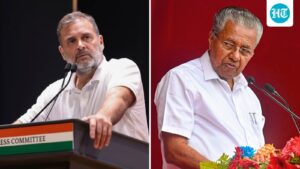
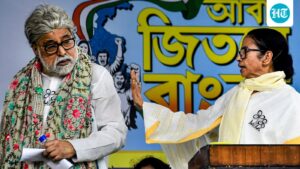
A day after the BJP government’s Constitution (131st Amendment) Bill failed in Parliament – as it sought to speed up the implementation of a 33% women’s quota in legislative assemblies – Tamil Nadu’s ruling DMK proposed a special members’ bill instead, separating reservation from any change in the overall number and boundaries of constituencies.
The DMK bill proposed implementing 33% reservation for the next elections, on the existing 543 Lok Sabha seats, without any increase in seats, delimitation, or new or old census data.
The bill, introduced by DMK MP Wilson, is the most direct legislative response by any opposition party so far to the BJP’s charge that rival parties have blocked reservations for women altogether.
But the sessions of both chambers were postponed indefinitely on Friday, so the bill cannot be discussed at the moment.
Boundary demarcation question
The women’s quota was originally passed with almost all party support in 2023; Opposition leaders pointed out that the question now revolves around a “hasty” demarcation proposal based on old 2011 census data, without addressing larger issues related to the regional distribution of seats and sub-caste quotas.
The DMK Bill has proposed amending the Constitution to make women’s reservation 2023 effective immediately.
This will be in the Lok Sabha, the state assemblies, and the union territory assemblies of Delhi, Puducherry and Jammu and Kashmir, without increasing the total number of seats and without waiting for a census or demarcation of boundaries.
Unlike the government’s Nari Shakti Vandhan Adhinyam Bill, 2023, which capped reservation at 15 years, the DMK bill also seeks to make reservation permanent.
The DMK has served notice to the Speaker of the Rajya Sabha under Rule 267, seeking suspension of the day’s work to facilitate immediate discussion on reservation of women without demarcation or census.
On April 17, the Central government’s Constitution Amendment Bill led by Prime Minister Narendra Modi on women’s quota failed in the Lok Sabha — with votes standing at 298-230 in favor of the government, but not the required two-thirds majority — as the Opposition, including the DMK, argued against linking quotas to increases and redrawing seats, that too on old data.
What does counteroffer mean?
The DMK’s move intensifies the political standoff that has defined the three-day special session.
The government has introduced three bills combining the women’s reservation amendment with a comprehensive delimitation process based on the 2011 census and expanding the House of Representatives to 816 seats at present, with a maximum of 850 seats as per the bills.
After the opposition voted against these resolutions, the BJP’s response was to accuse the Congress, TMC, DMK and Samajwadi Party of betraying 700 million women.
The TMC and DMK are regional parties, in West Bengal and Tamil Nadu respectively, and are contesting the BJP in the elections this month.
Throughout the session, opposition leaders argued that reservation in the existing 543 seats could be implemented without any of the disputed provisions.
Congress MP KC Venugopal said in Lok Sabha, “You (the government) have set a condition that a census will be conducted, followed by delimitation, and then reservation will happen. We never said that.”
Opposition leader Rahul Gandhi said the opposition would support the original Women’s Bill, 2023 “100%” if the government returns it without a demarcation link.
The government is yet to respond to the DMK bill. I have argued in the past that expanding the entire House of Representatives would protect the interests of current political leaders while also creating more room for women.
A Union Cabinet meeting chaired by Prime Minister Modi is also scheduled to be held on Saturday.
Why DMK, the bigger issues
But there are also larger questions about the demarcation of the border, which in any case is constitutionally required to follow any modern census after 2026.
These questions revolve around whether population alone can form the basis for redrawing the electoral map. This could “punish” the southern states because they have managed to control their populations, while the north, where the BJP is stronger, has not. This has been the DMK’s contention for years now.
Read also | Why is the women’s quota not implemented in the current House of Representatives, which consists of 543? What Oppn, the government, and why said remains an OBC question
There is also the issue of possible reservations on OBCs once caste data becomes available as part of the ongoing census scheduled to be completed within two years.