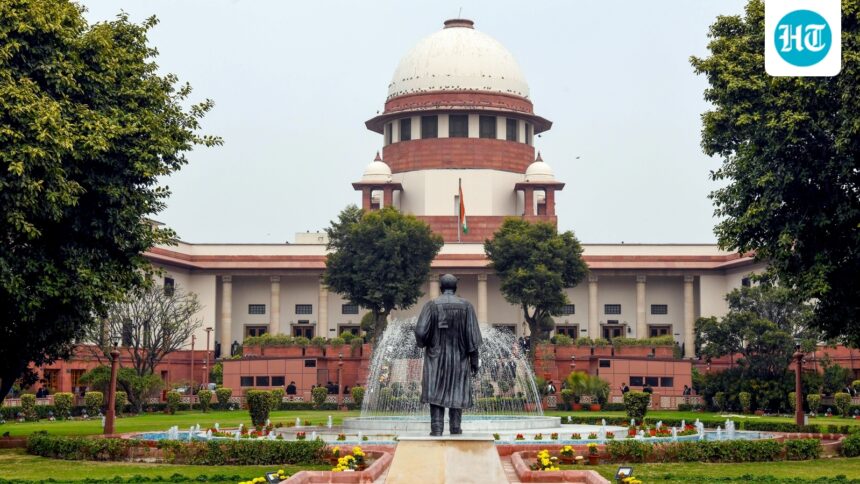
The Supreme Court has taken strong objection to a section on “corruption in the judiciary” in the new Class 8 social science textbook issued by the National Council of Educational Research and Training (NCERT), terming it a “deep-rooted” and “calculated” insult to the institution.

Despite NCERT’s apology, the court on Wednesday ordered the confiscation of all copies, including those already sold, and issued show-cause notices to senior board officials, warning that any attempt to distribute the material would amount to contempt. Here’s a detailed timeline of how the controversy escalated.
1. When SC automatically took notice
Chief Justice of India (CJI) Surya Kant on Wednesday informed the Bar Association that the Supreme Court has taken suo motu cognizance of a new section in the Class 8 social science textbook by NCERT discussing “corruption in the judiciary”.
“I will not allow anyone on earth to defame the institution. No matter how high it is, no one is above the law. Don’t worry… I know how to handle it,” the CJI said. The comments came in open court after senior advocates urged intervention.
Senior advocate Kapil Sibal told the bench, which also included Justice Joymalia Bagchi, that the Bar Association was “deeply disturbed”. “Children in Class VIII are taught about ‘Corruption in Judiciary’. It is part of the NCERT syllabus and in their textbook,” Sibal said.
CJI Surya Kant responded that he was aware of the matter. “I am fully aware of the matter,” he said. “I can assure you… that it certainly concerns the entire institution. All the stakeholders, and the judges in the high courts, are equally disturbed and have informed me about it.”
He added that he had “already issued the order from the administrative side” and that the court would take up the matter on its own.
2. Controversial content of the textbook
The dispute centers around a recently released eighth-grade social science textbook titled Exploring Society: India and Beyond. A chapter entitled “The Role of the Judiciary in Our Society” lists “corruption at various levels of the judiciary” and a huge backlog of cases, some 81,000 cases in the Supreme Court, more than 6.2 million cases in the superior courts, and some 47 million cases in the district courts.
As previously reported by HT, the chapter also refers to the Code of Conduct for Judges, internal accountability mechanisms, and complaints received via the Central Public Grievance Redressal and Monitoring System (CPGRAMS) – noting more than 1,600 complaints between 2017 and 2021.
A similar chapter in the previous edition, particularly based on the 2005 National Curriculum Framework, discussed delay and judicial structure but did not explicitly address corruption.
The review came at a time when NCERT is reviewing textbooks in line with the National Education Policy 2020 and the new National Curriculum Framework for School Education.
3. Control and notification of the reason
On Thursday, the Supreme Court ordered the immediate confiscation of physical copies and removal of digital copies of the controversial textbook.
It issued show-cause notices to the director of NCERT and the secretary of the school education department, questioning why criminal contempt proceedings were not initiated.
Despite Attorney General Tushar Mehta’s apology and NCERT’s earlier statement expressing regret, the bench, also comprising Justices Joymalia Bagchi and Vipul M Pancholi, said the response lacked remorse and appeared to justify the contents.
“We have seen the NCERT notice, and there is not a simple word of apology in it. The way this director has framed this notice, there does not seem to be remorse but justification… It appears to be a deep-rooted conspiracy,” the bench observed.
The court considered the government’s claim that the two people involved in preparing this chapter would no longer be associated with the ministry “a very light measure.”
4. NCERT apology and recovery attempt
After taking notice of the Supreme Court, NCERT issued an apology, admitting “inappropriate textual material and error in judgement”, and withdrew the book from distribution.
The Council affirmed that it “holds the judiciary in the highest regard and considers it the guardian of the Indian Constitution and the protector of fundamental rights.”
According to ANI, NCERT is trying to recover 38 copies of the textbook that were sold. Out of the 2.25 lakh copies printed, only 38 copies were sold while the remaining 2,24,962 were in stock and called to the NCERT warehouse.
5. The work of the Supreme Court
The court directed NCERT, in coordination with Union and state education departments, to ensure that all physical and digital copies of the book are removed from public access. A complete ban has been imposed on production and distribution, with any attempt to distribute the book constituting a deliberate breach of the system.
NCERT has been directed to effect seizure of all distributed copies and submit a compliance report.
Chief Education Secretaries of all states have been directed to ensure that no instructions are transmitted using the book and to report compliance within two weeks.
The principal was also asked to submit the names and credentials of the members of the National Curriculum Council who drafted the chapter and the original minutes of the deliberations. A hearing in the case is scheduled for next month.