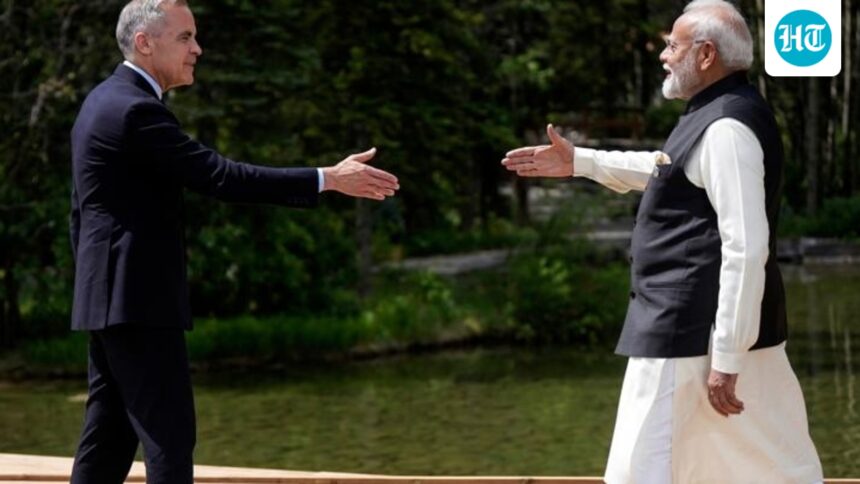
India and Canada have had a strategic partnership for more than a decade, a position that has remained largely on paper rather than in practice. This strategic partnership has now been officially recognized by the Canadian government. However, adding a defense dimension to Canadian Prime Minister Mark Carney’s visit to India would revive efforts to make this a reality.

Carney is accompanied by four ministers: Foreign Minister Anita Anand, Finance and National Revenue Minister François-Philippe Champagne, International Trade Minister Maninder Sidhu, and National Defense Minister David McGuinty, whose presence indicates the direction in which the relationship may be moving.
“Canada and India have a strategic partnership that already exists,” said Veena Nadjibula, vice-president of research and strategy at the Canadian Asia-Pacific Foundation. “Of course, a lot has changed since then. The relationship has had its ups and downs. So it’s about reviving that, but also setting a more ambitious agenda.”
The strategic partnership began when Prime Minister Narendra Modi visited Canada in April 2015. “The two prime ministers agreed to elevate their bilateral relations into a strategic partnership,” the joint statement issued with then Canadian Prime Minister Stephen Harper said.
The foreign and defense ministers of the two countries later participated in the 2+2 dialogue to take the partnership forward, and it was officially confirmed in 2018.
But little progress has been made in the defense sector, which could change when Canada unveils its first defense industrial strategy earlier this month. This strategy has also been integrated into Canada’s international trade framework. With negotiations on the Comprehensive Economic Partnership Agreement, or CEPA, expected during Carney’s visit, the defense sector could be an important component.
“We can expect agreements on artificial intelligence, uranium supplies, critical minerals and defence,” said Ajay Bisaria, former Indian high commissioner in Ottawa.
“Canada is committed to spending five per cent of its GDP on defence, making it an important global defense player. It has a strong defense production sector, including powerful aviation technology, sonar, icebreaking and low-temperature technology. India can benefit from cooperation in these sectors,” he added.
India’s current High Commissioner in Ottawa Dinesh Patnaik recently told the Hindustan Times that “defense will be an important aspect that we look forward to.”
“In the entire defense chain, from strategic production to defense production to equipment, etc., we are looking at what we can do together,” he said. This will extend to aerospace and cybersecurity.
Of course, security will also include hedging against the United States and the unpredictable tariff regime that President Donald Trump is imposing on India and Canada, with the latter preparing to renegotiate a free trade agreement between Canada, the United States and Mexico later this year.
“The Canadian government is putting a lot of effort into trying to create confidence that there is a new system in the city. India will have to be involved in that process, of course,” said Julie Hyder, president and CEO of the Business Council of Canada.
“We can expect a political statement that implicitly insulates the relationship from shocks against security issues, moves to a phase of constructive rebuilding and emphasizes solidarity between the middle powers. Both countries have similar interests in de-risking the turbulent United States,” Besaria noted.
More importantly, this will be Carney’s first visit abroad since his speech in Davos about the “rupture” of the rules-based global order. In that speech at the World Economic Forum, which received a lot of global attention, Carney said this represented “the beginning of a brutal reality where geopolitics between the great powers is unconstrained.”
He stressed that the middle powers are not powerless, but rather have “the ability to build a new system” that embodies their values.
Notably, Carney’s visit to the Asia-Pacific region includes stops in India, Australia and Japan, thus covering every Quad member except the United States.
“So there could be areas for exploration here, both on the industrial side, but also more generally, a strategic conversation on maritime security as well as the changing security dynamic in the Indo-Pacific region. Canada has a strategy in the Indo-Pacific region. India has been identified in that strategy as an important partner. Canada has developed discussions on maritime security, maritime domain awareness with other partners in the region, and it will be interesting to see to what extent those discussions can continue with India now that we have reached this new moment,” Nadjibula said.
Of course, the main message from the visit will be that the reset of relations turns into renewal. Relations deteriorated on September 18, 2023, when Prime Minister Justin Trudeau stated in the House of Commons that there were “credible allegations” of a possible link between Indian agents and the killing of pro-Khalistan figure Hardeep Singh Nigar in Surrey, British Columbia, three months earlier. India rejected these accusations, describing them as “ridiculous” and “motivated.”
Things changed when Carney replaced Trudeau as prime minister in March of last year. The reset took place when Modi called a G7 leaders’ summit in Kananaskis in June 2025, where they agreed to reinstate high commissioners in the two capitals. They met again on the sidelines of the G20 Leaders Summit in Johannesburg in November and agreed to launch new negotiations on EPA and EPA. When they meet in India, it will be the third bilateral meeting in less than ten months.
Najibullah felt that “the relationship is moving from mere crisis management and focusing on resetting things step by step to a desire to expand and advance the partnership.”
Besaria agrees: “Both sides appear determined to rebuild a stronger relationship than the one that existed in the past decade, and fulfill the promise of the strategic partnership announced in 2015.”
Since the relationship envisaged is wide-ranging, defense will be an important element but will depend on the level of trust between the two governments. “From my point of view, what is important is that this has been on the agenda, and that the Defense Minister will travel. It is the beginning of the conversation, and it will take some time,” Nadjibula said, even as her organization scheduled a Track 1.5 discussion on defense industrial cooperation in New Delhi next month, shortly after Carney leaves India.