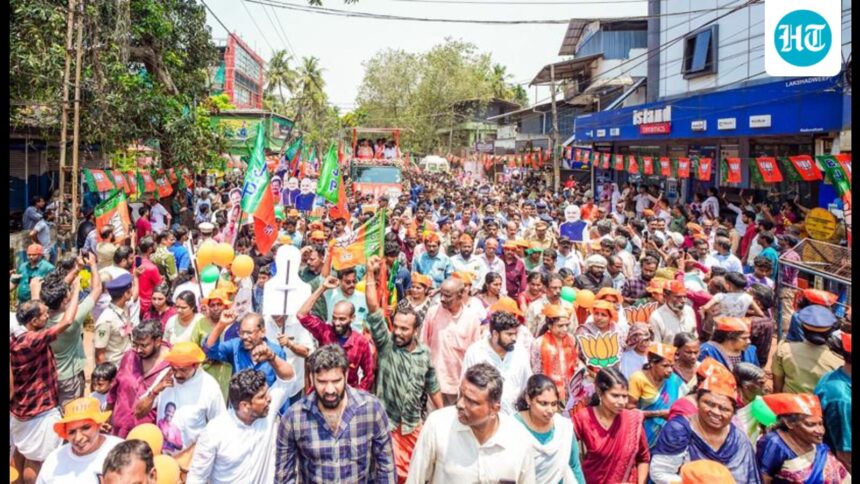
Congress leader Rahul Gandhi has created a stir in the poll-bound state of Kerala by nominating a woman as chief minister. Addressing a rally ahead of the April 9 legislative assembly elections, Gandhi said he looked forward to the day when the state, which has an almost 100% literacy rate, greater gender parity and high social indicators, has its first woman elected official.

Ironically, Congress fielded only nine female candidates, representing less than 10% of its total 92 candidates. Memes showing Congress leaders V D Sathisan, KC Venugopal, Shashi Tharoor, Ramesh Chennithala and K Sudhakaran wearing sarees have highlighted the irony.
Analysts believe that Gandhi’s statement was not a surprise, but rather a calculated move, which supported the Congress-led United Democratic Front’s statement, which promises social welfare and women’s empowerment. Women voters played a crucial role in poll results in places like Bihar (2025), thanks to, among other things, a cash deposit system designed for them.
Gandhi’s mere expression of desire, without the emergence of a woman prime ministerial candidate, is unlikely to succeed in a state like Kerala, where levels of awareness and ambitions are higher.
With the exception of Kerala, three of the four major states that will go to the polls – Assam, Tamil Nadu and West Bengal – have had female chief ministers. Mamata Banerjee hopes to return to power for the fourth time since 2011 in West Bengal.
The late J Jayalalithaa served as Chief Minister of Tamil Nadu for six terms between 1991 and 2016. Assam has only had one woman Prime Minister, Lady Anwara Timur of the Congress (December 6, 1980 to June 30, 1981).
Overall, 18 states and one union territory in 12 states and one union territory have had 18 female chief ministers since 1963. Sucheta Kriplani became the first chief minister of Uttar Pradesh in October 1963, decades before Mayawati rose to hold the state’s highest elected office four times. There are currently only two women Prime Ministers, Mamata Banerjee and Rekha Gupta (Delhi).
India has had women presidents, a female prime minister (Indira Gandhi), and two Lok Sabha speakers (Soumitra Mahajan and Mira Kumar). But only a small number of women head political parties. Sushma Swaraj became the first woman Chief Minister of Delhi and took over as General Secretary of the Bharatiya Janata Party. Mamata Banerjee (Trinamool Congress), J Jayalalithaa (All India Anna Dravida Munnetra Kazhagam) and Mayawati (Bahujan Samaj Party) represented strong women-led parties.
Women’s representation in legislative assemblies remained weak, but women outnumbered men to vote in states such as Kerala. According to the Election Commission of India, of the 26,953,644 voters in Kerala, 13,126,048 are male, 13,827,319 are female, and 277 are transgender. Kerala recorded a voter turnout of 76% in the 2021 Lok Sabha elections, with almost as many women voting as men. In Uttar Pradesh, women also voted as actively as men.
An analysis by news portal Newslick in March 2021 showed that Kerala elected 2,027 candidates in a total of 14 assembly elections, of which only 91 were women. Kerala implemented a 50% quota for women in local self-government institutions in 2009, but women’s representation in the state legislature remains weak.
Against this backdrop, will Rahul Gandhi’s desire to see a woman chief minister in Kerala still motivate women voters to support the Congress? Will the desire for political empowerment succeed in changing the rules of the game?