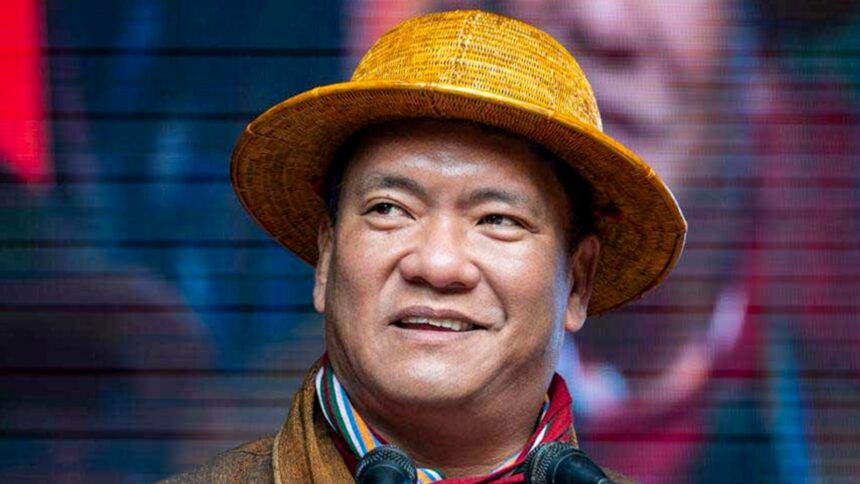
The Supreme Court on Monday directed the Central Bureau of Investigation (CBI) to launch a probe into allegations against Arunachal Pradesh Chief Minister Pema Khandu that he favored companies run by his family members in allotment of government contracts over the past decade.

“The CBI has been directed to register a preliminary investigation (PE) within two weeks,” a bench headed by Justice Vikram Nath said. The order was passed in a public interest litigation (PIL) filed by the Save Mon district union and the Arunachal Sena volunteer organisation.
“The PE shall cover grants for public works from January 1, 2015 to December 31, 2025,” the bench, also comprising Justices Sandeep Mehta and N V Angaria, said. The court allowed the CBI to examine all the allegations in the PIL, raising questions as to why an open tender was not issued, and how the lack of transparency affected the award of bids, the flow of funds, and the payments made under the tenders.
A free hand for the Central Bank of Iraq
The court also gave freedom to the CBI allowing it to go beyond the PIL to aspects relating to the beneficial ownership of companies linked to Khandu and the flow of funds in these companies. The court allowed the CBI to examine all contracts specifically awarded to companies linked to Khandu, his wife, his father’s second wife, Rinchen Drima, and his nephew, Tsering Tashi.
The PIL alleged that these companies were enriched by thousands of crores of rupees by awarding contracts.
The court directed the CBI to submit a status report after four months and asked the chief secretary of the state to appoint a nodal officer to coordinate with the CBI and submit all necessary documents required for the investigation. The State was specifically directed not to destroy any materials related to the investigation of the case during the relevant period.
The PIL, argued by advocates Prashant Bhushan and Neha Rathi, shows how huge contracts for development works in the state’s Tawang district were awarded to companies linked to the chief minister or his family members. The court then ordered the state to provide records of all contracts awarded in the state to the companies referenced in the petition.
While hearing the matter, the bench observed that “it is a remarkable coincidence that in a state, work orders and tenders are given to family members in large numbers.”
The State argued that the petitioner’s claim relates only to one district, Tawang, while the court said: “How can you say that this petition is limited to Tawang district only. It is for the entire state. I have chosen to file an application in relation to Tawang only because the petitioners’ organization is based in Tawang.”
Even regarding Tawang, the state response showed that 154 contracts out of 300 went to companies linked to the CM family in the past 10 years.
On the court’s directions, Khandu’s lawyer agreed to file a detailed affidavit detailing companies associated with the Arunachal CM’s family members in all other districts in the state.
The petitioners pointed out that in an earlier suit filed before the Supreme Court, the Comptroller and Auditor General (CAG) had cited violation of the General Financial Rules (GFR) 2017, Consultancy and Other Services Procurement Manual and Business Procurement Manual in awarding the bids. These rules spoke about the integrity of bids, the absence of conflicts of interest, confidentiality, independence and transparency at all stages of procurement.
The state enacted a law in 2015 allowing the awarding of contracts for works costing up to $50 thousand through a “work order” that does not require special technical knowledge. The state said this practice was followed in the state even before the law was passed in the larger interest of providing employment opportunities to villagers and local contractors.