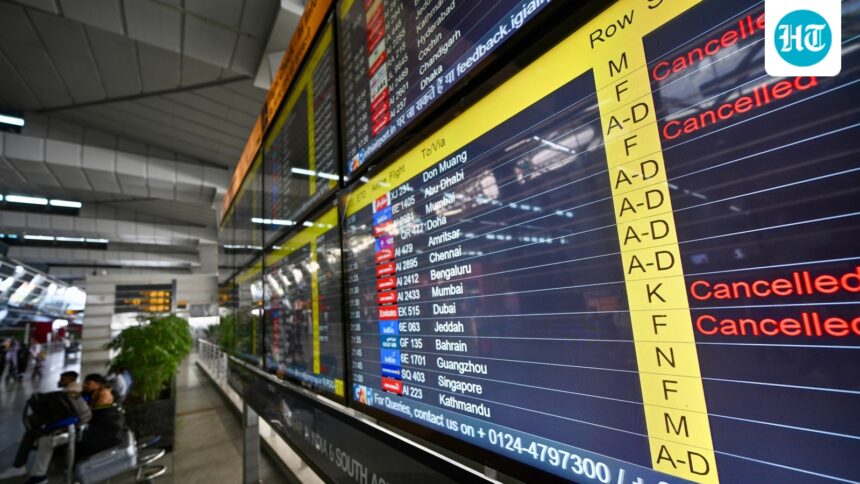
The Israeli-US war with Iran has brought West Asia to a standstill and stranded thousands in one of the busiest transportation regions, with many countries closing their airspace due to the conflict.

Dubai and Abu Dhabi airports temporarily closed their operations after the UAE government announced a temporary partial closure of airspace. The country’s two airlines, Etihad Airways and Emirates, announced that they will operate at a limited capacity until at least March 4, with some repatriation flights.
But passengers have been advised not to go to airports unless notified by carriers.
Air India on Tuesday said it will deploy its higher capacity widebody aircraft on its services to Dubai and Jeddah, Saudi Arabia on March 3 and 4 to facilitate the return of passengers affected by the ongoing situation in the region.
IndiGo also said it will operate 10 relief flights from Jeddah.
The airspaces of Qatar, Bahrain and Kuwait remain closed due to missile and drone threats from Iran.
There is some relief as far as Oman is concerned, as Air India Express said it will operate its scheduled flight to Muscat on March 4.
“Air India Express will continue to operate its scheduled flights to and from Muscat on March 4. Besides regular services to and from Delhi, Kochi, Kozhikode, Mangaluru, Mumbai and Tiruchirappalli, we will also operate additional flights to Delhi, Kochi and Mumbai,” the airline said in a statement on Tuesday.
Jordan announced that it would reopen its airspace after an initial partial closure that took effect on Monday.
On Tuesday evening, Israel’s Ben Gurion Airport also announced that Israeli airspace is set to gradually reopen overnight from Wednesday to Thursday with just one passenger flight per hour in the first phase.
The US-Iranian war continues
The United States, along with Israel, continued its military operation against Iran that began on February 28 and resulted in the deaths of hundreds, including Iranian Supreme Leader Ayatollah Ali Khamenei and several senior political and military leaders in Tehran.
Iran is retaliating even as the United States and Israel continued their strikes as of Tuesday, and has expanded the area under barrage from Iranian missiles and drones, targeting many of Washington’s assets in the region.
Tehran has also been launching missiles and drones at neighboring Arab countries, primarily closing airspace and strangling shipping through the Strait of Hormuz, with a fifth of the world’s oil and liquefied natural gas trade passing through its coasts.