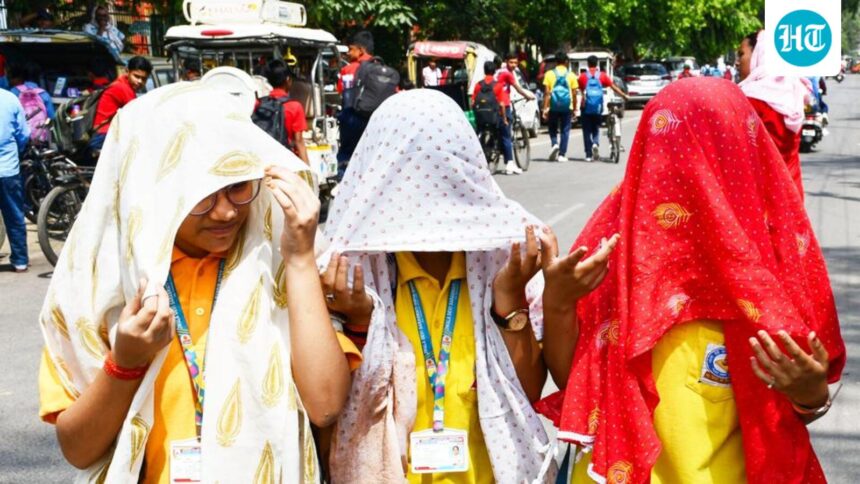
India has yet to experience the worst of the extreme heat waves caused by the climate crisis, with its land warming just 0.88 degrees Celsius between 1980-1990 and 2015-2024, compared to 1.4 degrees Celsius for the planet as a whole, according to a new research paper released Wednesday, which picks an unusual candidate as one of the main factors behind the anomaly: air pollution.

“Understanding this warming gap is important for adaptation planning, because the processes that have partially suppressed warming in parts of India are not guaranteed to continue,” says the paper, “Critical Perspectives on Extreme Heat in India,” from the Salata Institute for Climate and Sustainability at Harvard University. It addresses issues raised during an interdisciplinary conference in Delhi last year titled “India 2047: Building a Climate Resilient Future,” organized by the Salatha Institute for Climate and Sustainability at Harvard University, the Lakshmi Mittal and Family Institute in South Asia, and India’s Ministry of Environment, Forest and Climate Change.
In particular, winter daytime temperatures in northern India show a weaker warming than the national average, and in some regions, a clear cooling trend is also observed, especially in January. The months of October, November and December also show a lower rise in temperatures in North India compared to the national average. The reason is pollution and intensive irrigation in this area, the granary of India. Aerosols cool the daytime surface by scattering or absorbing incoming shortwave radiation, and irrigation contributes to cooling through evaporation.
Aerosol loading or air pollution levels may decrease under various clean air policies such as the National Clean Air Program and related state-level initiatives. The paper notes that reducing aerosols would improve public health even as the partial radiation mask of global warming is removed, leading to moderate increases in winter daytime temperatures over northern India.
“Temperature action plans, agricultural forecasts, worker protections, and financial instruments calibrated to historical averages risk systematically underestimating the exposure that populations will face within their planning horizons,” the study adds. “A warming trend that has appeared modest over recent decades may not remain so.”
An estimated three-quarters of the country’s workforce, nearly 380 million people, are engaged in heat-exposed work, including agriculture, construction, and a wide range of informal occupations that support about half of India’s gross domestic product, Sachit Balsari, an associate professor in the Department of Global Health, Population, and Emergency Medicine at Harvard University, wrote in the paper.
“In the near future, the scale of exposure is expected to increase: up to 200 million people in the country could face deadly heat conditions as early as 2030, while rising heat stress is expected to cause tens of millions of job losses globally. Adaptive capacity remains highly unequal: for example, only about 8% of households currently have access to air conditioning, leaving the majority of the population to cope with rising temperatures through limited or ineffective means.”
The paper also addresses the issue of rainfall intensity. Some models predict that India’s annual rainfall will increase by more than 20% by the end of this century in a worst-case climate change scenario; Others expect an increase of more than 60%.
“Both scenarios will require a significant amount of adaptation by farmers, and efforts to better constrain this model uncertainty are an urgent research priority. Furthermore, climate models predict increases in annual changes as the climate warms, highlighting the need for accurate long-term forecasts for farmers,” the paper said, stressing that extremely high temperatures are expected to worsen under all climate change scenarios, and historical trends in relative humidity across India are a cause for concern if they turn out They are forced due to anthropogenic carbon emissions.
The Harvard researchers also discussed passive design strategies that will be implemented on a large scale in India and modular insurance that could help workers weather bouts of extreme heat.
Focusing on cool surfaces alone could distract from efforts to address the potentially dangerous effects of moist heat, the researchers said.
Unlike hurricanes or floods, extreme heat cannot be seen, but its human and economic toll is enormous in the form of ill health, reduced productivity, higher energy demand, and accelerated damage to infrastructure. The researchers found that policymakers and financiers alike have long downplayed the macroeconomic impacts of heat, but apathy toward cooling financing persists despite expanding demand for air conditioning, thermal retrofits, and shaded infrastructure across India’s cities.
“India’s immediate task is to create the financial and institutional foundations for heat resilience. This includes defining budget lines, strengthening early warning systems and proactive financing, and improving coordination between states and cities. Sectoral budgets in health, labour, housing, disaster management and transport will need to converge,” the report said.