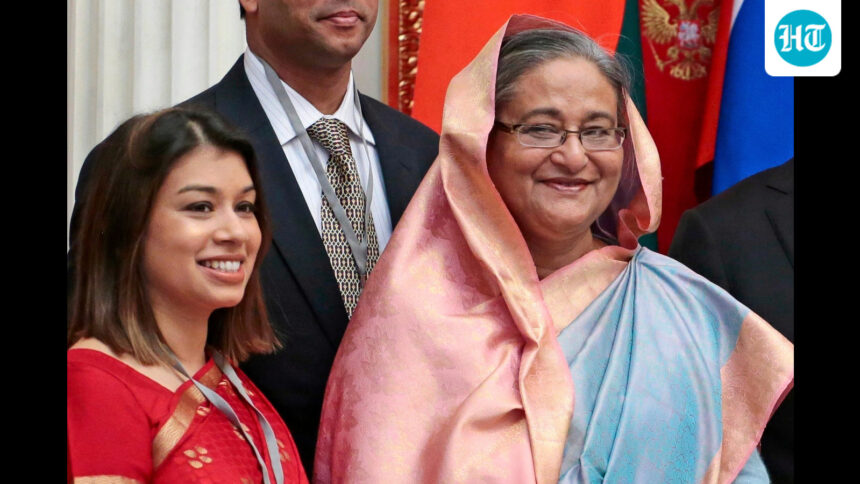
India said on Friday that the Bangladesh government’s extradition request for former Prime Minister Sheikh Hasina is being examined as part of judicial and legal processes, while assuring that New Delhi will engage constructively with all stakeholders on the matter.

There has been a slight shift in India’s position on the issue, which was raised when Bangladesh Foreign Minister Khalilur Rahman met External Affairs Minister S Jaishankar in New Delhi on April 8, especially in view of the Indian side’s focus on establishing a working relationship with the new government in Dhaka.
Sheikh Hasina has been living in self-imposed exile in India since fleeing Bangladesh in August 2024 after her government was overthrown following weeks of student-led protests. Bangladesh’s previous interim government first requested its delivery in December 2024.
“The request is being studied as part of the ongoing judicial and internal legal processes. We will continue to engage constructively in this issue with all stakeholders,” Jaiswal said in a weekly press conference in response to a question from Hizb ut-Tahrir.
Jaiswal responded to another question about the law passed by the Bangladesh Parliament this month, which is expected to give legal support to the interim government’s ban on Hasina’s Awami League party, saying: “We are following all developments closely.”
He referred to the External Affairs Ministry’s statement on the meeting between Jaishankar and Rehman in New Delhi and said: “I would also like to emphasize that the External Affairs Minister reiterated India’s desire to engage constructively with the new government.” [in Dhaka] “And continue to strengthen bilateral relations.”
The two sides agreed to explore proposals to deepen their partnership through relevant bilateral mechanisms. He added that formal follow-up meetings are expected to be held early.
A statement issued by the Bangladesh Foreign Ministry after Rahman’s meeting with Jaishankar said that the Bangladeshi side “reiterated its request for the extradition of Sheikh Hasina and her Home Minister Asaduzzaman Khan Kamal” as they were sentenced to death by the International Crimes Court.
The court, a local war crimes court, handed down the death sentence to Hasina and Kamal on November 17 last year after convicting them of crimes against humanity during the crackdown on student-led protests in 2024. In a legal letter sent to Bangladeshi authorities this month, Hasina demanded that the death sentence be overturned as “legally invalid,” and that any further proceedings against her be conducted in accordance with international fair trial standards.
The Anti-Terrorism (Amendment) Bill, 2026, recently passed by the Bangladesh Parliament to uphold the interim government’s Anti-Terrorism (Amendment) Bill, 2025, provides for a ban on individuals or entities engaging in terrorist activities, people familiar with the matter said. The law does not specifically refer to any political party, and it remains to be seen whether it will be used against the Awami League, sources said.
At the same time, people pointed out India’s long-standing position of establishing an inclusive system of governance in Bangladesh. Ahead of elections in Bangladesh in February, the Ministry of Foreign Affairs called for “free, fair, inclusive and credible” elections.