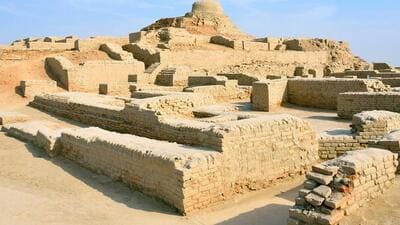
Trade has been the lifeblood of civilization for over three millennia. On the machinery that enabled the greatest and earliest societies throughout Mesopotamia, Egypt. As China and India progressed, traders provided lubricants that helped the empires operate and develop. The discovery of artifacts from Greco-Roman trade at Indus-Valley culture sites and the presence of Indian artefacts in markets and homes in the Mediterranean region and elsewhere show that trade agreements are not modern-day constructs. However, although trade is an ongoing practice, and forms an element of budgeting as we know it, nothing like a modern budget existed before the 19th century, at least not in India where James Wilson presented the income and expenditure statement of the colonial government in India in 1860.
A budget (derived from the word bulge or bag) was certainly not introduced in any modern sense. (Worldwide Oceanographic Institution website)Nomenclature of the budget
A budget (derived from the word bulge or bag) was certainly not introduced in any modern sense. From French bouse, which comes from Latin bulga, itself borrowed from Celtic bolog, meaning a bag or sack. This same root gives rise to swelling, and is closely related to the stomach, bearing the sense of anything that contains or swells with contents.
The first recorded use of the word ‘budget’ was in 1733 when British Prime Minister Robert Walpole presented the financial statements but for the next 100 years or so budgets consisted mainly of income tax statements. Napoleon Bonaparte (1769–1821), French general, is generally accepted as the enabler or modern monetary system and a central monetary authority.
Nevertheless, prior to the rise of democracy, monarchical or aristocratic regimes had systems of accounting for expenditure and income. Revenue was generated by the state through various taxes and customs duties and thus the exchequer was maintained at a healthy level.
More Read

Budgeting in Ancient India
The main categories of tax-based revenue according to Orthashastra (300 BCE-300 CE) were land revenue (including forest produce and horticulture), customs duties, sales tax, various types of property taxes, fines and penalties for a myriad of offences, profits from commercial enterprises and other income in the state mining sector.
However, the internal accountability of the court was how the king and his ministers maintained the financial health of the kingdom or empire, as the case may be. For example, we have several references from literary works such as Visakhadatta’s Buddhist Mahavamsa and Mudrarakshas about Dhana Nanda’s misrule which provided the necessary conditions for the Brahmin teacher Chanakya to instigate rebellion and install Chandragupta Maurya as the king of Magadha. Dhan-nanda was known for greed and indulgence which is considered extreme.
More Read

But we are on a firmer footing with the financial treatment of the development of public works under the Western Satrap Rudradamana I in 150 AD. At Sudarshan Lake in present-day Junagadh, Gujarat, a remarkable inscription records the establishment, maintenance and degradation of the man-made lake over 500 years. The lake was built during the Mauryan period and fell into disuse in later centuries before it was renovated and repaired during the reign of Rudradaman I. The inscription is significant not only because it records the continuation of public works but also from a financial point of view because it clearly states that the lake was repaired by the king and not usually renewed by King Levi. The inscription says, “The Mahakshatrapa Rudradamana, for the increase of his religious merit and fame,—without oppressing the inhabitants of the city and country by taxes, forced labor and works of affection—(expended) a large sum of money from his own treasury and not three times as much in a very long time. . [on] all [banks] . . .. (and so) made (this lake) (even) more beautiful to look at”.
Turushk-Danda: A Mystery of the Gahadabalas
Dharmashastras like Manusmriti, Yajnavalkyasmriti discuss at length how a king should use taxation as a means of raising revenue for state activities. They also suggest that the tax rates especially on businessmen and traders should be decided on scientific basis i.e. precise data on actual income rather than arbitrarily.
They authorize the raising of taxes for public works or to meet special needs such as war campaigns and other similar needs of the state. This classical sanction meant that taxes were often raised, even as recently as the 18th-19th centuries for ad hoc and oppressive reasons. For example, during the 19th-20th century Awad, landowners, not content with illegal najrana and taxes, often demanded additional cesses in the name of buying new cars, elephants, horses and even gramophones. Farmers to talukdars who were turned into wish-fulfilling animals, who also collected taxes in the name of certain holy days and festivals. An instance is recorded of a landlord collecting a ‘dust-tax’ for passing a dusty road on a tour of his estate!
A mysterious penal levy was introduced in the 11th century by the relatively short-lived Gahdabala dynasty of Kanauj-Kashi (1080–1220 CE). Several inscriptions belonging to their emperors mention Turushka-danda as a tax. The inscriptions themselves issued land to record land grants made to Brahmins. Inscriptions record these taxes as part of these declarations, which confuses scholars. Was it levied to raise an army to protect the kingdom and its major cities from Ghaznavid invasion or was it a punitive tax levied on prisoners taken from their wars with the Ghaznavid armies? Historians and scholars have disagreed on its exact nature, with some even suggesting it was a tax on a scented reed! However, the last recorded inscription mentioning this tax dates back to 1168 AD during the reign of King Jayachandra Gahdabala towards the end of this dynasty.
(HistoriCity is a column by writer Balay Singh that tells the story of a city in the news, going back to its documented history, mythology and archaeological digs. Opinions are personal.)