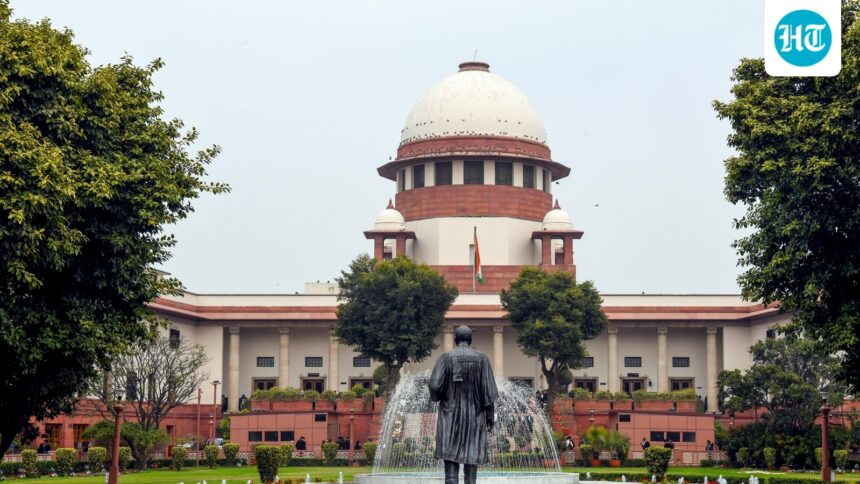
NEW DELHI: The Supreme Court on Thursday ruled that women prisoners cannot be excluded from open correctional institutions (OCIs or open prisons) on vague “security” grounds, declaring that their exclusion from such facilities constitutes “blatant gender discrimination” and violates their constitutional rights.

In a far-reaching ruling aimed at ushering in structural reforms of prisons, a bench of Justices Vikram Nath and Sandeep Mehta issued a slew of binding directions to the Centre, states and union territories to end systematic exclusion of women from open prisons, rationalize eligibility criteria, expand infrastructure and adopt uniform national norms.
The court ruled that “security concerns shall generally not be a reason to deny women prisoners access to OCI facilities,” and directed governments to develop “gender-sensitive and security-conscious mechanisms” that facilitate rather than thwart their access.
The ruling came on the basis of a petition filed by civil rights activist Suhas Chakma seeking effective use of OCIs to address prison overcrowding and promote rehabilitation. Senior advocates K Parameshwar and Vijay Hansarya assisted the court as amicus curiae.
The bench noted that several states, including Assam, Gujarat, Madhya Pradesh, Odisha, Punjab, Telangana, Uttarakhand, Uttar Pradesh and West Bengal, have categorically stated that women are not eligible for welfare transfer. Even in jurisdictions such as Delhi, Karnataka and Tamil Nadu, where women were technically eligible, no conversions occurred.
The court described this as a “deeply worrying pattern” and found that the exclusion of women from open prisons did not comply with the 2016 Model Prison Manual, and international standards including the Nelson Mandela Rules and the Bangkok Rules.
“The right to reform, emanating from Article 21, is inherent in every prisoner,” the bench said, adding that administrative convenience cannot replace the constitutional obligation.
The court directed all states and union territories to review and amend any rules that directly or indirectly exclude women from open prisons within three months, and to establish dedicated facilities where integration into existing open prison institutions is not possible.
Supreme Committee for Unified Standards
Recognizing the lack of uniformity in governance, eligibility criteria and rehabilitation facilities across the country, the court also ordered the formation of a high-level committee for “reform and management of open correctional institutions.”
The committee will be headed by former Supreme Court judge Justice S Ravindra Bhatt, with representation from the Union Home Ministry, state home secretaries, police research and development bureau, social justice ministry, skill development ministry and prison authorities.
Its mandate includes formulating common minimum standards for the governance and management of social care institutions, harmonizing correctional practices across countries, recommending uniform protocols for eligibility assessment, and ensuring inclusive and gender-sensitive access, including for women and transgender prisoners.
The committee was asked to submit its report within six months of its first meeting. The National Legal Services Authority (NALSA) will act as the nodal agency. Advocate Rashmi Nandakumar appeared for NALSA. The case is scheduled to be heard on September 1.
Addressing underutilization and overcrowding
The ruling also addressed the chronic underuse of open prisons. According to the India Prison Statistics 2022 report by the National Crime Records Bureau, there are 91 prisons open nationwide, of which 41 are in Rajasthan and 19 in Maharashtra. However, many states have announced a large number of vacancies.
All states and union territories have now been directed to prepare time-bound protocols within three months to fill existing vacancies, re-evaluate the stringent eligibility criteria that keep prisoners confined in closed prisons for long periods, and ensure that comprehensive care centers function as true rehabilitation spaces – and not “labor camps or appropriate places of detention”.
The court ordered structured skill development, fair wages linked to minimum wage standards, access to healthcare, education, digital literacy, community employment opportunities, and promotion of family integration including home leave and cohabitation wherever possible.
To prevent the directions from remaining on paper, the Supreme Court directed all High Courts to register suo motu writ petitions as continuing mandatory orders to monitor compliance. Each State and UT must constitute a monitoring committee headed by the CEO of the State Legal Services Authority within four weeks. Quarterly status reports must be submitted to the relevant high courts, with consolidated annual reports submitted to the Supreme Court.
The court stressed that “the enduring strength of constitutional democracy lies not in the severity of its punishments, but in its commitment to restoring dignity, hope and opportunity,” stressing that prisoners do not cease to be bearers of constitutional rights when imprisoned.