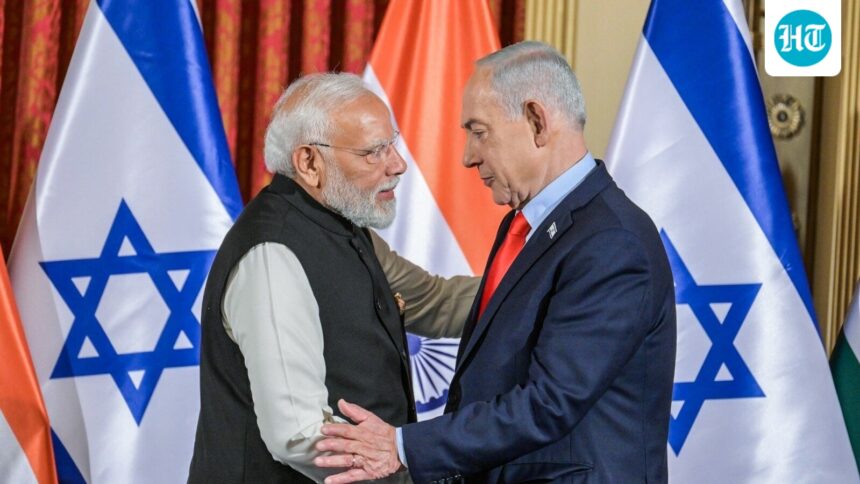
Prime Minister Narendra Modi on Thursday said that India and Israel have elevated their bilateral relations to the level of a special strategic partnership, adding that the “historic decision” reflects the aspirations of the peoples of the two countries whose relationship is based on “deep trust, shared democratic values and human ties.”

“In today’s meeting, we discussed giving a new direction and greater momentum to our cooperation,” Modi said at a joint press conference with Israeli Prime Minister Benjamin Netanyahu after the two leaders held delegation-level talks in Jerusalem.
Discussions covered a wide range of areas including defence, security, technology and innovation; cybersecurity; Trade, investment and communication; agriculture, water and environmental protection; combating terrorism and promoting peace; parliamentary cooperation; health; education; And exchanges between people.
Read also | In his speech at the Knesset, Modi called for a “just and lasting” peace and said that India stands firmly with Israel
“The leaders noted the tremendous progress that has been made in bilateral relations between India and Israel in diverse areas, including emerging technologies, cyber, agriculture, water management, health, entrepreneurship, defence, security, etc. Prime Minister Netanyahu and Prime Minister Modi agreed and decided to take the strategic partnership to a new level – a ‘Special Strategic Partnership for Peace, Innovation and Prosperity,’” a joint statement issued in Jerusalem said.
In a special press conference later, Foreign Minister Vikram Misri said that tensions between the United States and Iran and the overall regional situation emerged in the discussions between the two prime ministers.
Al-Masri said, “Prime Minister (Modi) affirmed India’s firm belief in the value of dialogue and seeking to find peaceful solutions to all these issues. He also reiterated India’s readiness to provide its support for the peaceful resolution of the issues.”
Responding to a question about the role that India could play in the post-conflict reconstruction of Gaza, he said: “We see a role. Defining that role depends on greater clarity about how things will develop on the ground in Gaza. I will not speculate at this stage on the specific areas that we might go into, but India has very specific capabilities and capabilities that will be of great importance in a situation like the one we see on the ground in Gaza. We have the ability to contribute.”
India-Israel relations ‘stand the test of time’
Several outcomes were finalized during the talks including in the areas of technology, science, trade, financial services, artificial intelligence, cybersecurity, agriculture, blue economy, labor mobility, education and culture.
The results included 17 memorandums of understanding or agreements, and 10 other announcements, including an announcement about upgrading the relationship to a special strategic partnership.
“Our relations have stood the test of time. Our economic cooperation continues to serve as an engine for growth, innovation and shared prosperity. Last year, we signed a bilateral investment agreement to promote mutual investments. We will also soon finalize a mutually beneficial free trade agreement,” Modi said at the press conference.
Read also | India and Israel elevate ties to a special strategic partnership during Prime Minister Modi’s visit, and UPI will be used in Israel
The statement stated that the leaders affirmed their commitment to achieving the free trade agreement and assigned the negotiating teams to accelerate the negotiations in order to reach an early result.
Modi said that technology lies at the heart of the future partnership between the two countries.
“Today, we decided to create a partnership in the field of critical and emerging technologies. This will give new impetus to cooperation in areas such as artificial intelligence, quantum technologies and biominerals,” the Prime Minister said at the press conference.
India and Israel believe that this initiative on critical and emerging technologies, led by the National Security Advisors of both countries, will unify each other’s individual strengths in specialized technologies, fostering a focused and forward-looking partnership.
The joint statement said that the two leaders presented a vision and roadmap for future defense cooperation, following the memorandum of understanding signed last November to enhance defense cooperation.
“We have enjoyed decades of trusted cooperation in the defense sector. The MoU signed last year will add new dimensions to this partnership. Together we will move forward towards joint development, joint production and technology transfer,” Modi said.
Read also | Prime Minister Modi is among the rare world leaders to receive the highest honors from Israel and Palestine
The memorandum of understanding was signed in Tel Aviv last November to provide a unified vision and political direction to deepen the already strong defense cooperation between the two countries. It will enable the exchange of advanced technology and promote joint development and joint production of weapons and systems.
Modi said the two countries will continue to strengthen their cooperation in areas such as civil nuclear energy and space. The two leaders welcomed the ongoing collaboration between the Israel Space Agency (ISA) and the Indian Space Research Organization (Isro), while recognizing the great potential for Israeli space startups and companies to engage more deeply with their Indian counterparts.
“They stressed the importance of promoting greater cooperation between the space industries of the two countries, and encouraging joint projects, innovation partnerships and knowledge exchange to drive progress in the global space sector,” the statement said.
“I am pleased that an agreement has been reached to enable the use of UPI in Israel. We are also committed to improving the lives of our people by sharing our experiences in the field of digital health,” Modi said.
He touched on agricultural cooperation between the two sides. “Agricultural cooperation between our two countries has a long and successful history. Today, we are determined to give this cooperation a future direction.
Read also | An official reception for Prime Minister Modi in Israel and hugging Netanyahu He watches
The Centers of Excellence in Agriculture established in India with Israeli cooperation are a shining example of our friendship. We have set a goal to increase their number to 100 (from 43 currently).”
Establishment of Villages of Excellence in India is also being worked on, he said.
“This initiative will bring Israeli technology to every village in India, significantly increasing the income and productivity of millions of farmers. We will also develop future-ready agricultural solutions. The establishment of the Indo-Israeli Innovation Center for Agriculture in India will provide a strong foundation for strengthening this cooperation.”
Modi described the people-to-people relations as an important pillar of the India-Israel relationship, adding that through the 2023 Manpower Mobility Agreement, India has made significant contributions to Israel’s construction and caregiving sectors.
“This cooperation is being expanded to include areas such as trade and services. Connecting youth, researchers and innovators of both countries has been a key priority for us. Today, we are establishing the India-Israel Academic Forum,” the Prime Minister said. He said that with a focus on strengthening regional connectivity, the two sides will move with renewed momentum on the India-Middle East-Europe Economic Corridor (IMEC) and the India-Israel-UAE-USA (I2U2) initiatives.
Modi said that India and Israel are clear that terrorism has no place in the world and cannot be tolerated in any form. He added that New Delhi’s security interests are directly linked to peace and stability in West Asia.
“We have stood shoulder to shoulder in opposing terrorism and those who support it, and we will continue to do so… From the beginning, we have supported dialogue and peaceful resolution of issues. India’s position is clear — humanity must never become a victim of conflict. The Gaza peace plan has opened a path towards peace. India has extended its full support to these efforts. We will continue to engage in dialogue and cooperation with all countries,” Modi added.
The two leaders condemned unequivocally and strongly terrorism in all its forms and manifestations, including cross-border terrorism. They called for decisive and concerted international efforts to combat terrorism in a comprehensive and sustainable manner, reaffirming their collective resolve to combat this threat as leaders of two vibrant and resilient democracies.
“They strongly condemned the heinous October 7, 2023 terrorist attack on Israel, the brutal terrorist attack on Indian tourists at Pahalgam in Jammu and Kashmir, India on April 22, 2025, and the terrorist incident near Red Fort, New Delhi on November 10, 2025,” the statement read.
Modi’s visit comes at a time when India is seeking to create a formidable military capability to defend the country’s defense and civilian installations against air attacks, as well as respond with overwhelming force under Mission Sudarshan Chakra, indicating the country’s intent to prepare to meet future battlefield challenges.
The Prime Minister announced the Sudarshan Chakra Mission in his Independence Day speech last year and set a 10-year deadline for the development of the National Defense Shield, which is expected to integrate some Israeli technologies and missile systems.