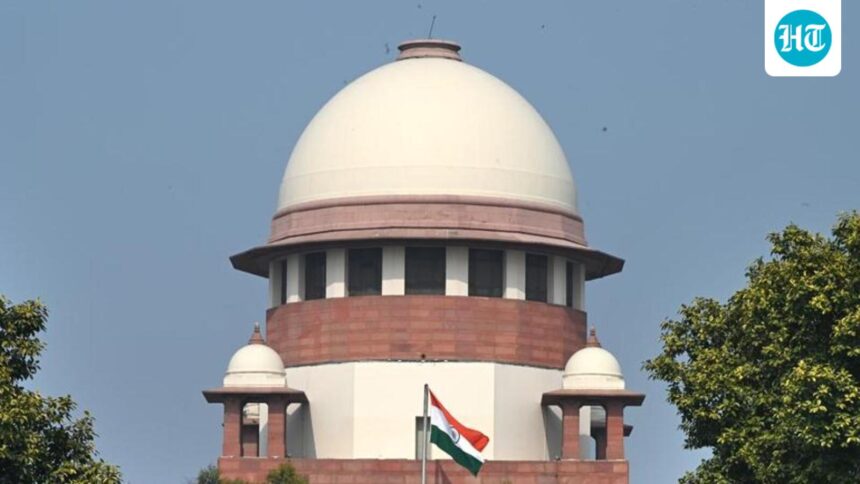
The Supreme Court bench has decided that judges appointed to become Chief Justices should be transferred to their new high courts early, preferably two months before the vacancy arises, signaling a crucial policy shift aimed at ensuring a smoother transition of leadership in the high courts.

The decision, taken at a meeting on Wednesday evening led by Chief Justice of India Surya Kant, aims to enable the new chief justices to familiarize themselves with the administrative and judicial performance of their new courts before formally taking charge.
“The Collegium has taken a policy decision that in order to enhance the efficiency and quality of administration of justice, the proposed judge may be transferred to assume the office of Chief Justice at an early date, preferably two months before the vacancy arises, so that in the meantime the person recommended becomes well acquainted with the affairs of that Supreme Court and assumes charge of the office of Chief Justice, upon the retirement of the present Chief Justice,” the statement said.
The bench also includes Justices Vikram Nath, JK Maheshwari, PV Nagaratna and MM Sundresh.
Implementing the new policy for the first time, the bench decided to recommend the transfer of Justice Lisa Gill from the Punjab and Haryana High Court to the Andhra Pradesh High Court. She has also been recommended for appointment as Chief Justice of that Supreme Court with effect from the vacancy date later in April, following the retirement of current Chief Justice Dheeraj Singh Thakur.
Read also: The Supreme Court bench has approved the appointment of 5 retired judges to a special role in the Allahabad High Court
The statement added: “Following this political decision, the collegium has decided to recommend the transfer of Ms. Justice Lisa Gill, Judge of the Punjab and Haryana High Court, to the High Court of Andhra Pradesh and her appointment as Chief Justice of that High Court with effect from the date the vacancy arises.”
The college also recommended the appointment of Justice Sushrut Arvind Dharmadhikari, currently a judge of the Kerala High Court (Mother High Court: Madhya Pradesh), as Chief Justice of the Madras High Court. The recommendation comes in the wake of the impending retirement of current Chief Justice M M Shrivastava on March 5.
Justice Shrivastava is currently a member of the Lok Sabha panel tasked with probing the allegations against Allahabad High Court judge Justice Yashwant Varma over the discovery of unaccounted cash at his official residence in Delhi last year. After Shrivastava’s retirement, the committee was reconstituted, with Lok Sabha Speaker Om Birla nominating Chief Justice of the Bombay High Court Shri Chandrashekar in his place, while the other two members continued.
However, the bench is yet to recommend appointment of a full-time Chief Justice to the Rajasthan High Court, which has been working under the supervision of an acting Chief Justice since September 2025.
In a separate decision, the college approved the appointment of nine lawyers as judges of the Patna High Court: Dr Nadeem Siraj, Ranjan Kumar Jha, Kumar Manish, Sanjeev Kumar, Girjesh Kumar, Alok Kumar, Raj Kumar, Rana Vikram Singh and Vikash Kumar.
A person familiar with the deliberations said the new policy reflects a conscious effort to enhance institutional continuity and administrative efficiency in the high courts. “Chief Justices play a pivotal role not only in judicial work but in roster allocation, infrastructure planning, case management and overall administrative supervision. By ensuring that the judge appointed to become Chief Justice spends time in the new Supreme Court before formally assuming office, the collegium hopes to minimize disruption and enhance efficiency from day one,” the person told HT.
The move is expected to streamline transitional processes at a time when many high courts are witnessing frequent changes in leadership, following the provision in the Memorandum of Procedure (MoP) that requires the Chief Justice to be appointed from outside the parent Supreme Court. This policy has been developed to maintain institutional independence, avoid local influences and enhance public confidence in the impartial administration of justice.