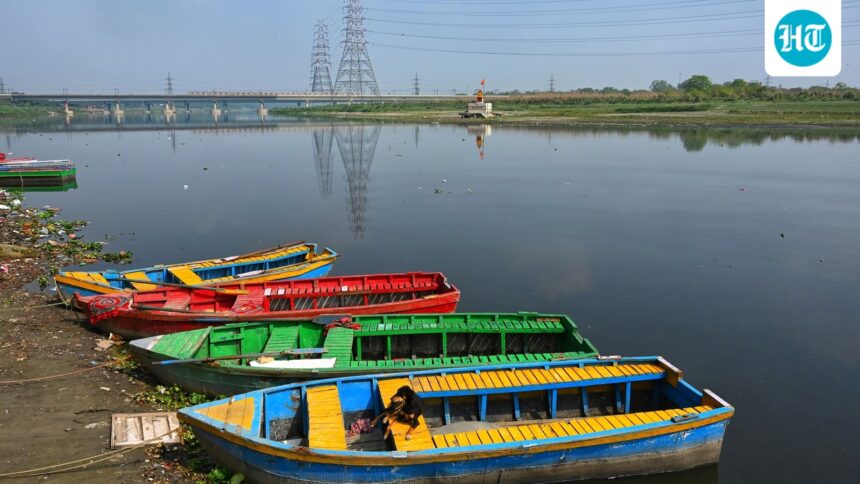
After two decades and more $Rs 2,454 crore has been pumped into the flagship Intercept Sewerage Project (ISP) of the Delhi Jal Board (DJB), and a major chunk of this investment appears to have effectively gone down the drain. The inspection ordered by the center found that the project stopped only 60% of the volume of wastewater that the DJB claimed it stopped entering the Yammouna River.

This ambitious project, launched in 2006, is designed to intercept small drains that feed the Yamuna River and divert raw sewage to sewage treatment plants. But a series of inspections by the Delhi Pollution Control Committee (DPCC) in February this year, on orders from the Centre, found widespread discrepancies in the DJB’s performance data.
Also Read: Tamil Nadu 59, Karnataka 42: Amit Shah’s shares collapse in Lok Sabha states after delimitation
117 million million gallons per day of untreated waste still flows into the Yammouneh River
According to the DPCC report, seen by HT, while the DJB claimed to have exploited and diverted 238 million gallons per day of wastewater, only about 142 million gallons per day was stopped through measures implemented under the ISP. The report added that more than 117 million million days of untreated waste is still flowing into the river from drains that the authority declared “complete.”
Furthermore, the updated flow of wastewater into small drains has increased to a total of 260 million gallons per day.
Of the 109 so-called “interception points” that were inspected, only 56 points were successfully diverted. The remaining points had unused or excess wastewater, totaling 117.7 million gallons per day. The DPCC report said five points could not be inspected due to excessive dumping of waste, lack of infrared radiation, and damage caused by construction work.
Read also: ‘We had a very good conversation’: Trump makes phone call with ‘friend’ of PM Modi
Lapses in monitoring
The inspection also revealed serious oversight gaps. DJB has installed flow meters at only 12 points, of which four are already non-functional. CCTV cameras were reportedly installed at 23 locations, but only eight locations were found operational. The council’s claimed sewage pumping capacity of 310.26 million gallons per day was also found to be inflated, with the actual capacity being 259.72 million gallons per day.
The DJB did not respond to queries regarding the report.
Last year, the Delhi government had told the central government in a report that the ISP was “complete and verified” through an independent assessment. “The Yamuna Monitoring Committee has obtained an independent assessment of the ISP through a team. The team has confirmed that the wastewater trapping portion of the ISP has been completed,” the DJB’s report to the Union Ministry on Jal Shakti on September 22, 2025, said.
Also Read: ‘There is no greater feminist than PM Modi’: Kangana Ranaut during discussion on Women’s Quota Bill in Lok Sabha
The DJB has said that while trapping is being carried out, the treatment will only improve after the rehabilitation of the old treatment plants.
The aim of the ISP was to prevent sewage from entering the Yamuna River by building sanitary drains and treating it before it enters the river. The project targeted three major drains – Najafgarh, Shahdara and Supplementary Drain – with the aim of absorbing a total of 242 million gallons per day (MGD) of untreated sewage.
Work began in 2011, four years after the Supreme Court approved the plan, and the initial completion target was 2015. “The three large drains currently carry 242 million million gallons per day of sewage to the Yamuna. The treated water was then to be directed into the river through the drains, in the process raising the level of biological oxygen demand to an acceptable level,” explained a Nile River Board official.
Bhim Singh Rawat, a Yamuna activist and member of the South Asia Network on Dams, Rivers and People (SANDRP), said the ISP had delayed for more than a decade and had failed to deliver results on the ground. “The project was expected to be completed by 2016, but sewage generation has increased since then with the expansion of unauthorized colonies. This indicates a failure of planning,” he said.
In 1994, after the Supreme Court took cognizance of the poor condition of the Yamuna River, the Delhi government proposed installing sewage treatment plants at the mouths of 23 drains to discharge sewage into the river. The project was marred at the planning stage by land availability problems.