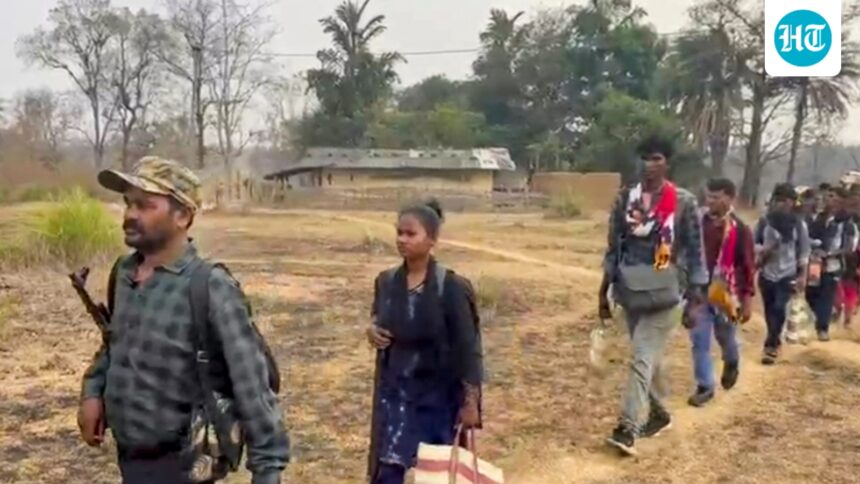
Bijapur: On Tuesday morning, in Chhattisgarh’s Bijapur district, security force companies set out to patrol along the roads, as they always do.

Does this land look freshly dug?
Was this bush pressed by force?
Was this rock here when we last surveyed this stretch?
These are the questions they ask, even as they, with the help of sniffer dogs and mine detectors, scan roadsides. Typically, two teams work together, starting at points 10 km apart, and covering a distance of 5 km to the middle, where they meet. They do it every day, day after day.
They have been doing so ever since the troops established their camps in what was once the heart of the Red Corridor.
Tuesday was no exception. Later the same day, India will declare that the war against left-wing extremism has been won.
For the first time in more than six decades, the country appears free of Maoist control. No villages remained under their control, and the CPI(M) political and military leadership – with one exception – surrendered, were arrested or killed. The only remaining member of the Central Committee is inactive, in hiding, and lacks the military power he once commanded.
But here in Bijapur, the absence of violence does not mean peace. At least, not yet.
Bijapur is one of the two remaining districts affected by LWE (or Naxalism); The other is Sukma. The number came down from 38 in 2024 and 157 in 2006. Spread over an area of 8,529 sq km and bordering Telangana and Maharashtra, it was once the largest recruiting ground for the Maoists’ military wing. Till Tuesday when Chhattisgarh recorded the surrender of 33 Maoists, 25 of them were from Bijapur. It was inside the national park area around which the Naxals hid $2.90 crore in cash and 7.2 kg of gold. Last month’s rebound of more than $3 crore cash and 1 kg gold also happened here.
An officer involved in the operation, requesting anonymity, said: “The money and gold were kept in a steel container and buried 8-9 feet deep in the ground. Only some senior commanders knew about it. They also cut branches of a tree near it in a certain way to mark the location. Apart from the cash, the jungle area here was full of IEDs.”
Police records trace the roots of the insurgency here to 1980, when Maoists first entered Bastar – then part of undivided Madhya Pradesh – from Andhra Pradesh through the dense forests of present-day Bijapur to establish their guerrilla base.
“Since nearly 70-80% of the district has forests, this was the best cover for the Naxalites to set up their base,” said Jitendra Yadav, Superintendent of Police (Bijapur).
They established popular governments (Janatana Sarkars) everywhere. “Indravati National Park was their core area. Till two years ago, Bijapur had at least 101 active Janatana Sarkars. One Sarkar ruled 3-4 villages. There are about 699 villages of which only 580 are inhabited. Today there is no Naxal government in any village but we are still following the protocol. There are no gun battles now, so majority of the police team is engaged in rebuilding trust with the locals,” Yadav added.
There is an acknowledgment that this will take time. The cost of haste will be measured in lives.
A second security forces official, who requested anonymity, said: “There is no military formation, but you still have to be careful. Naxalism is an ideology and it will take time to win people over. Any extremist hiding as a villager can place an IED to take revenge for what happened to the Naxal army. They may not have revealed the location of all the IEDs. Taking a risk in a place like Bastar can cost lives.”
Troops in Bijapur alone recovered 734 of the 900 IEDs they found in Bastar district last year. This year the number has already exceeded 195.
Troops across the region are currently engaged in a large-scale mine clearance operation.
Other arms of the state are doing their bit to reach the people. Over the years, Maoists have forced 325 schools across the district to close, district collector Sambit Mishra said. “We have reopened 264 streets in the last two years. More will be reopened gradually. About 900 km of roads are also being built. The Border Roads Organization is involved in the construction of a 40 km road linking the city with Tarim and Bammer, which were once Maoist strongholds.”
The local administration is also working to restore identity and entitlements. Mishra said that most of the villagers in Naxal-controlled areas do not have any identity papers. “Officials walk to the villages to prepare their documents. Teams travel on foot to these villages so that the villagers avail all the benefits. Tractors transport the food grains to the nearest available place where the materials are dropped for public distribution system distribution.”
The goal is simple: to heal people, win hearts, and convince them that the state is not their enemy.
This is a particularly difficult task in Bijapur where the scars are still fresh. Bijapur is where the first blood was shed, in what officials call the final push against the Maoist insurgency. Nearly four months after the new BJP government came to power in the state, the region witnessed the first of hundreds of armed battles that led to the elimination of the Naxals. On April 2, 2024, security forces killed 13 Naxals in an encounter – the largest such operation in a decade at the time. Exactly two weeks later, 29 more Naxals were killed in nearby Bastar Kanker district by a Border Security Forces team. Months later, on February 9, 2025, this record was also broken when 31 Maoists were killed in a single operation in Bijapur. A soldier who has been part of dozens of operations over the past two years said the approach has changed radically in 2024: “With the BJP governments at both the state and the Centre, announcing a deadline, the nature of operations has changed. It has become a competition to get more surrender or neutralize top commanders. Troops have started fielding 2,000-3,000 personnel in a single operation. Squads from different areas will enter the jungle and encircle the Naxals, leaving them with no option.” But the surrender began from Bijapur.
But it wasn’t all one way. Between 2024 and 2026, Naxals killed at least 74 civilians in Bijapur for working as police informants. This year, a villager died when he accidentally stepped on an explosive device. Even today, the district still has a heavy troop deployment – more than 15,000 CRPF personnel and around 4,000 Chhattisgarh Police. So far this year, Bijapur has witnessed eight gun battles in which 13 Naxals were killed. 154 have surrendered. The police and security forces hope that the war will end and that the marker of the worst-hit Naxal district of Bijapur will be removed. But in reality, caution is key.
When security forces travel to villages for civic education, they find the villagers welcoming – but they still travel in groups. A third officer explains why. “Many villagers have lost their friends and family members to our bullets in the past two or three years. They may be angry and want to take revenge by attacking us with everything they have at home. Even one such incident could set us back months.”