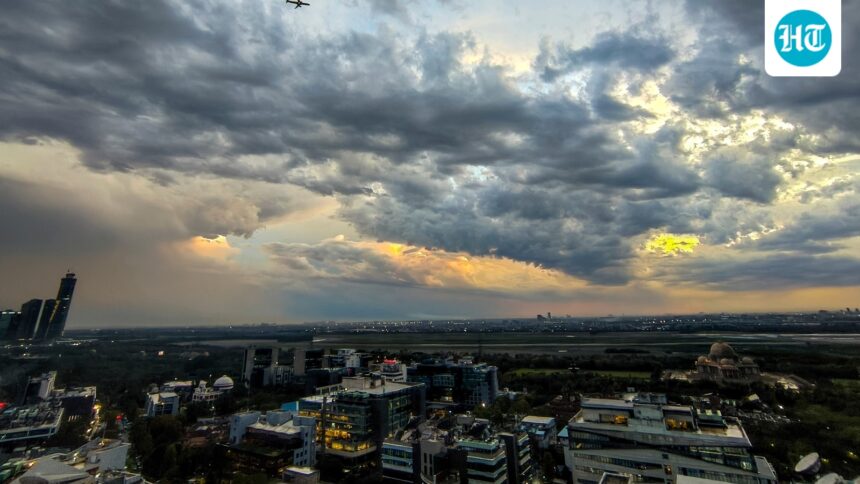
North and west India are facing a cold front accompanied by rain, hailstorms and storms, while summer is expected to begin around mid-April, according to meteorologists.

Weather experts have warned of a strong western disturbance that is expected to bring heavy rains and hailstorms in some parts of India and temperatures to drop sharply while traveling through northwest India.

According to the India Meteorological Department (IMD) bulletin issued on April 1, the active western disturbance is expected to reach peak activity along with a hailstorm on April 3 and 4 with isolated heavy rains over the main influence area of Kashmir Valley on the 3rd.
A wet spell with thunderstorms and lightning is likely to occur over the central parts of the country till April 6 with possible isolated hailstorm activity on April 3, the IMD said, adding that daytime temperatures are likely to remain near normal to below normal over northwest India on April 6.
The weather was colder than usual for this time of year in many parts of the country, with rare rain. The second half of last month also witnessed a western disturbance that brought rain and a drop in mercury over northwest India, including parts of Delhi and the National Capital Region.
‘Strong’ western disturbance and ‘U-shaped jet streams’
Weather experts described the disturbance as strong, with U-shaped jet streams expected to bring hailstorms accompanied by rain in parts of the country. Rain and hailstorms lashed several places in Haryana and Punjab on Tuesday, raising concerns among wheat farmers, who expected damage to their crop that was ready for harvest.
Dr Pradeep, who describes himself as a climate scientist on
Read also | ‘Crazy cover’: What makes Delhi unusually cold? It is a rain band “1000 km” long.
He said the main impact areas (heavy rain/snow and storms) would likely be Jammu and Kashmir and Ladakh, where heavy rains and heavy snowfall on mountains are expected; Punjab and Rajasthan, where widespread thunderstorms and gusty winds are expected; and Gujarat, where there is likely to be a significant impact along the northern border and interior areas.
Isolated thunderstorms will develop across the plains and central/eastern belts, including north/central Haryana, Delhi NCR, western Uttar Pradesh, Himachal Pradesh and western Madhya Pradesh, Dr Pradeep said in his post.
Central/southern parts of Maharashtra (Vidarbha/Marathwada), Chhattisgarh, Telangana, parts of Odisha and West Bengal are also likely to receive rain and thunderstorms as the system moves through.
He said in a post on Tuesday that he expected a sharp drop in mercury levels after the rains, but added in another post that summer would likely begin during the second half of April.
“The jets are flowing perfectly in a U-shape in preparation for the upcoming western disturbance starting April 3,” Navdeep Dahiya, an amateur meteorologist, said on X.
Mahesh Palawat, vice president of climate and meteorology at Skymet Weather, also said that when the westerly jet stream is particularly wavy, “we sometimes see an increase in the influence of low-latitude WDs.” An earlier HT report quoted Palawat as saying, “The undulating jet stream is linked to rapid warming in the Arctic.”
“The entire north and west of India will see cold frontal rains, hail and storms. The states in the central and south of the peninsula will see severe evening storms,” Dahiya said in his post on
He also said that the late summer season is likely to start only after April 15.
According to an earlier HT report, March recorded eight western disturbances against a normal range of five to six, and at least three more disturbances are expected until mid-April. The rise is made all the more surprising by what preceded it: January and February saw far fewer snowfalls than usual, resulting in lower snowfall across the Himalayas. Regulations have intensified sharply since mid-March.
Western disturbances refer to moisture-laden hurricane systems that originate over the Mediterranean Sea and move eastward along the jet stream — the narrow, elevated band of fast-moving winds that surrounds the globe at an altitude of about 30,000 feet.