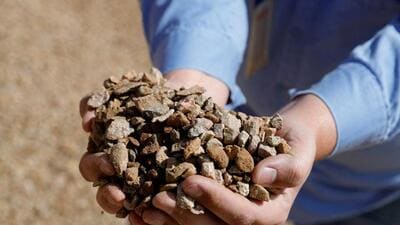
Union Finance Minister Nirmala Sitharaman on Sunday proposed setting up a dedicated rare earth corridor in Odisha, Kerala, Andhra Pradesh and Tamil Nadu to tackle constrained global supply chains. The move was part of a suite of tariff concessions aimed at strengthening India’s critical mineral and clean energy infrastructure.
Mineral-rich states will receive assistance in promoting rare earth mining, processing, research and production. (Reuters/Representative Image)Mineral-rich states will receive assistance in promoting rare earth mining, processing, research and production. At the same time, the government will provide tariff exemptions on capital goods required for processing important minerals and various renewable and nuclear energy materials.
“I am proposing basic duty exemption on capital goods used to manufacture lithium-ion cells for batteries, batteries also used to manufacture lithium-ion cells for energy storage systems,” Sitharaman said in his budget speech.
Also read: What gets cheaper and more expensive after Budget 2026. See full list
The announcement is based on Cabinet approval of a scheme to promote production of sintered rare earth permanent magnets by November 2025. This first type of initiative has a financial cost ₹7,280 crore and aims to set up rare earth permanent magnet production of 6,000 metric tonnes per annum to increase self-sufficiency.
More Read

Sitharaman framed measures against an external environment “where trade and multilateralism are hindered and access to resources and supply chains are disrupted.” He added that new technologies are “transforming production systems while sharply increasing demand for water, energy and critical minerals.”
Rishabh Jain, a fellow at the Council on Energy, Environment and Water (CEEW), said the rare earth corridors marked “an important shift from national policy and regulatory reform to state-level implementation through local value addition,” building on the National Critical Minerals Mission and the recent magnet project deployed on state shores.
Also read: Focus on transport, big boost on defence: Portfolio-wise breakdown of Union Budget 2026-27
More Read

“By anchoring supply chains in mineral-rich states we are finally bridging the critical gap between upstream mining and downstream manufacturing,” Jain said. He noted the CEEW analysis highlighted mineral processing as a key missing link but cautioned that the government needs to pursue stronger offtake guarantees and technology transfer from international partners for complex sintering processes.
Dattatreya Das, energy analyst at Ember, said that while there were no big-ticket announcements for renewable energy in the budget, “continued tariff concessions, support for key minerals, and manufacturing reforms are expected to quietly strengthen the clean energy supply chain.”
“To promote decarbonisation, a provision ₹20,000 crore over the next five years to promote Carbon Capture, Utilization and Storage (CCUS) technologies that reflect India’s commitment to obligations under the Paris Agreement to reduce GHG emissions. The National Manufacturing Mission has been expanded to focus on developing a domestic ecosystem for EV batteries – a major step towards green mobility, solar PV cells, electrolysers and wind turbines. In the next five years, 20 new national waterways will be launched, which will help reduce the carbon footprint of logistics – again a big step towards eco-friendly transport,” said Union Environment Minister Bhupender Yadav.