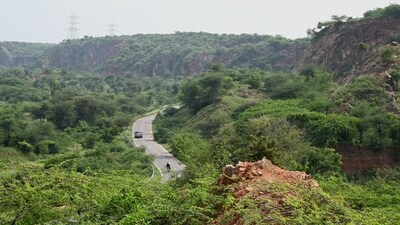
NEW DELHI: The Supreme Court on Thursday stayed the Haryana government’s Aravalli Zoo Safari project in Gurugram, saying it could not go ahead until a clear definition of the Aravalli Hills – pending in another case related to mining rights. The apex court made it clear that “not even an inch of land” in the ecologically sensitive Aravalli range will be allowed to be used for any purpose until experts comprehensively examine all aspects of the issue.
SC Hry’s zoo safari has been put on hold until Aravallis is clearly definedThe court issued the order while considering a petition filed by five retired Indian Forest Service (IFS) officers, challenging the project.
A bench headed by Chief Justice of India (CJI) Surya Kant posted the matter with a self-initiated plea on the definition of the Aravalli Hills, saying, “Aravalli is a composite range. It does not start in Haryana and does not end in Haryana. Without a clear definition there is no scope for granting permission to the project.”
In December 2025, the Supreme Court initiated proceedings on its own motion to define the Aravalli hills, following a judgment passed by another bench on November 20, 2025, that the Aravalli hills would include structures 100 meters or more in height from the local relief. This definition was criticized by experts, who claimed that the perceived ambiguity and lack of clarity would harm the Aravalli Range. The court stayed its order and invited suggestions on the names of independent experts, who could revise the definition keeping in mind the overall ecological integrity of the Aravalli range. This matter is listed for February 26.
The state, represented by Additional Advocate General (AAG) Lokesh Singhal, informed the court that on January 21, the court had asked the Central Empowered Committee (CEC) to submit a report on the project.
More Read

The report, submitted on February 10 and accessed by HT, read, “The State Government may be directed to place on record the revised Detailed Project Report (DPR) including geo-referenced map, land description, details of statutory approval/sanctions and relevant ecological and environmental assessment.”
In view of the CEC report, Sinhala urged the court to allow the preparation of the revised DPR.
A bench comprising Justices Jayamalya Bagchi and Vipul M Pancholi said, “We have already passed an order on October 8, 2025 that no further action be taken on the project. The move to frame the DPR is a step in that direction.”
More Read
The court also observed that, given an opportunity, the state could present a “rosy picture” showing how trees and green cover would be enhanced to “trap” the court into passing a favorable order.
“We are already examining the wider issue related to Aravalli Hills. We are not going to allow an inch of land in this area unless we get an independent expert body to examine all these issues, for which we have already passed an order requesting assistance from the Centre,” the bench said.
The court ordered the petition to be listed along with other Aravalli matters, which are likely to be listed on February 26.
The petitioners, represented by advocate Shivani Ghosh, claimed that the safari would be a “death knell” for the ecologically fragile region. In their petition, they alleged that the project would initiate large-scale construction of permanent infrastructure including guest houses, staff quarters, animal enclosures, roads and utility networks in a protected forest area.
The court observed, “We do not know at whose instance this petition has been filed. We will deal with it independently in the Aravalli matter.”
The Haryana government had initially filed an affidavit in this regard, stating that the earlier proposal to allocate 10,000 acres for the project was scrapped and it would occupy around 3,300 acres.
More Read

As per the project plan, 30% of the total restricted area will be used for perimeter, and 70% of the area will be kept as green area. “Rather than a death knell, the project will be a conservation initiative for the Arabalis as the area will be fenced off with a boundary wall and ecological restoration with native species of plants,” the state said.