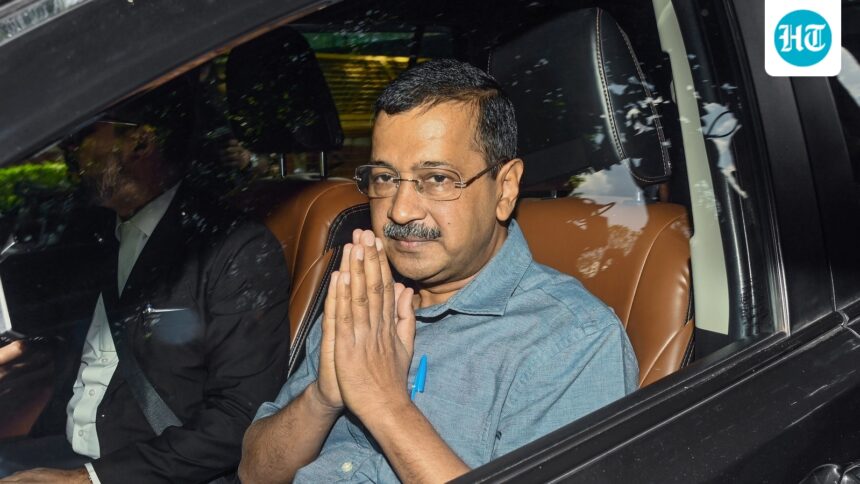
AAP national convener and former Delhi Chief Minister Arvind Kejriwal on Monday personally discussed the petition filed by him in connection with the issue of excise duty policy in Delhi.

Kejriwal’s petition seeks to disqualify Supreme Court Justice Swarana Kanta Sharma from hearing the CBI’s plea against the dismissal order passed in favor of the AAP chief and others in the case.
During the arguments, Kejriwal said the court treated the accused in the case as “guilty” and “corrupt”, despite their release. He also cited Justice Sharma’s four-time attendance at programs linked to the BJP and RSS, saying it “raises concerns”. He said the “fear of bias” was enough for one litigant to request a judge’s response. Citing an earlier judgment titled Ranjith Thakur v Union of India, Kejriwal said: “It is not a question of whether the judge is actually biased but whether the litigant has concerns.”
The bench said that stepping down would only happen for two reasons. “The most important thing to focus on is that you realize that I will not be able to get justice for you, that I will go to the Adhivakta Parishad and give them (CBI and ED) all the comforts…,” the judge said.
Meanwhile, Solicitor General Tushar Mehta, representing the CBI, spoke about the precedent this case will set. “The question is not whether Your Honor can hear the matter, but if judges start stepping down accordingly, will any judge be able to hear these cases,” he said.
Kejriwal cites Justice Sharma’s presence at an RSS-related event
Kejriwal recalled Justice Sharma attending an event organized by the Akhil Bharatiya Adhivakta Parishad (ABAP) of the Rastriya Swayamsevak Sangh (RSS), which he said was linked to a “certain ideology”.
“The ideology they follow is something we strongly oppose, and we oppose openly. This issue is political,” the former Delhi chief minister said. “Your presence four times creates apprehension in my mind — whether I will get justice,” Kejriwal told the judge.
The AAP president also later went on to point out “the manner in which the court has dealt with the criminal review petitions”. “At the speed at which this case is moving, and others as well, there is no other case moving at this pace. Both cases involve prominent opposition political parties,” he said, prompting the judge to question whether he was indicating “political bias.”
SG Mehta said Parishad was a bar association. “If the Bar Association, the moot question would be, if the Bar Association invites any honorable judge to speak on the subject of the law, will the judge be justified in refusing,” Mehta said. He also highlighted the attendance of Supreme Court judges at events related to the authority.
“Observations are judgments”
Five cases were earlier brought before the Delhi High Court, including the bail plea, Kejriwal said, alleging that the remarks made in those cases amounted to judgments.
“My case came in connection with the arrest. The bail applications of Sanjay Singh and K.K. were also heard,” Kejriwal said. Kavitha, and Aman Dal. “The observations made by this court in these matters amount to rulings,” he said, adding that the court was not required to make a final ruling on the reasons. “The court appears to have made a final ruling on many of these points in just two hearings,” he added. Bar and seat.
“I was almost declared corrupt.”
Kejriwal referred to Justice Sharma’s ruling upholding his arrest in the tax policy case.
“It was decided and adjudicated considering that the amount was used by AAP in the Goa elections,” he said, adding that he had “almost declared his corruption.”
“One of the issues that was raised was about consent,” he said. “On this too, you presented a finding… A final finding was presented on this as well… I have almost been declared guilty. All that remains is the verdict to be pronounced.”
Confronting Kejriwal, Chief Secretary Mehta said the “law requires” the judge to delve into the issue. He also alleged “concealment of facts”, saying: “The order passed by Your Honor (upholding Kejriwal’s arrest), which is the reason to believe that the order passed by this bench, has been confirmed by the Hon’ble Supreme Court, and none of them (the applicants) have referred to that.”
Kejriwal stressed that the trial court’s findings, on the other hand, were “diametrically opposed to those reached by this court.” “The lower court said that the way the CBI obtained approval, their conduct was intended to prove an intentional result. Ultimately, the lower court dismissed me entirely,” he said.
“The court adheres to the previous results.”
The AAP’s national convener said the lower court order was issued after three months of hearings.
He said: “When I presented my case before you earlier, you said that the consenters’ statements were admissible. And here, after a hearing of only five minutes, you said that the court’s findings regarding the consenters’ statements were wrong.” Kejriwal said this was “worrying”, while stressing that the court “remains firmly committed to its earlier findings”.
He also questioned the order passed by the court on March 9 “in favor of the Executive Directorate.”
“The order was issued without following the principles of natural justice,” Kejriwal said, adding that it had “serious consequences” and sent a message to the public. The former Delhi Chief Minister also highlighted the “trend” that “every CBI and ED amendment has been approved”.
“SC granted bail due to long imprisonment”: SG Mehta
Meanwhile, Solicitor General Mehta said the Supreme Court granted bail to the accused on the basis of “long imprisonment”. He said the HC “met the requirements under Section 45 of the Anti-Money Laundering Act”.
“This matter was taken to the Supreme Court, and the Supreme Court granted bail, not because the court did not agree with the findings, but because of the long imprisonment. It is on this basis only that Mr. Sisodia was released,” he said.
The hearing was at the time of filing this report.